I am three weeks behind on this, but will once again be caught up by the end of the week. I allowed myself to fall behind to complete by Best of posts.
I have more than sufficient inventory to sustain two months of Sundays now, even if I don't complete new work, and I WILL complete new work.
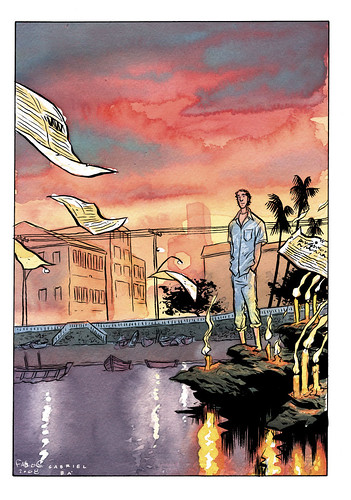
It's been a long time since I posted a page of A Private Myth. Here's the next page! The following page is on the board and proceeding well.
Also, I finally took a minute to verify my numbering. This is page 18. It was the cover experiment that threw off my ability to count (duh).
Regarding this page: is this the calm before the storm, or just calm?
Well, there's always a storm coming sooner or later, so for now, I'm going to let the ladies enjoy each other for a page or three.
I cannot tell you how much fun it was drawing this page! I'm trying to relax and embrace the flow as regards drawing scenery. I suppose it is something of a "dodge" to separate character and environment, but the next page will remedy that.
Next: some slightly older stuff.
Insights about comics, prog rock, classic cartoons and films, higher education, sexuality and gender, writing, teaching, whatever else comes to mind, and comics. I know I said comics twice. I like comics!
Sunday, January 23, 2011
Saturday, January 22, 2011
Best comics of 2010: No. 1( tie) : Comic Book Guy, the Comic Book
Best. Miniseries. Ever.
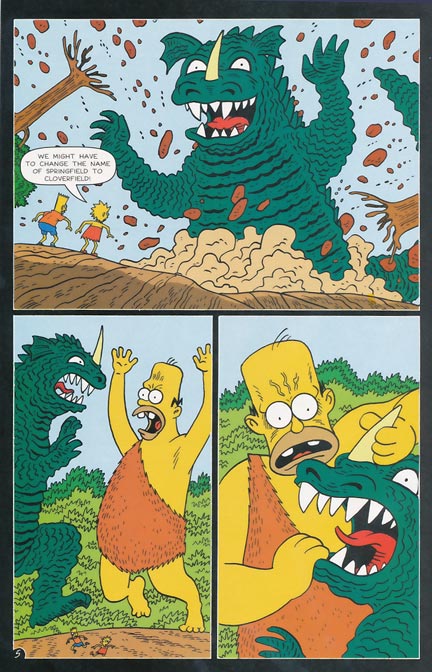
This isn't just another Simpsons comic. Those can be fun, even if there's a sameness to them after a while and the art sometimes drifts off-model a bit (I should talk, right?), especially in some of the otherwise delightful Treehouse of Horror annuals. This Jamie Hernandez page is a case in point.
Comic Book Guy, the Comic Book is a miniseries that reflects the love of comics and comic geekdom shown in other Bongo titles, including Simpsons Superhero Spectacular and the brilliant Radioactive Man series. I wish there were a proper affordable TPB of the RM books- it would be a perfect comics history text!
But comic book guy is us. Everyone who's been to more than three comic book stores has met someone, usually a store owner, who shares traits with Comic Book Guy (proper name: Jeffrey "Jeff" Albertson, Master's Degree in Comparative Mythology).
This mini touches all the right buttons. It's like listening to PDQ Bach- it's fun enough in its own right, but the more you know about music, the funnier it is.
So it is with this mini and comic fans.Beginning with Issue one's four alternate covers, all presented on the same issue (thank you! No need to buy multiple copies!), there are in-jokes aplenty.
The covers for issue 1 parody, in order:
Fantastic Four No. 1
Death of Superman (Superman No. 75)
Avengers No. 56
Crisis on Infinite Earths No. 7
Three of the four are death covers, and the Crisis is a Pieta cover. More on Pieta covers another day.
This silly story integrates elements of fandom geekery with self-parody. We laugh at Comic Book Guy's overblown language and his fanatic love of mass market adventure because we see it in ourselves.
And there's a comfort in that. It's not simply all right that we revere these things, but as The Android's Dungeon decays into shallow, simpering cuteness under Marge's post-mortem management, it becomes clear that the passion for solid story and adventure is what sustains the store, and by extension, the stories and their readers.
While Comic Book Guy is a joke, he's our joke.
It's like Robert McKee explained in his book STORY.
A sympathetic character = likeable.
An empathetic character = like me.
We resonate better with empathetic characters.
There are so many other aspects to this. Subtle and not so subtle jabs at industry trends and societal mores.
When Comic Book Guy passed on, all sarcasm vanished from the Internet, TV and daily conversation. This resulted in the Internet becoming a haven for the free exchange of ideas, causing in turn the government shutdown of the Internet.
A bit of a reach in the real world, but hey, we don't have bright yellow skin, round eyeballs and four fingers either.
The point is that this delightful story reminds us of who we are, and who we can be. Behind all his cynicism, posturing and self-pity, there's something noble about Comic Book Guy- excuse me, Jeff Albertson, M.A.
Fan on, Comic Book Guy!
Tomorrow, we return to Original Art Sundays, after a (embarrassed glance down) three week hiatus!
This isn't just another Simpsons comic. Those can be fun, even if there's a sameness to them after a while and the art sometimes drifts off-model a bit (I should talk, right?), especially in some of the otherwise delightful Treehouse of Horror annuals. This Jamie Hernandez page is a case in point.
Comic Book Guy, the Comic Book is a miniseries that reflects the love of comics and comic geekdom shown in other Bongo titles, including Simpsons Superhero Spectacular and the brilliant Radioactive Man series. I wish there were a proper affordable TPB of the RM books- it would be a perfect comics history text!
But comic book guy is us. Everyone who's been to more than three comic book stores has met someone, usually a store owner, who shares traits with Comic Book Guy (proper name: Jeffrey "Jeff" Albertson, Master's Degree in Comparative Mythology).
This mini touches all the right buttons. It's like listening to PDQ Bach- it's fun enough in its own right, but the more you know about music, the funnier it is.
So it is with this mini and comic fans.Beginning with Issue one's four alternate covers, all presented on the same issue (thank you! No need to buy multiple copies!), there are in-jokes aplenty.
The covers for issue 1 parody, in order:
Fantastic Four No. 1
Death of Superman (Superman No. 75)
Avengers No. 56
Crisis on Infinite Earths No. 7
Three of the four are death covers, and the Crisis is a Pieta cover. More on Pieta covers another day.
This silly story integrates elements of fandom geekery with self-parody. We laugh at Comic Book Guy's overblown language and his fanatic love of mass market adventure because we see it in ourselves.
And there's a comfort in that. It's not simply all right that we revere these things, but as The Android's Dungeon decays into shallow, simpering cuteness under Marge's post-mortem management, it becomes clear that the passion for solid story and adventure is what sustains the store, and by extension, the stories and their readers.
While Comic Book Guy is a joke, he's our joke.
It's like Robert McKee explained in his book STORY.
A sympathetic character = likeable.
An empathetic character = like me.
We resonate better with empathetic characters.
There are so many other aspects to this. Subtle and not so subtle jabs at industry trends and societal mores.
When Comic Book Guy passed on, all sarcasm vanished from the Internet, TV and daily conversation. This resulted in the Internet becoming a haven for the free exchange of ideas, causing in turn the government shutdown of the Internet.
A bit of a reach in the real world, but hey, we don't have bright yellow skin, round eyeballs and four fingers either.
The point is that this delightful story reminds us of who we are, and who we can be. Behind all his cynicism, posturing and self-pity, there's something noble about Comic Book Guy- excuse me, Jeff Albertson, M.A.
Fan on, Comic Book Guy!
Tomorrow, we return to Original Art Sundays, after a (embarrassed glance down) three week hiatus!
Thursday, January 20, 2011
Best comics of 2010: No. 1 (tie) : Blacksad
In 1990, I interned with Reed Waller on Omaha the Cat Dancer for six months.
Or as I put it these days, it was for about 5 minutes a hundred years ago.
It was one of the most catalytic (pun unintended) experiences of my life, both personally and professionally.
This experience, in tandem with my childhood of reading Barks Duck stories, before I had a clue who Barks was, and my 80s and 90s love of Don Rosa's work (note that my affections for these works continue to this day), has given me quite an affinity for the funny animal genre, despite it being a very loosely defined genre.
I mean really. Look at this Omaha image and this Duck image, and tell me where their commonalities lie, beyond the animal-as-person device.
Caveat: this work is not for the young in maturity. Adults only, please, in every sense. It involves people enjoying their bodies, and children can't see that until they're not children any more. I think it's a little screwy, but that's the way we roll in this society.
Okay,the other similarity is solid storytelling. But that's as far as it goes.
Two points:
1. Waller and Worley did a more Barks-style funny animal story, the wonderful Speakingstone, which ran in two issues of Fantagraphic's Critters and was never completed.
2. I would also be remiss if I didn't mention that this Omaha page is one of the ones I worked on. My work was inking heavy blacks in the background, in this case.
Ahem.
In any event, as a result of the work of Barks and Rosa, Waller, Worley and Vance, Talifero, Freddy Milton, and so many more that don't come to mind as readily, the notion of humanized animals, or animals with human traits, has been a part of comics ever since there have been comics. What do you think Krazy and Ignatz are, after all?
A new character entered this delightful mix in the early 2000s, from Spanish creators published by the French company Dargaud. Writer Juan Díaz Canales and artist Juanjo Guarnido collaborated on the three graphic volumes of Blacksad. Sporadically printed in the US (the third book only recently appeared as part of this collection), they developed a reputation akin to Corto Maltese among devoted comics lover.
This year, Dark Horse published a goregeous volume of all three stories. That volume is my tie choice for Number One comic of the year 2010.
Another caveat: as always, these choices are based on personal criteria and quite arbitrary. If you have your own list, I welcome it!
Blacksad is a private detective. The story is set in 1950s America.
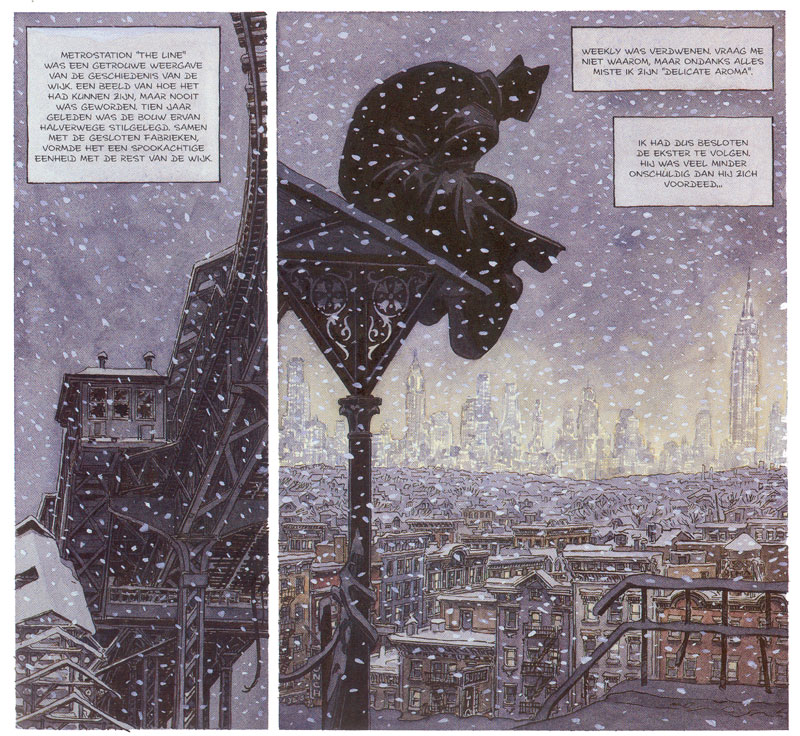
The level of detail is stunning and appropriate. The palette is precise and reinforces the mood, which ranges from gripping to hilarious to tragic.
In short, this work is beautiful in very sense, even when it's recounting ugly events.
The trappings of noir, or what the casual student thinks of as noir (I'm a bit more than casual, but still a student) are all here. The femmes fatale, the levels of fear, greed and corruption, the broken hearts, the sense of unrelenting desperation. There are also some odd male bonds- not so odd as in the classic Gilda, but Blacksad's repulsion/friendship with the reporter Weekly is a rather odd but serviceable bond.
Blacksad is very much a loner, though. His friendships are tenuous at best, and as in the final tale, Red Soul, making its first US appearance in this volume. This story deals with Communism, blacklisting, and unanticipated betrayals.
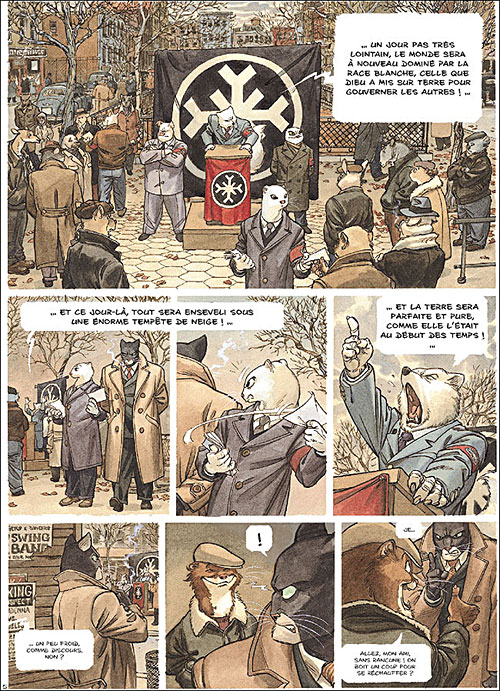
That's the final story in this volume. The first, Somewhere Within the Shadows, is an eloquent noir with the traditional trappings, skillfully handled. The middle story, Arctic Nation, plays up the animal aspect by using polar bears as white supremacists a la the KKK.
The use of the stylized snowflake as stand-in for the KKK cross is brilliant.
There's one aspect of noir that I question in this book.
Common wisdom on noir holds that there are no heroes, only villains, victims and survivors. And the character who has the best-defined moral code and lives up to it despite damning evidecne of the pointlessness of doing so is the closest we come to a hero.
Well, in reading this, I can't help thinking that Blacksad is a hero, and that's all there is to it.
So is it still noir? In most ways, yes. But no matter. It's a damn good comic, no matter how it's classified.
I'm pleased to note that the creators have two more volumes of bandes desinee coming out. Dark Horse, are you paying attention?
Tomorrow, the best comic of 2010. Ever.
Or as I put it these days, it was for about 5 minutes a hundred years ago.
It was one of the most catalytic (pun unintended) experiences of my life, both personally and professionally.
This experience, in tandem with my childhood of reading Barks Duck stories, before I had a clue who Barks was, and my 80s and 90s love of Don Rosa's work (note that my affections for these works continue to this day), has given me quite an affinity for the funny animal genre, despite it being a very loosely defined genre.
I mean really. Look at this Omaha image and this Duck image, and tell me where their commonalities lie, beyond the animal-as-person device.
Caveat: this work is not for the young in maturity. Adults only, please, in every sense. It involves people enjoying their bodies, and children can't see that until they're not children any more. I think it's a little screwy, but that's the way we roll in this society.
Okay,the other similarity is solid storytelling. But that's as far as it goes.
Two points:
1. Waller and Worley did a more Barks-style funny animal story, the wonderful Speakingstone, which ran in two issues of Fantagraphic's Critters and was never completed.
2. I would also be remiss if I didn't mention that this Omaha page is one of the ones I worked on. My work was inking heavy blacks in the background, in this case.
Ahem.
In any event, as a result of the work of Barks and Rosa, Waller, Worley and Vance, Talifero, Freddy Milton, and so many more that don't come to mind as readily, the notion of humanized animals, or animals with human traits, has been a part of comics ever since there have been comics. What do you think Krazy and Ignatz are, after all?
A new character entered this delightful mix in the early 2000s, from Spanish creators published by the French company Dargaud. Writer Juan Díaz Canales and artist Juanjo Guarnido collaborated on the three graphic volumes of Blacksad. Sporadically printed in the US (the third book only recently appeared as part of this collection), they developed a reputation akin to Corto Maltese among devoted comics lover.
This year, Dark Horse published a goregeous volume of all three stories. That volume is my tie choice for Number One comic of the year 2010.
Another caveat: as always, these choices are based on personal criteria and quite arbitrary. If you have your own list, I welcome it!
Blacksad is a private detective. The story is set in 1950s America.
The level of detail is stunning and appropriate. The palette is precise and reinforces the mood, which ranges from gripping to hilarious to tragic.
In short, this work is beautiful in very sense, even when it's recounting ugly events.
The trappings of noir, or what the casual student thinks of as noir (I'm a bit more than casual, but still a student) are all here. The femmes fatale, the levels of fear, greed and corruption, the broken hearts, the sense of unrelenting desperation. There are also some odd male bonds- not so odd as in the classic Gilda, but Blacksad's repulsion/friendship with the reporter Weekly is a rather odd but serviceable bond.
Blacksad is very much a loner, though. His friendships are tenuous at best, and as in the final tale, Red Soul, making its first US appearance in this volume. This story deals with Communism, blacklisting, and unanticipated betrayals.
That's the final story in this volume. The first, Somewhere Within the Shadows, is an eloquent noir with the traditional trappings, skillfully handled. The middle story, Arctic Nation, plays up the animal aspect by using polar bears as white supremacists a la the KKK.
The use of the stylized snowflake as stand-in for the KKK cross is brilliant.
There's one aspect of noir that I question in this book.
Common wisdom on noir holds that there are no heroes, only villains, victims and survivors. And the character who has the best-defined moral code and lives up to it despite damning evidecne of the pointlessness of doing so is the closest we come to a hero.
Well, in reading this, I can't help thinking that Blacksad is a hero, and that's all there is to it.
So is it still noir? In most ways, yes. But no matter. It's a damn good comic, no matter how it's classified.
I'm pleased to note that the creators have two more volumes of bandes desinee coming out. Dark Horse, are you paying attention?
Tomorrow, the best comic of 2010. Ever.
Wednesday, January 19, 2011
Best comics of 2010: the runners-up
These are the books I thought about including in my list, but demurred. These are all fine books equally deserving of your attention. If I would have turned left instead of right, or eaten a different breakfast or whatever, some of these would be on my Best list.
First, second and third, books from last year's list. These books maintained their quality, but I wanted to give some newcomers more of a chance.
First, The Unwritten.
This book has maintained its intelligence, pace and imaginative art. In issue 17, with our old friend Ryan Kelly getting primary art credits (see link in daytripper post), the story is designed as a "choose your own adventure" comic, making it a meta-narrative, a sort of "nod and a wink" to remind readers that this is a book about books.
Next, Sweet Tooth.
The story continues to evolve and hold its quality. As is often the case in post-apocalyptic narratives, factions have formed and the backstory is revealed incrementally.
Lemire is now also writing Superboy. I've had little use for the smug Superboy of the last few years, but with Jeff at the helm, I'll give the book another chance.
Third up: The Lone Ranger.
The last issue of this eloquent series came out last month, though I've yet to pick it up. I've enjoyed everything about the way this material has been handled: faithful, but not slavish, to its source material.
As my Machiavellian mind began to wrap itself around the idea of creating a custom bind of this book sometime in 2011, Dynamite announced that The Masked Man would be a guest in a new Zorro book. And again with the multiple covers.
Ya can't win.
Other surprises in 2010:
Sweets
This tense, moody noir set in the Big Easy hits all the right notes, and is an enjoyable read to say the least. But it's nothing revolutionary. Not that it has to be. Nothing wrong with a solid gritty murder mystery.
Again, thanks to Image Comics for another great surprise in 2010.
Doom Patrol
Doom Patrol has always been my favorite uber-weird superhero book. This issue, in which the always borderline team leader,The Chief, assumes the powers of Superman despite no longer having even crippled legs, was great superhero energy and big fun. But I lost patience with some aspects of Kieth Giffen's writing. If everything is snarky, cynical and argumentative, it loses its impact.
Tom Strong and the Robots of Doom
Top drawer adventure, even if not from the mind of Alan Moore. Tight plotting, consistent characterization, and a nicely handled time travel story. Not the revelation that Moore's original Tom Strong books (which tie nicely in with Promethea) was, but still the kind of book that you read and just say "cool" when the plot twists and fight scenes come.
Superman: Last Family of Krypton
Writer Cary Bates and artist Renalo Arlem bring a 3-part Elseworlds story based on a simple premise. Instead of shooting baby Kal to Earth, Jor is able to bring the whole Family of El!
This has some fascinating aspects to it, but at times resonates of Astro City. It's still well worth one's time, but it suffers from the problem that plagues most Elseworlds stories. Ultimately, the universe ends up more or less the same as it is in regular contintuity.
Even with that, this felt like reading a really good Imaginary Story from the 60s or 70s. A very welcome feeling, that.
Final runner-up:
Superman No. 701
JMS' work on Wonder Woman was engaging, but not spectacular.
I posted on the whole costume thing with WW back when the transitional issue hit. While ensuing issues were better than good, it wasn't as effective as his handling of Superman.
This issue in particular, the beginning of Superman's walk across the US, is big fun. It captures some long-neglected facets of the character, like his populist bent. His handling of this smug blowhard amuses me no end.
JMS also wrote a very well-received Superman graphic novel in 2010. Not having read it yet, I can't in good conscience review it.
That's everything but the two books tied for the No. 1 spot for 2010. I'm not letting the cat out of the bag, aside from saying that the first posts tomorrow!
First, second and third, books from last year's list. These books maintained their quality, but I wanted to give some newcomers more of a chance.
First, The Unwritten.
This book has maintained its intelligence, pace and imaginative art. In issue 17, with our old friend Ryan Kelly getting primary art credits (see link in daytripper post), the story is designed as a "choose your own adventure" comic, making it a meta-narrative, a sort of "nod and a wink" to remind readers that this is a book about books.
Next, Sweet Tooth.
The story continues to evolve and hold its quality. As is often the case in post-apocalyptic narratives, factions have formed and the backstory is revealed incrementally.
Lemire is now also writing Superboy. I've had little use for the smug Superboy of the last few years, but with Jeff at the helm, I'll give the book another chance.
Third up: The Lone Ranger.
The last issue of this eloquent series came out last month, though I've yet to pick it up. I've enjoyed everything about the way this material has been handled: faithful, but not slavish, to its source material.
As my Machiavellian mind began to wrap itself around the idea of creating a custom bind of this book sometime in 2011, Dynamite announced that The Masked Man would be a guest in a new Zorro book. And again with the multiple covers.
Ya can't win.
Other surprises in 2010:
Sweets
This tense, moody noir set in the Big Easy hits all the right notes, and is an enjoyable read to say the least. But it's nothing revolutionary. Not that it has to be. Nothing wrong with a solid gritty murder mystery.
Again, thanks to Image Comics for another great surprise in 2010.
Doom Patrol
Doom Patrol has always been my favorite uber-weird superhero book. This issue, in which the always borderline team leader,The Chief, assumes the powers of Superman despite no longer having even crippled legs, was great superhero energy and big fun. But I lost patience with some aspects of Kieth Giffen's writing. If everything is snarky, cynical and argumentative, it loses its impact.
Tom Strong and the Robots of Doom
Top drawer adventure, even if not from the mind of Alan Moore. Tight plotting, consistent characterization, and a nicely handled time travel story. Not the revelation that Moore's original Tom Strong books (which tie nicely in with Promethea) was, but still the kind of book that you read and just say "cool" when the plot twists and fight scenes come.
Superman: Last Family of Krypton
Writer Cary Bates and artist Renalo Arlem bring a 3-part Elseworlds story based on a simple premise. Instead of shooting baby Kal to Earth, Jor is able to bring the whole Family of El!
This has some fascinating aspects to it, but at times resonates of Astro City. It's still well worth one's time, but it suffers from the problem that plagues most Elseworlds stories. Ultimately, the universe ends up more or less the same as it is in regular contintuity.
Even with that, this felt like reading a really good Imaginary Story from the 60s or 70s. A very welcome feeling, that.
Final runner-up:
Superman No. 701
JMS' work on Wonder Woman was engaging, but not spectacular.
I posted on the whole costume thing with WW back when the transitional issue hit. While ensuing issues were better than good, it wasn't as effective as his handling of Superman.
This issue in particular, the beginning of Superman's walk across the US, is big fun. It captures some long-neglected facets of the character, like his populist bent. His handling of this smug blowhard amuses me no end.
JMS also wrote a very well-received Superman graphic novel in 2010. Not having read it yet, I can't in good conscience review it.
That's everything but the two books tied for the No. 1 spot for 2010. I'm not letting the cat out of the bag, aside from saying that the first posts tomorrow!
Monday, January 17, 2011
Best comics of 2010: No. 2 (tie) : The Muppet Show
Whoda thunk it?
There should be no way The Muppet Show would translate into a comic book. Gags are dependent on timing, and there's so much of this you just can't reproduce on a printed page.
It's so delightful in such a cornball way. There should be no way that the old guys in the balcony or the backstage antics work in a comic book.
But they do!
The drawing is perfect. Much as I like The Simpsons comic line, sometimes the art is just wrong for the characters. Not so here!
Every issue, there's a couple story lines going- the one onstage and the one backstage, just like in the show. However, in the comic, they can stretch a bit more. the layouts offer chances for innovation, and they're able to take the storyline outside the studio, which the show seldom did (aside, of course, from the immortal PIGS IN SPACE, which I still say should have been a feature film).
Charming, witty stories of werewolves and Sherlock Holmes pastiches, interspersed with wisecracking deities gaming with the lives of our troupe.
Writer/artist Roger Landridge, who sadly announced his departure from the book amicably for his own reasons by the end of 2010, created an unexpected masterpiece out of what was largely thought of as a dated kids' show. The artist on issues 4 - 8 was one Amy Mebberson, whose work is deserving of recognition in its own right.
Landridge began doing Muppet comics in the late lamented Disney Adventures Digest. this was another haven for kid's comics.
A couple points need to be made here.
First, I'm so sick of hearing things like "safe for kids" and "fun for all ages"that I could puke coat hangers. A good story is a good story is a good story. Are there stories that are too nuanced for kids? Possibly, but you could make the same argument for many adults. Sadly, there are a large number of adults who think this material is somehow beneath them, more fools they.
Second, this is not the first time that The Muppets have been around the funny books. In addition to appearances in The Muppet Magazine of the mid-80s, Marvel had a great Muppet Babies comic as part of their 80s Star! line of comics aimed at the youth market.
These were also very smart, imaginative comics. But Muppet Babies was the best thing on Saturday morning for 7 years (1984 - 1991), so they had great source material too.
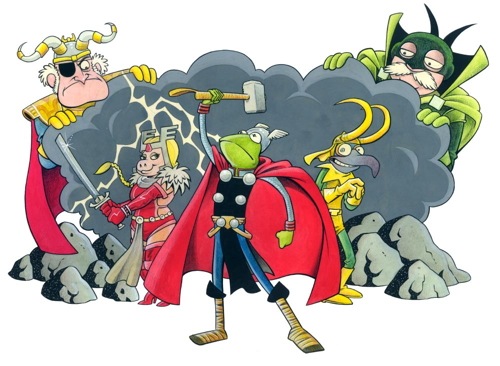
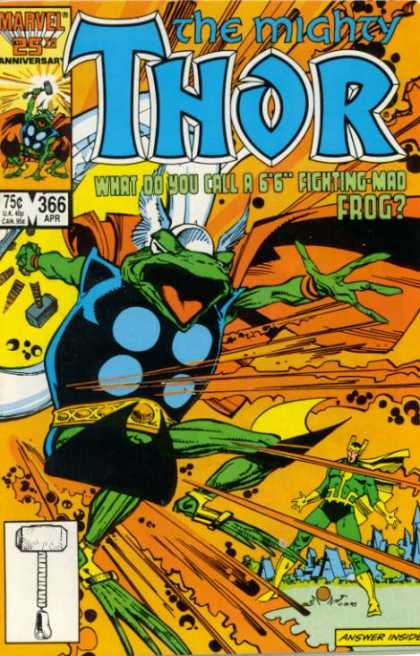
We wish Landridge well in his future endeavors. He's also moving on from writing THOR, which means we'll probably never see this scene....
Much as I like Simonson's Thor-frog, pictured below, Landridge's might be better. You be the judge.
Next: Best of 2010: the runners-up.
There should be no way The Muppet Show would translate into a comic book. Gags are dependent on timing, and there's so much of this you just can't reproduce on a printed page.
It's so delightful in such a cornball way. There should be no way that the old guys in the balcony or the backstage antics work in a comic book.
But they do!
The drawing is perfect. Much as I like The Simpsons comic line, sometimes the art is just wrong for the characters. Not so here!
Every issue, there's a couple story lines going- the one onstage and the one backstage, just like in the show. However, in the comic, they can stretch a bit more. the layouts offer chances for innovation, and they're able to take the storyline outside the studio, which the show seldom did (aside, of course, from the immortal PIGS IN SPACE, which I still say should have been a feature film).
Charming, witty stories of werewolves and Sherlock Holmes pastiches, interspersed with wisecracking deities gaming with the lives of our troupe.
Writer/artist Roger Landridge, who sadly announced his departure from the book amicably for his own reasons by the end of 2010, created an unexpected masterpiece out of what was largely thought of as a dated kids' show. The artist on issues 4 - 8 was one Amy Mebberson, whose work is deserving of recognition in its own right.
Landridge began doing Muppet comics in the late lamented Disney Adventures Digest. this was another haven for kid's comics.
A couple points need to be made here.
First, I'm so sick of hearing things like "safe for kids" and "fun for all ages"that I could puke coat hangers. A good story is a good story is a good story. Are there stories that are too nuanced for kids? Possibly, but you could make the same argument for many adults. Sadly, there are a large number of adults who think this material is somehow beneath them, more fools they.
Second, this is not the first time that The Muppets have been around the funny books. In addition to appearances in The Muppet Magazine of the mid-80s, Marvel had a great Muppet Babies comic as part of their 80s Star! line of comics aimed at the youth market.
These were also very smart, imaginative comics. But Muppet Babies was the best thing on Saturday morning for 7 years (1984 - 1991), so they had great source material too.
We wish Landridge well in his future endeavors. He's also moving on from writing THOR, which means we'll probably never see this scene....
Much as I like Simonson's Thor-frog, pictured below, Landridge's might be better. You be the judge.
Next: Best of 2010: the runners-up.
Best comics of 2010: No. 2 (tie): daytripper
This was a surprise.
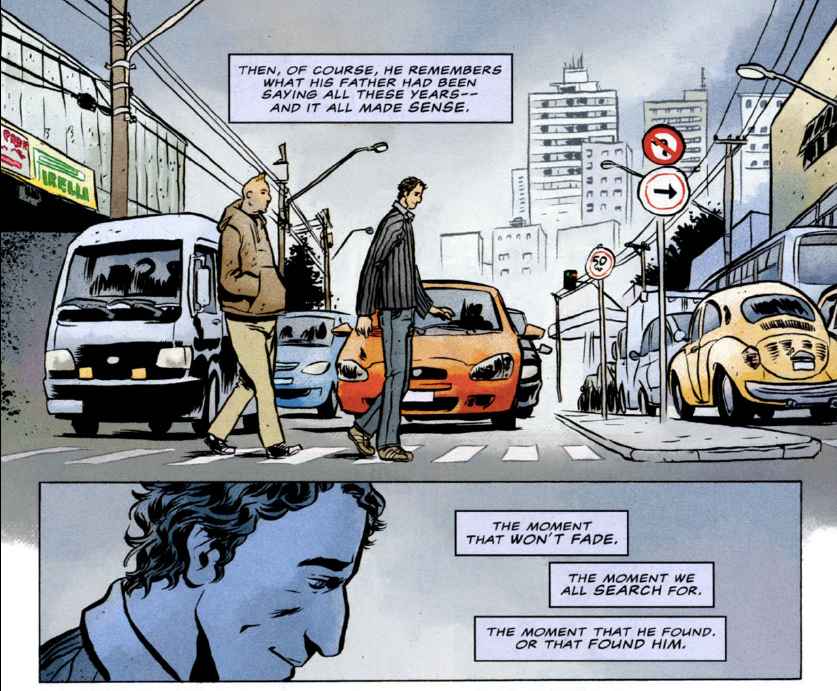
Daytripper is the life of a writer, one Bras de Oliva Domingos. Told in pivotal moments and the events leading up to them, he dies at the end of every issue. Each death is a death of a part of him, though all are presented as literal deaths.
This is eloquent, tender, raw and brutally honest. Daytripper avoids being saccharine or cynical. The book's creative team, Fabio Moon and Gabriel Ba, are doing the con circuit starting this year in Peru! Gabriel is the artist on the new Marvel book Casanova, written by Matt Fraction.
Moon's and Ba's art (they work in tandem on writing and illustration)has that slight distortion that reminds me of both Paul Pope and Ryan Kelly. Its fascinating, having qualities of simplicity and complexity simultaneously.
And the writing - well, the writing just pulses.
It's a book about being there for your own life, even when that means accepting your failures without ennobling them.
It's a book of wonder, not flinching from any part of the human condition.
And it's set in contemporary Brazil.
Sadly, as well received as the book was critically, it didn't translate into sales. Following issue #1, Daytripper's sales were consistently below the 10,000 copy mark, according to monthly reports at The Beat. I am hopeful that sales of the TPB, due out next month, will eclipse that.
We've speculated here in the past that the "floppy", the conventional comic book periodical, may be little more than a loss leader for TPBs in today's comic market. Based on some of the figures Colleen Doran has reported on her blog (and if you're not reading Colleen's blog, go do so right now- it's linked on this one and I'll still be here when you're done), I've come to question that blanket supposition lately.I'm not convinced that TPBs actually sell better, despite having presumably longer shelf life and a more diverse marketing and distribution platform.
But when Vertigo, a branch of DC Comics, can't move 10,000 units of so eloquent a book as Daytripper, we have a problem.
Next: Best of 2010, No. 2, part 2: light the lights!
Daytripper is the life of a writer, one Bras de Oliva Domingos. Told in pivotal moments and the events leading up to them, he dies at the end of every issue. Each death is a death of a part of him, though all are presented as literal deaths.
This is eloquent, tender, raw and brutally honest. Daytripper avoids being saccharine or cynical. The book's creative team, Fabio Moon and Gabriel Ba, are doing the con circuit starting this year in Peru! Gabriel is the artist on the new Marvel book Casanova, written by Matt Fraction.
Moon's and Ba's art (they work in tandem on writing and illustration)has that slight distortion that reminds me of both Paul Pope and Ryan Kelly. Its fascinating, having qualities of simplicity and complexity simultaneously.
And the writing - well, the writing just pulses.
It's a book about being there for your own life, even when that means accepting your failures without ennobling them.
It's a book of wonder, not flinching from any part of the human condition.
And it's set in contemporary Brazil.
Sadly, as well received as the book was critically, it didn't translate into sales. Following issue #1, Daytripper's sales were consistently below the 10,000 copy mark, according to monthly reports at The Beat. I am hopeful that sales of the TPB, due out next month, will eclipse that.
We've speculated here in the past that the "floppy", the conventional comic book periodical, may be little more than a loss leader for TPBs in today's comic market. Based on some of the figures Colleen Doran has reported on her blog (and if you're not reading Colleen's blog, go do so right now- it's linked on this one and I'll still be here when you're done), I've come to question that blanket supposition lately.I'm not convinced that TPBs actually sell better, despite having presumably longer shelf life and a more diverse marketing and distribution platform.
But when Vertigo, a branch of DC Comics, can't move 10,000 units of so eloquent a book as Daytripper, we have a problem.
Next: Best of 2010, No. 2, part 2: light the lights!
Sunday, January 16, 2011
Best comics of 2010: No. 3 (tie): The Land of Oz
After a rough couple days of writing deadlines and wrestling with money, I can get back to posting for a brief time.
The tie for the No. 3 spot is Marvel's Land of Oz.
I've been enjoying Marvel's Oz adaptations a great deal, not just because the writing of Oz scholar Eric Shanower is faithful to the source texts, but because Scottie Young's art manages the neat trick of being fresh and feeling at home with this book. Since the original novel was first published 107 years ago, that's no mean feat!
The story has new life in these adaptations. The duo has moved on to the third Oz book now, and I hope sales continue to warrant new adaptations through the 15 OZ books by Baum (including the short story collection Little Wizard Stories of Oz, and not including the Big Little Book The Laughing Dragon of Oz, written by Baum's son).
The writing on the Marvel Oz books is faithful not only in plot and tone, but in spirit. There are many thousands of people who love Oz because of the Judy Garland film (as do I, for reasons previously enumerated), but if those people have never read an Oz book, especially one by Baum, they really don't know Oz.
Sidebar: it needs to be said that the 1939 film is not without its problems. Those problems are skillfully enumerated by Peter David in his 1990 essay, which predates Gregory Maguire's Wicked by more than a decade. Interesting, as Maguire is building his narrative on some of the ideas in the David essay. Not to say he lifted the ideas. Far from it. Great minds often think on similar lines.
So what is the tone that eludes so many creators in adapting Oz?
Baum's stories are driven by a very sophisticated blend of wit, melancholy and pacing.
He refused to write down to children.
There have been hundreds, probably thousands, of Oz adaptations over the 11 decades since the first book. Many of these, building on the homilies in the 1939 film (which I do love, so much, despite my protestations here), have a cuteness bordering on simpering.
Again, a long post on Oz in comics is forthcoming sometime next month. Perhaps I'll do that as my birthday present to me.
Meanwhile, the book at hand.
The character designs are a nice cross between the heavy-line work of Denslow on the first book and the delicate pen work of the great Jon R. Neill on subsequent books (it should be noted in passing that Neill was an official author, or "royal historian", for seven Oz books following the Ruth Plumly Thompson series).
The pages flow cleanly and efficiently, as in this spread from issue 3.
But that's what happens when a good artist is also a good writer.
Not to take anything away from Scottie Young, but Shanower's comic work has been top-notch since his debut on some Nexus material in the early 80s. I've followed his career through the Nexus work, several appearances in Gay Comics, the First comics Oz graphic novels, the wonderful Trojan war book Age of Bronze, and now this. He's never disappointed. He even wrote a couple very good Oz novels!
And the Marvel series does not shy away from the transgender aspect of the original novel, which is quite welcome in itself.
These are fresh, smart versions of stories over 100 years old. Marvel is doing the comics world a favor in publishing them. This was just about the only Marvel book I bought this year.
That's partially Marvel's own fault. Their storytelling has been uneven, but the big sticking point is the ads. For example, in Land of Oz No. 4, there are 8 pages of ads, not counting the inside front cover and both sides of the back cover. That's a quarter of this 32 page book, which sold for $3.99. And that's a skimpy ad count compared to some. Daredevil No. 50, a few years ago, was the worst offender in recent memory, with a 50/50 ad/editorial ratio! Every other page an ad? Come on now!
In fairness, Marvel has been producing lovely (if very thin) hardcovers of these Oz series shortly following the completion of the storyline. Listing at $29.99, and probably a lot less online, that's an OK deal. Single issue price is $24 for the run.
But why gouge the reader of traditional format comics (AKA floppies) like that? Of the 8 pages of ads, half are house ads or ads for Marvel-related projects. If they need to offset their single-issue printing revenue that badly, they're in trouble.
That aside, this series (along with its predecessor, the Wizard of Oz, and the current successor, Ozma of Oz) deserves accolades.
If I've piqued your interest in matters Oz, do yourself a favor and get back issues of the paperback magazine put out by Shanower and his partner David Maxine for six years, OzStory!
Next: best of 2010 No. 2, part 1: As days go by...
The tie for the No. 3 spot is Marvel's Land of Oz.
I've been enjoying Marvel's Oz adaptations a great deal, not just because the writing of Oz scholar Eric Shanower is faithful to the source texts, but because Scottie Young's art manages the neat trick of being fresh and feeling at home with this book. Since the original novel was first published 107 years ago, that's no mean feat!
The story has new life in these adaptations. The duo has moved on to the third Oz book now, and I hope sales continue to warrant new adaptations through the 15 OZ books by Baum (including the short story collection Little Wizard Stories of Oz, and not including the Big Little Book The Laughing Dragon of Oz, written by Baum's son).
The writing on the Marvel Oz books is faithful not only in plot and tone, but in spirit. There are many thousands of people who love Oz because of the Judy Garland film (as do I, for reasons previously enumerated), but if those people have never read an Oz book, especially one by Baum, they really don't know Oz.
Sidebar: it needs to be said that the 1939 film is not without its problems. Those problems are skillfully enumerated by Peter David in his 1990 essay, which predates Gregory Maguire's Wicked by more than a decade. Interesting, as Maguire is building his narrative on some of the ideas in the David essay. Not to say he lifted the ideas. Far from it. Great minds often think on similar lines.
So what is the tone that eludes so many creators in adapting Oz?
Baum's stories are driven by a very sophisticated blend of wit, melancholy and pacing.
He refused to write down to children.
There have been hundreds, probably thousands, of Oz adaptations over the 11 decades since the first book. Many of these, building on the homilies in the 1939 film (which I do love, so much, despite my protestations here), have a cuteness bordering on simpering.
Again, a long post on Oz in comics is forthcoming sometime next month. Perhaps I'll do that as my birthday present to me.
Meanwhile, the book at hand.
The character designs are a nice cross between the heavy-line work of Denslow on the first book and the delicate pen work of the great Jon R. Neill on subsequent books (it should be noted in passing that Neill was an official author, or "royal historian", for seven Oz books following the Ruth Plumly Thompson series).
The pages flow cleanly and efficiently, as in this spread from issue 3.
But that's what happens when a good artist is also a good writer.
Not to take anything away from Scottie Young, but Shanower's comic work has been top-notch since his debut on some Nexus material in the early 80s. I've followed his career through the Nexus work, several appearances in Gay Comics, the First comics Oz graphic novels, the wonderful Trojan war book Age of Bronze, and now this. He's never disappointed. He even wrote a couple very good Oz novels!
And the Marvel series does not shy away from the transgender aspect of the original novel, which is quite welcome in itself.
These are fresh, smart versions of stories over 100 years old. Marvel is doing the comics world a favor in publishing them. This was just about the only Marvel book I bought this year.
That's partially Marvel's own fault. Their storytelling has been uneven, but the big sticking point is the ads. For example, in Land of Oz No. 4, there are 8 pages of ads, not counting the inside front cover and both sides of the back cover. That's a quarter of this 32 page book, which sold for $3.99. And that's a skimpy ad count compared to some. Daredevil No. 50, a few years ago, was the worst offender in recent memory, with a 50/50 ad/editorial ratio! Every other page an ad? Come on now!
In fairness, Marvel has been producing lovely (if very thin) hardcovers of these Oz series shortly following the completion of the storyline. Listing at $29.99, and probably a lot less online, that's an OK deal. Single issue price is $24 for the run.
But why gouge the reader of traditional format comics (AKA floppies) like that? Of the 8 pages of ads, half are house ads or ads for Marvel-related projects. If they need to offset their single-issue printing revenue that badly, they're in trouble.
That aside, this series (along with its predecessor, the Wizard of Oz, and the current successor, Ozma of Oz) deserves accolades.
If I've piqued your interest in matters Oz, do yourself a favor and get back issues of the paperback magazine put out by Shanower and his partner David Maxine for six years, OzStory!
Next: best of 2010 No. 2, part 1: As days go by...
Thursday, January 13, 2011
Best comics of 2010: No. 3(tie): Market Day
James Sturm is a national treasure.
His work is tinged with emotion and possibility, yet mired in tragedy. All done so subtly that you're just sucked in before you know what happened to you.
Sturm has given us such classics as The Golem's Mighty Swing. This year's offering is the deceptively slim volume Market Day. In this less than a hundred page story about a rug maker, Sturm has encapsulated the nature of creativity and the tragedy of being a truly creative human being in a less than appreciative, which is to say, sometimes indifferent bordering on hostile, marketplace.
Published by the always brave and innovative Drawn & Quarterly, who also publish Lynda Barry and countless other comics luminaries, this is a story that asks a simple question. What's to become of a creator when the market for his creations dries up?
The others who take their work to market on the appointed day may take pride in their craft, but not like our hero. He wants people to buy his rugs, and he wants the rugs to enrich their lives.
He is so eager for the market, the exchange of ideas, goods and possibilities!
He sees possibilities for new rug designs in everything.
In short, his work and commerce keep him alive in every sense.
However, when he discovers that his primary buyer has retired, he no longer has a place to sell his rugs. With a pregnant wife due any day, he must find another buyer for his rugs, quickly.
He is forced to question his decisions. Has he indulged in a foolishness? The rugs he wove have served every aspect of him, and sustained him and his wife. Until now.
This is a labor of love.
Market Day is dedicated in part to MCAD compatriot Michelle Ollie, who ventured across country to begin the Center for Cartoon Studies, working in tandem with Sturm.
Sturm's art is like his writing: simple, direct and on point, leaving the reader with a larger sense than before the work's consumption.His tightly controlled palette and deceptively plain shapes work to advance the story and its attendant themes much more succinctly than many of the over-embellished flavor of the month superhero artists.
Read this if the issues around a creative person surviving in the world are of the slightest interest to you. Heck, read it anyway. If those issues don't matter to you, Market Day will give you a glimmer as to why they should.
Tomorrow: Best of No. 3, part 2, as we cross a different rainbow!
His work is tinged with emotion and possibility, yet mired in tragedy. All done so subtly that you're just sucked in before you know what happened to you.
Sturm has given us such classics as The Golem's Mighty Swing. This year's offering is the deceptively slim volume Market Day. In this less than a hundred page story about a rug maker, Sturm has encapsulated the nature of creativity and the tragedy of being a truly creative human being in a less than appreciative, which is to say, sometimes indifferent bordering on hostile, marketplace.
Published by the always brave and innovative Drawn & Quarterly, who also publish Lynda Barry and countless other comics luminaries, this is a story that asks a simple question. What's to become of a creator when the market for his creations dries up?
The others who take their work to market on the appointed day may take pride in their craft, but not like our hero. He wants people to buy his rugs, and he wants the rugs to enrich their lives.
He is so eager for the market, the exchange of ideas, goods and possibilities!
He sees possibilities for new rug designs in everything.
In short, his work and commerce keep him alive in every sense.
However, when he discovers that his primary buyer has retired, he no longer has a place to sell his rugs. With a pregnant wife due any day, he must find another buyer for his rugs, quickly.
He is forced to question his decisions. Has he indulged in a foolishness? The rugs he wove have served every aspect of him, and sustained him and his wife. Until now.
This is a labor of love.
Market Day is dedicated in part to MCAD compatriot Michelle Ollie, who ventured across country to begin the Center for Cartoon Studies, working in tandem with Sturm.
Sturm's art is like his writing: simple, direct and on point, leaving the reader with a larger sense than before the work's consumption.His tightly controlled palette and deceptively plain shapes work to advance the story and its attendant themes much more succinctly than many of the over-embellished flavor of the month superhero artists.
Read this if the issues around a creative person surviving in the world are of the slightest interest to you. Heck, read it anyway. If those issues don't matter to you, Market Day will give you a glimmer as to why they should.
Tomorrow: Best of No. 3, part 2, as we cross a different rainbow!
Wednesday, January 12, 2011
Best comics of 2010: No. 4: Phoenix Without Ashes
In 1973, an awful TV series came out. It was based on a great idea, and was ruined by unnecessary "creative" input from studio executives.
The series was called The Starlost.
Based on a treatment by Harlan Ellison, the beautiful idea was watered down to nothing.
Watch if you're brave.
The premise: a generational ship is taking representative micorocosms of human cultures to another star. Problem is, they've been in space so long they think their self-contained structures are all there is. To compound the dilemma, the ship is wearing out, and may soon fall into a nearby sun.
Great idea, lousy execution.
Ellison wrote (with co-author Ed Bryant) a novelization of the first teleplay, Phoenix Without Ashes. In the accompanying essay, Ellison details the chaotic world of TV executives, and how their pointless interference caused him to fall back on his screen pseudonym, Cordwainer Bird, in the show's credits. The unfilmed version of the first script won a Writers Guild Award as best teleplay of the year.
This year, IDW released a comic book of it. A four-issue miniseries, to be precise.
It's such great vindication. I hope Ellison (who I've met twice and managed not to offend both times, last time we had a great little chat about the difference between having a good story and telling the story well) feels the same way about it. He sets a high standard for adaptations of his work.
But I think this measures up. It certainly did for me.
The mini deals with a young man in a harsh Puritanical dome society discovering parts of the truth of his world, and trying to overcome the Philistine pig ignorance of his elders. So much is at stake: the quest for truth, the transformation of this and potentially many other dome societies, and the survival of the human species.
Here our erstwhile hero, who until now has only known harsh Puritan existence and the punishments of elder scolds, learns some of the truth.
It's about time this wonderful idea was given a proper dramatization.
Alan Robinson's art is innovative and has a hard-edged caricature quality to it. His line style reminds me of some of Ron Cobb's stronger work. And that, my friends, is a compliment!
This is not the first time Harlan Ellison has worked in comics. Far from it.
He's written Batman, the Hulk, the Avengers, a comic book version of his classic A Boy and His Dog (illustrated by Rich Corben), and of course, his Dark Horse series Harlan Ellison's Dream Corridor.
His Batman story for Julie Schwartz was a real treat, with Batman unable to find a single crime while on patrol!
There was also the underground comic Harlan Ellison's Chocolate Alphabet. I also rather liked Marshall Rogers' work on Ellison's Demon with a Glass Hand, which was part of a very well done series of DC graphic novel adaptations of SF and fantasy classics. That series was also my first exposure to George R.R. Martin's classic Sandkings.
This is not intended as exhaustive. Far from it. I suspect that Harlan Ellison's written more comics than I've had hot breakfasts.
As reported on Colleen Doran's blog a while back, this year's Wiscon will be Harlan's last public appearance. He has announced that his health is failing and that he's done with the convention and autograph circuit.
It's Harlan's life, and his death, when such a sad day comes. But I'm a fearful, selfish little thing. The prospect of the world without Harlan in it seems a bit more drab.
Tomorrow: best of 2010 No. 3, tie, Part 1: the day it begins and ends.
The series was called The Starlost.
Based on a treatment by Harlan Ellison, the beautiful idea was watered down to nothing.
Watch if you're brave.
The premise: a generational ship is taking representative micorocosms of human cultures to another star. Problem is, they've been in space so long they think their self-contained structures are all there is. To compound the dilemma, the ship is wearing out, and may soon fall into a nearby sun.
Great idea, lousy execution.
Ellison wrote (with co-author Ed Bryant) a novelization of the first teleplay, Phoenix Without Ashes. In the accompanying essay, Ellison details the chaotic world of TV executives, and how their pointless interference caused him to fall back on his screen pseudonym, Cordwainer Bird, in the show's credits. The unfilmed version of the first script won a Writers Guild Award as best teleplay of the year.
This year, IDW released a comic book of it. A four-issue miniseries, to be precise.
It's such great vindication. I hope Ellison (who I've met twice and managed not to offend both times, last time we had a great little chat about the difference between having a good story and telling the story well) feels the same way about it. He sets a high standard for adaptations of his work.
But I think this measures up. It certainly did for me.
The mini deals with a young man in a harsh Puritanical dome society discovering parts of the truth of his world, and trying to overcome the Philistine pig ignorance of his elders. So much is at stake: the quest for truth, the transformation of this and potentially many other dome societies, and the survival of the human species.
Here our erstwhile hero, who until now has only known harsh Puritan existence and the punishments of elder scolds, learns some of the truth.
It's about time this wonderful idea was given a proper dramatization.
Alan Robinson's art is innovative and has a hard-edged caricature quality to it. His line style reminds me of some of Ron Cobb's stronger work. And that, my friends, is a compliment!
This is not the first time Harlan Ellison has worked in comics. Far from it.
He's written Batman, the Hulk, the Avengers, a comic book version of his classic A Boy and His Dog (illustrated by Rich Corben), and of course, his Dark Horse series Harlan Ellison's Dream Corridor.
His Batman story for Julie Schwartz was a real treat, with Batman unable to find a single crime while on patrol!
There was also the underground comic Harlan Ellison's Chocolate Alphabet. I also rather liked Marshall Rogers' work on Ellison's Demon with a Glass Hand, which was part of a very well done series of DC graphic novel adaptations of SF and fantasy classics. That series was also my first exposure to George R.R. Martin's classic Sandkings.
This is not intended as exhaustive. Far from it. I suspect that Harlan Ellison's written more comics than I've had hot breakfasts.
As reported on Colleen Doran's blog a while back, this year's Wiscon will be Harlan's last public appearance. He has announced that his health is failing and that he's done with the convention and autograph circuit.
It's Harlan's life, and his death, when such a sad day comes. But I'm a fearful, selfish little thing. The prospect of the world without Harlan in it seems a bit more drab.
Tomorrow: best of 2010 No. 3, tie, Part 1: the day it begins and ends.
Tuesday, January 11, 2011
Best comics of 2010: No. 5: Chew
Another one that eluded me at first. Hence its presence on the 2010 list, not the 2009.
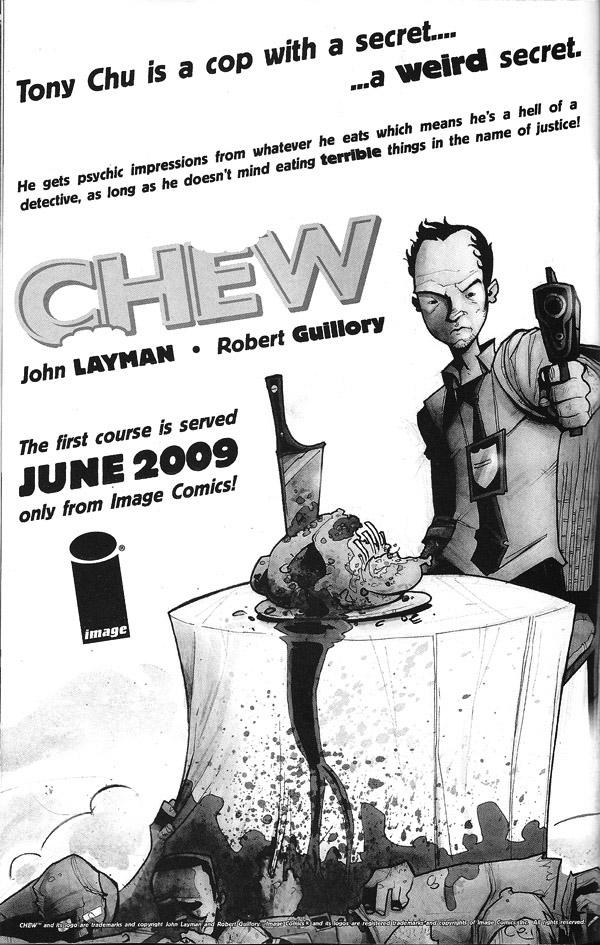
CHEW is about a cibopath. For those not "in the know" that means that Detective Tony Chu gets psychic impressions from every food he eats.
Except beets.
As the series begins, he's working vice in Philly. His brother's an ex TV chef who had a psychotic episode on the air concerning the "chicken conspiracy" (more on that below).
While on stakeout, Tony and his partner John Colby observe Tony's brother on infra-red. He's packing. Not heat, but meat. Turns out chicken has been made illegal due to a bird flu epidemic, and the FDA now has more power than the FBI. As a result of this, there's a huge bootleg traffic in chicken parts.
Well, that's a summary of the first 6 pages of issue 1.
After a preview in The Walking Dead no. 61, the book took off. It remains one of the few books to demand any sort of coin on the back issue market, despite numerous reprints and a couple very tasteful (sorry) TPBs.
(House ad from Walking Dead No. 60)
Ahem. Back to issue 1.
Tony and Colby are having lunch, when Tony's gift/curse reveals that one of the sous chefs is a serial killer who eats his victims and cooks with them, serving the results to restaurant customers. They confront him. Colby gets a hatchet upside his head for his trouble.
At the end of issue, Chu becomes an FDA agent. He works on cracking the conspiracy behind the bird flu scandal. Colby becomes his reluctant partner, following a facial reconstruction that leaves him looking like a poor man's Terminator.
As the story twists the readers into abstract sculptures, Tony finds a girlfriend, a food critic whose reviews are so well written that they make people taste the food.
It's also revealed that Chu is one of three cibopaths.
Who are the others?
What is happening with the mysterious octopus-pineapple-chicken plant thing in issue 6?
It might seem like this facile device would wear out in short order. After all, the bit only works if you keep putting food with criminal ties of some kind on the protagonist's plate.
Surprisingly, writer John Layman and artist Rob guillory manage to keep it fresh (there's really no way to avoid food puns on this one, so let's just muddle through, shall we?).
The book has been optioned for a TV series. The production company is the one responsible for The Walking Dead show on AMC, which is quite good, so I have hopes that the material will translate successfully.
The comic's writing is action-driven, but not the expense of intelligence. A book based on an idea this wild could be terminally stupid. This is not. There's a delightful balance of humor, empathy and the macabre.
Not so surprising when you think about it. Some of the best horror stories are also comedies. Perhaps instead of whistling by the graveyard, we ought to chuckle.
As with Meta4, kudos to Image for putting out such an unusual and delightful book. It's also to their credit that these books have such different styles and, one presumes, different core audiences. But then, I'm reading both, so possibly not so different.
Perhaps the difference, if there is one, is in the core readership for each book. People who read Meta4 might be more willing to give CHEW a chance than vice versa, akin to Clockwork Orange fans being more accepting of Singin' in the Rain than the reverse.
I hope the pop culture references in CHEW don't wear thin over the years. I'd like to see this book become one of those comics that is recommended for decades.
Hm. Maybe this cover really is timeless at that.
Tomorrow: Best of 2010, no. 4: it burns!
Subscribe to:
Posts (Atom)