Beginning my start of year countdown of the ended year's best.
As stated last year, I have mixed feelings about DC's "New 52" concept. I don't completely see the necessity in narrative terms of scrapping decades of stories just to start over. But I do understand the commercial necessity of attracting new readers, and I know on a practical level that you can't always do that with old stories. I also accept the notion that a mythos needs to be reinvented every generation, and New 52 factors into that.
That said, I've fallen away from most of the New 52 titles. Everything is urgent, fast, and full of so many gritted teeth that I suspect what the new heroes really need is one of the fine laxatives on the market. I also question the frequency of these "cataclysmic" epics.
When every story is an Earth shattering new mythology that will change things
forever, it rapidly becomes mundane.
There are a couple notable exceptions.
First of these is James Robinson's Earth 2.
This has many of the aforementioned elements I find tedious, but it uses them effectively and consistently rises above them.
This is in no small part due to James Robinson's storytelling. I've made no secret of my admiration for his work on Starman (though I have mixed feelings about his script for the film version of League of Extraordinary Gentlemen). Robinson manages to effectively meld characterization and action with the space opera superheroics that charmed so many us relics in the 1960s.
In some ways this is reminiscent of DC's First Wave of a couple years back- reinventing heroes and their relationships with one another, all while on the move in a nonstop story owning as much to Republic serials as to more recent comic storytelling innovations.
But here we begin by doing away with the Big 3.
In issue 1, we lose (or possibly just misplace- I'm a couple issues behind) Superman, Batman and Robin and Wonder Woman.
Then things pick up steam.
With no heroes (or as they're called in this narrative, "wonders") left, Earth seems helpless against the onslaught of dual forces. First is an elemental force, building on now decades old concepts in Alan Moore's Swamp Thing. Second comes a "save the world by destroying it" threat in the person of one Terry Sloan.
Robinson's playing with some great concepts here. He crosses some of the origins to create hybridized versions of the heroes with whom we're so familiar. The Atom is a military man with atomic powers, a la Captain Atom. The Flash is granted power by the god Mercury, making him something of a Wonder Woman pastiche. And Green Lantern builds on the Swamp Thing Earth elemental concept.
There was substantial ballyhoo concerning Alan Scott being reinvented as a gay man. It struck me as a tempest in a teaspoon. Robinson has written smart gay characters in the past (again, see Starman) and he handles Green Lantern's personal life with equal aplomb.
More significantly than the character being gay, there is a plot element that plays out involving a choice between Scott's sexuality and his new mission as a wonder.
When tempted by a false image (an echo? a simulacrum?) of his deceased lover, seen at right in his introduction (while still alive in the storyline), Scott chooses to abandon the illusion of contentment for the struggle to do right.
This is Orpheus, this is Christ in the desert, this is the temptation of Doctor Faustus, this is Jabez Stone fighting for his soul.
This is the stuff of myth and faith, dressed up in ecological superhero drag.
And it works.
Unlike Keith Giffen, Robinson knows how to temper the bickering between his protagonists to keep it from becoming tedious, though it does come close at times.
But the interaction of Hawkgirl and the Atom poses a challenging dynamic. Her "I don't have time to teach you this stuff" tutoring of the impulsive Flash is equally engaging.
The most recent issue I read was no. 6, so I'm about 50 pages behind on this story. But rest assured, I will catch up.
I'd be remiss if I failed to note the art of Nicola Scott. Team books tend to be overly busy and loud, but Scott brings subtlety and just the right measure of ornate design to her work.
She manages to maintain a high level of detail and accuracy, even when illustrating crowds and battle scenes.
She also never neglects to show emotion in her faces, and is quite adept at doing so. Others have compared to George Perez, which in turn evokes comparison to Phil Jiminez. I think those are valid analogies, but I'd go a step farther and say that her storytelling chops homage the man I consider the master of superhero art, Curt Swan.
I've enjoyed her past work on both Birds of Prey and Secret Six. Ideally, Earth 2 will increase her recognition and options for work. I'll be keeping up with this Australian artist!
Tomorrow: Number 11 of the Best of 2012, another entry from the New 52.
Insights about comics, prog rock, classic cartoons and films, higher education, sexuality and gender, writing, teaching, whatever else comes to mind, and comics. I know I said comics twice. I like comics!
Showing posts with label Starman. Show all posts
Wednesday, January 2, 2013
Saturday, January 21, 2012
Best Comics of 2011 No. 5: The Shade mini-series
James Robinson's work on Starman remains a benchmark not just in superhero stories, but in family and extended family narratives.
Is it any wonder, then, that I really like the new Shade mini-series?
The Shade is a 1960s Flash villain, re-imagined as a bit more of a moral cipher in the previous Starman series. In the revisioned narrative, Shade had befriended Oscar Wilde and had film director Tod Browning as a mystic nemesis. This is not the simple saw of villains being more interesting. It's more about the line between good and evil being blurred in one character, which makes for fascinating writing.
In this mini, the side focus is on Shade and his evolving relationship with Molly O'Dare, sister of and officer in the all-cop O'Dare clan, a relationship first suggested in Starman no. 41 (1998). An elaborate story involving Shade's continually cryptic past is the larger framework.
As is the case in much of Robinson's writing, the story offers new questions for every answer.
I was originally put off by the harshness of Cully Hamner's art on this book. I found Tony Harris' elegant, Deco-tinged interpretation of Opal City and its inhabitants a much better fit for Robinson's writing, but the work is growing on me.
I hope sales for this pick up. Robinson has indicated on twitter that the series might not be completed if the floppies don't sell well enough, which I would regard as a real loss. Much of Robinson's superhero work has been strong (though I didn't much care for The Golden Age), and as eager as I am for his upcoming Earth 2 series from DC, this is just as important.
Next: No. 4: a nice Springfield mish-mosh.
Is it any wonder, then, that I really like the new Shade mini-series?
The Shade is a 1960s Flash villain, re-imagined as a bit more of a moral cipher in the previous Starman series. In the revisioned narrative, Shade had befriended Oscar Wilde and had film director Tod Browning as a mystic nemesis. This is not the simple saw of villains being more interesting. It's more about the line between good and evil being blurred in one character, which makes for fascinating writing.
In this mini, the side focus is on Shade and his evolving relationship with Molly O'Dare, sister of and officer in the all-cop O'Dare clan, a relationship first suggested in Starman no. 41 (1998). An elaborate story involving Shade's continually cryptic past is the larger framework.
As is the case in much of Robinson's writing, the story offers new questions for every answer.
I was originally put off by the harshness of Cully Hamner's art on this book. I found Tony Harris' elegant, Deco-tinged interpretation of Opal City and its inhabitants a much better fit for Robinson's writing, but the work is growing on me.
I hope sales for this pick up. Robinson has indicated on twitter that the series might not be completed if the floppies don't sell well enough, which I would regard as a real loss. Much of Robinson's superhero work has been strong (though I didn't much care for The Golden Age), and as eager as I am for his upcoming Earth 2 series from DC, this is just as important.
Next: No. 4: a nice Springfield mish-mosh.
Sunday, June 19, 2011
Daddy's Day
More than a bit behind on posting, due to an increased work load of late. My apologies to the faithful! The Comments contest will be extended accordingly.
Today is Father's Day. My half-sister noted on Facebook that she has few photos of our Dad, so I will be scanning the ones I have.
Like many people, my relationship with my Father is complicated. But I was lucky to get to know him. Children of divorce have stuff to work out.
Rather than descend into the maudlin, I'll just post a few things.
First, here's one of my favorite parts of HEAD, brilliantly staged song by Harry Nillson.
While I'm not a huge fan of post-Gabriel Genesis, I do rather like the first three albums. Here's a Daddy song about a Scots war being lost by a father breaking his word.
To show what fatherhood is at its best, here's John Lennon's classic. Bear in mind that popular opinion is divided on the question of how good a father Lennon really was, because of the years Julian spent wanting to know him better.
And bringing it back to comics, we can bypass the abandonment issues of Superman and Batman and go right to the chase. The relationship of Ted and Jack Knight in Starman is arguably the best father/son relationship in comics, certainly the best in superhero books. It implies the inherited mantle that fathers aspire to in so many cases, and works as a model for the child coming to terms with the parent, each seeing the other for who they truly are.
I haven't forgotten about my self-imposed Original Art obligations! More soon!
Happy Father's Day. May we all get to know one another better..
Thursday, September 16, 2010
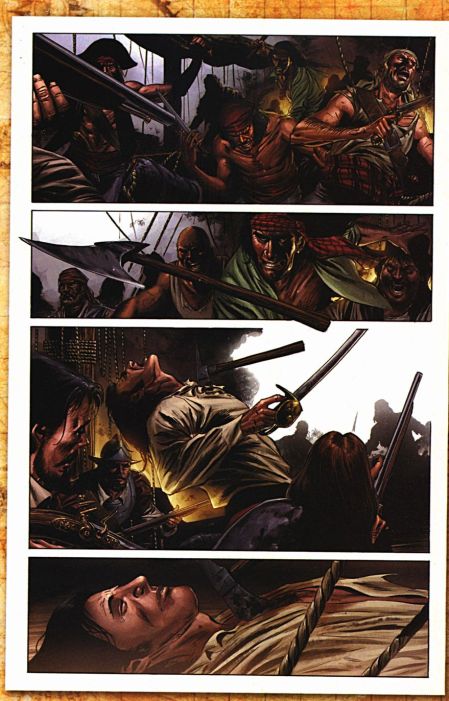
We'll be using yer guts fer garters, mate! (caption, panel 3)
This coming Sunday is National Talk Like A Pirate Day!
It draws many things to me beleaguered and rum-addled mind.
We'll let my old captain, Micheal Nesmith, interrupt now and again.
Arr. Now, then.
Since Pirates of the Carribean, there's been a revived interest in our bilge-soaked seafarers. Mr. Depp's over-the-top portrayal was a delight in that it made several things about pirates clear.
They're unclean.
They're dishonest with others, and not always so honest with themselves.
They're violent and greedy.
Despite that, they're really fun!
Yes. Quite right, then.
Pirates have been fixtures in comics forever. The origins of The Phantom and Tarzan are both steeped in pirate lore. Tarzan's parents were cast away from their burned ship by pirates, while pirates killed Kit Walker's parents in the 1600s, resulting in the Phantom legacy.
It's also worth mentioning that
Ahem. As we were saying.
It's also worth mentioning that many more contemporary superheroes have walked the planks under the skull and crossbones!
Benjamin J. Grimm, the Thing of Fantastic Four fame, was, in reality, Blackbeard.
One of the smartest superhero stories, James Robinson's Starman, uses pirates as a recurring theme, first as an adventure with Starman's late brother, then as a rescued damned pirate who saves Starman's bacon.
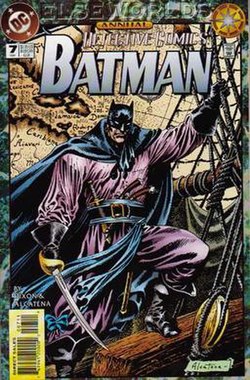
Detective Comics Annual No. 7 featured an Elseworlds story of a pirate Batman. The story, titled Leatherwing, is part of a series of unrelated stories, set outside standard DC continuity. While they often end with the central characters assuming the same roles they do in the "canon" continuities, these outings do give the creators a chance to stretch a bit.
There are also comics that are specifically about pirates, ranging from
(stop that!) er, ranging from this early Classics Illustrated, that adapts the Yul Brynner/Charlton Heston odd little quasi-historical epic The Buccaneer (one of my favorite childhood movies)
to Will Eisner's pre-Spirit strip Hawks of the Sea, represented here in its Canadian version,
to the more recent El Cadazor, from the late publisher CrossGen, whose smart, beautiful comics were hindered by an overly ambitious business plan and the vagaries of the economy.
This book, by the usually snarky/macho and slightly misogynist (but not nearly as bad as Beau Smith in that respect) Chuck Dixon, picks up on the Disney Pirates notion of a woman as captain. Not unheard of in the world of real pirates, but rather uncommon.
Another fixture of the pirate narrative: the abandonment of identity. In all these stories, there's an aspect of the character being reborn as another, a burial at sea of the land persona, if you will. This is often accompanied by a moral shift.
Following the astounding popularity of Disney's Pirates of the Carribean films, the theme began to recur in comics, including this delightful romp from Ted Naifeh, illustrator of the transgender tone poem How Loathsome, written by Tristan Crane.
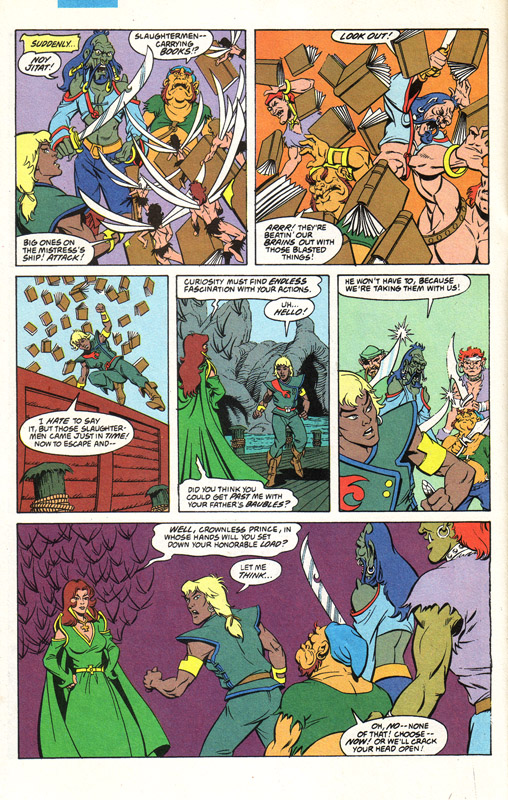
Along the same lines, there's the bright (if derivative of Elfquest) comic based on the short-lived series Pirates of Dark Water. In addition to a page of the narrative, here's the cover of the last issue, with art by the delightful and elegant Charles Vess!
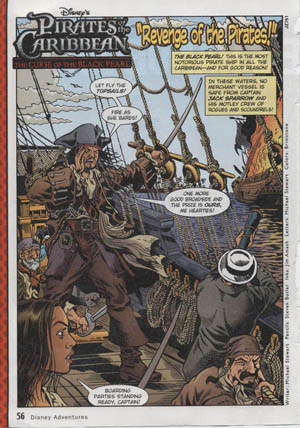
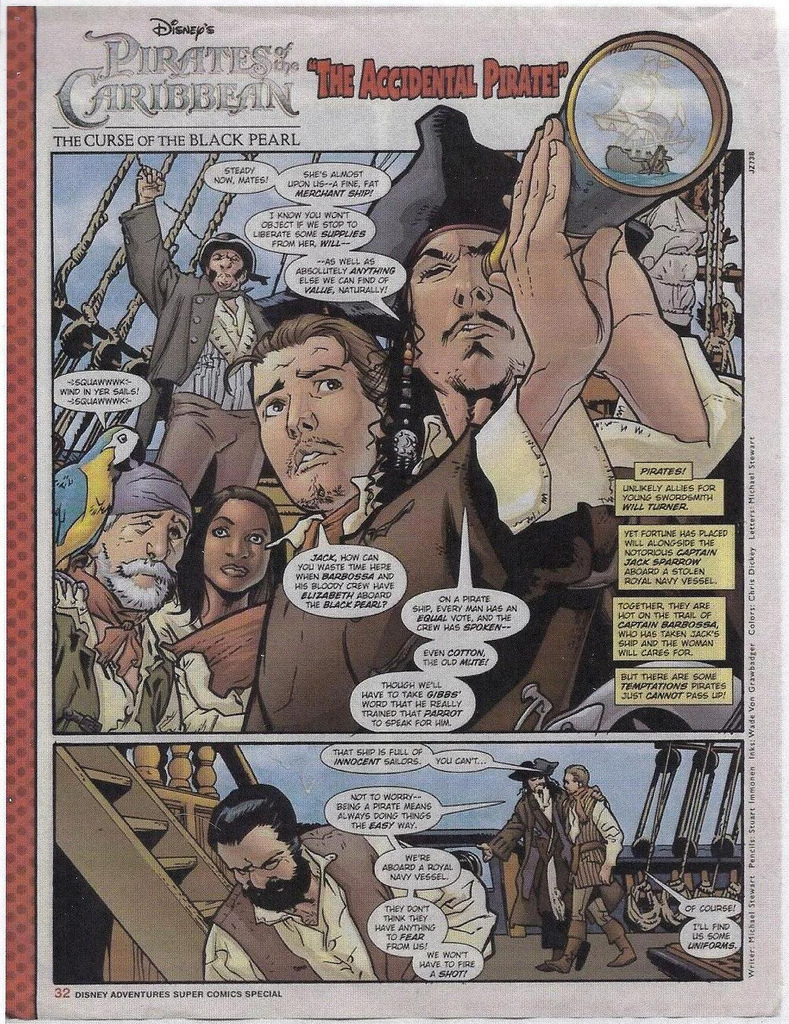
And thanks to the sadly demised Disney Adventures Digest, we have comics featuring Jack Sparrow and Company, illustrated by Brett Blevins, who also did the new Scarecrow of Romney Marsh comics for the same publication!
The first story was Revenge of the Pirates, from the August 2003 issue.
The final tale was The Accidental Pirate, from the Disney Super Special, Sept. 2009.
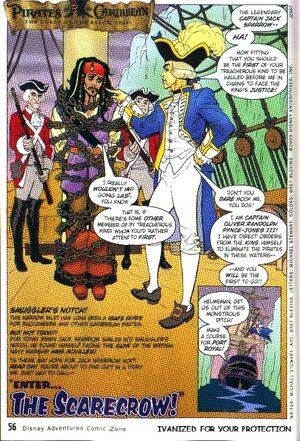
Approximately midway through the run, this tale appeared, introducing the usually land-bound pirate The Scarecrow of Romney Marsh, who was featured in a dozen or so stories of his own throughout the run of the magazine.
And the classics.
This post-trend EC title featured some remarkable art and some innocuous stories- of necessity, as demanded by the then-powerful Comics Code.
And let us not forget the use of pirates as metaphor in the meta-comic Tales of the Black Freighter, contained in The Watchmen.
I'll be having some grisly metaphor, if you will, Captain! The true nature of pirates is much closer to the surface here, and is taken to extremes by the labyrinthine S. Clay Wilson in his classic, Captain Pissgums and His Pervert Pirates!
Despite Disney's attempts to turn them into charming rogues, pirates remain lethal, often amoral figures bound by their own code. Their stories are a sort of seafaring noir, wrapped in desperation and urgency as they sail to treasure they can never spend.
This Gentle Giant song sums up the inevitable end of most pirates.
The world of pirates is colorful, adventurous and seductive. It's also nihilist, defeating and doomed. The core conflict is Man Against Sea, and Sea always wins.
Well, maybe it's not THAT grim...
Ah, Pirates do love their treasures!
It draws many things to me beleaguered and rum-addled mind.
We'll let my old captain, Micheal Nesmith, interrupt now and again.
Arr. Now, then.
Since Pirates of the Carribean, there's been a revived interest in our bilge-soaked seafarers. Mr. Depp's over-the-top portrayal was a delight in that it made several things about pirates clear.
They're unclean.
They're dishonest with others, and not always so honest with themselves.
They're violent and greedy.
Despite that, they're really fun!
Yes. Quite right, then.
Pirates have been fixtures in comics forever. The origins of The Phantom and Tarzan are both steeped in pirate lore. Tarzan's parents were cast away from their burned ship by pirates, while pirates killed Kit Walker's parents in the 1600s, resulting in the Phantom legacy.
It's also worth mentioning that
Ahem. As we were saying.
It's also worth mentioning that many more contemporary superheroes have walked the planks under the skull and crossbones!
Benjamin J. Grimm, the Thing of Fantastic Four fame, was, in reality, Blackbeard.
One of the smartest superhero stories, James Robinson's Starman, uses pirates as a recurring theme, first as an adventure with Starman's late brother, then as a rescued damned pirate who saves Starman's bacon.
Detective Comics Annual No. 7 featured an Elseworlds story of a pirate Batman. The story, titled Leatherwing, is part of a series of unrelated stories, set outside standard DC continuity. While they often end with the central characters assuming the same roles they do in the "canon" continuities, these outings do give the creators a chance to stretch a bit.
There are also comics that are specifically about pirates, ranging from
(stop that!) er, ranging from this early Classics Illustrated, that adapts the Yul Brynner/Charlton Heston odd little quasi-historical epic The Buccaneer (one of my favorite childhood movies)
to Will Eisner's pre-Spirit strip Hawks of the Sea, represented here in its Canadian version,
to the more recent El Cadazor, from the late publisher CrossGen, whose smart, beautiful comics were hindered by an overly ambitious business plan and the vagaries of the economy.
This book, by the usually snarky/macho and slightly misogynist (but not nearly as bad as Beau Smith in that respect) Chuck Dixon, picks up on the Disney Pirates notion of a woman as captain. Not unheard of in the world of real pirates, but rather uncommon.
Another fixture of the pirate narrative: the abandonment of identity. In all these stories, there's an aspect of the character being reborn as another, a burial at sea of the land persona, if you will. This is often accompanied by a moral shift.
Following the astounding popularity of Disney's Pirates of the Carribean films, the theme began to recur in comics, including this delightful romp from Ted Naifeh, illustrator of the transgender tone poem How Loathsome, written by Tristan Crane.
Along the same lines, there's the bright (if derivative of Elfquest) comic based on the short-lived series Pirates of Dark Water. In addition to a page of the narrative, here's the cover of the last issue, with art by the delightful and elegant Charles Vess!
And thanks to the sadly demised Disney Adventures Digest, we have comics featuring Jack Sparrow and Company, illustrated by Brett Blevins, who also did the new Scarecrow of Romney Marsh comics for the same publication!
The first story was Revenge of the Pirates, from the August 2003 issue.
The final tale was The Accidental Pirate, from the Disney Super Special, Sept. 2009.
Approximately midway through the run, this tale appeared, introducing the usually land-bound pirate The Scarecrow of Romney Marsh, who was featured in a dozen or so stories of his own throughout the run of the magazine.
And the classics.
This post-trend EC title featured some remarkable art and some innocuous stories- of necessity, as demanded by the then-powerful Comics Code.
And let us not forget the use of pirates as metaphor in the meta-comic Tales of the Black Freighter, contained in The Watchmen.
I'll be having some grisly metaphor, if you will, Captain! The true nature of pirates is much closer to the surface here, and is taken to extremes by the labyrinthine S. Clay Wilson in his classic, Captain Pissgums and His Pervert Pirates!
Despite Disney's attempts to turn them into charming rogues, pirates remain lethal, often amoral figures bound by their own code. Their stories are a sort of seafaring noir, wrapped in desperation and urgency as they sail to treasure they can never spend.
This Gentle Giant song sums up the inevitable end of most pirates.
The world of pirates is colorful, adventurous and seductive. It's also nihilist, defeating and doomed. The core conflict is Man Against Sea, and Sea always wins.
Well, maybe it's not THAT grim...
Ah, Pirates do love their treasures!
Subscribe to:
Posts (Atom)