Showing posts with label Daredevil. Show all posts

Sunday, November 28, 2021

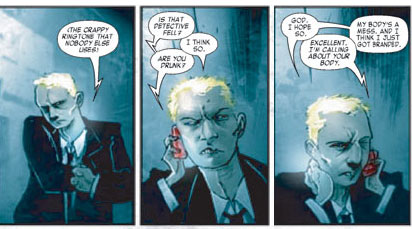
Original Art Sundays No. 290: Sharp Invitations: Curt, p. 22

Welcome back, loyal readers.

Much to discuss about today's page, so let's get right to it.

First thing to unpack here: the writing. The last page marked a shift away from the narrative heavy pages leading up to the move. There's a bit of exposition here, but I tried to frame it so it held its weight, without dominating the story. Clearly, layout was crucial to doing this.

We begin with the classic "frog in the frying pan", a metaphor often used to explain enduring abuse to those who haven't experienced it. This is a clear case of "show, don't tell."

My trans stuff doesn't figure overtly into this part of the narrative, but as we'll learn on the next page, it's omnipresent in the relationship.

For the balance of the page, I decided to channel my inner David Mack. I was so impressed with his use of layout and silhouette as narrative devices in Kabuki, Daredevil. and the brutal (but clever and beautifully rendered) COVER. It's thoughtful and still engages the reader. Also, it's fun to look at! And by isolating the text from the image, the idea that I was stuck in my own head with little to no attachment to the outside world is reinforced.

Not to say I didn't have a little fun with this page. The frog (drawn freehand after a quick look at photographic reference) was a delight to draw. The third panel, with simultaneous exercising and cooking, is a playful comment on the idea of the woman who can do it all. In the third silhouette panel,  I took the conceit of using The Best of Both Worlds onscreen. We did watch that one together, but it first aired before the big move. But it's such an iconic episode, I had to give it homage. ST: TNG was still in its initial run during our years together.

Another layout consideration: gray values are mostly represented in pencil until the last panel, to increase the emotional impact of that image. I freely stole the pose from the iconic Alan Moore/Curt Swan Superman collaboration Whatever Happened to the Man of Tomorrow? 

Minimal Photoshop corrections this time. 

Tools used:

  • Lead holder and 4B leads
  • Ames lettering guide
  • 4B graphite stick
  • Faber Castell Erasers
  • Dr. Martin's Black Star Ink
  • FW Acrylic White 
  • Crow quill and nib
  • Micron nos. .005, .02, .03, .05, .08, 1.0
  • Brushes: Richeson #2 Sable, Tight Spot for corrections
  • Photoshop

Overall, I'm quite proud of this page. 

Next week, Page 23!

I may up the ante to more than a page a week, if my schedule permits.


Wednesday, March 1, 2017

Best Comics of 2016: No. 5 - 2

Only two posts to finally end this year's list. I know it's VERY late, but I want to post anyway.
5. Black Widow
There were a LOT of impressive books with female leads in 2016, and a surprising number from Marvel. It should be apparent by now that I tend to prefer DC books, so this year was a surprise to me in that respect. Writer Mark Waid and artist Chris Samnee have given Black Widow a feel that echoes the best aspects of the early Wally Wood Daredevil run, yet has a contemporary sensibility. Like the Scarlet Witch book (see below), this title is at least partially inspired by the lead character's presence in Marvel movies (sidebar: Captain America: Civil War was a good Avengers movie, but it wasn't really a Captain America movie to me).
Movie crossover? Tense Tony Stark lays down the law!

In Black Widow, a noir sensibility, coupled with an affection for action and spy movie tropes, gives the book visual eloquence and urgency. The first issue, a nearly wordless chase story, is one of the most fun single issues in a long time. Once the running stops, there's the good old heroine's journey to propel the storyline. In this case, the backstory of Natasha revisiting her childhood training camp is tense and heartbreaking.
As the story develops, we work around to the on-again, off-again romance with Winter Soldier. While there were rumblings in the fan press that good old Bucky would finally be revealed as bisexual, there's nothing overt (and very little that's covert) in the actual book to support that premise.
However, it does make me wonder about the distinctions between romance in books with male heroes and those with female heroes. Marvel's been very good about diversity this year, not just in terms of inclusion, but inclusion that fits the stories and characters, with a few minor exceptions (the gay Iceman fiasco comes to mind).
Even with that, the book remains a solid read. I've fallen a bit behind, but I continue to pick it up, and eagerly anticipate a binge on the title again soon.
4. Scarlet Witch
James Robinson has written some of the best superhero comics ever done, like Starman, and authored a few that are awkward, like Justice League: Golden Age. I've long championed his League of Extraordinary Gentlemen film script, seeing it more as a Starman pastiche than as a Moore adaptation. I liked what he was doing with Squadron Supreme, but was quickly turned off by the vehement tone of the book. His C-3PO one-shot was brilliant.
In short, Robinson is back near the top of his game. In Scarlet Witch, he revisits and tries to clean up the backstory of Wanda Maximoff, whose tale has developed an alarming number of Marvel convolutions over the years.
As is the case in Black Widow, we have a journey into the heroine's childhood. But in this case, the journey is plagued by rocks on the road in the form of old nemeses, mentoring ghost witches, and revelations of and unknown family tree (once again, Wanda discovers she's not who she thought she was).
This book is visually alarming, in a good way. Wanda's new costume is brilliant. The covers, and some of the interiors, have arresting and compelling designs, often reminiscent of Coles Phillips' classic fadeaway paintings! Vanessa Del Rey is providing moody art that's still readable and tells a story, and Jordie Bellaire's coloring is a exquisite complement to both art and script.
Although it's working fairly well in Black Widow, I'm grateful there's little romance in this book. Not that the character doesn't deserve happiness, but it's refreshing to see a woman-centered book that isn't about romance.

3. Dr. Fate
Well, this does seem to be the year for magic, doesn't it? Between Dr. Strange, Scarlet Witch and this book, magic has regained its position near the top of the comics pile, and rightly so. In the case of Dr. Fate, the magic draws from the Kimetic, or ancient Egyptian, belief system. Since the character was created by Gardner Fox in 1940, with an origin story modeled in part on the 1922 expedition of Howard Carter that unearthed the tomb of Tutankhamen, this is no surprise. The surprise is that the character has never strayed far from its origins.
This incarnation of Dr. Fate, so to speak, brings the ancient connection home in a very different way. The helmet of Nabu, the source of power that possesses its hosts over time, is assumed by a young and somewhat naive college student, Khalid Nassour. The book alternates between his attempts to save the world from a flood caused by the ancient gods (which reminded me of the Peter Weir film The Last Wave), and (shades of early Spider-Man) trying to hold his life together and keep his secret.
Oh, yeah, and Kent Nelson, a long lost uncle as it turns out, puts in an appearance.
Slice panel showing
the head behind the mask. Brilliant.

I love the art on this! Paul Levitz's writing is as solid as it ever was here, with some brilliant characterizations, particularly Khalid's parents. But Ibrahim Moustafa's art is spot on. Stylized and angular, yet approachable in a good way, every issue of this now concluded (sob!) series shines. The layouts have nuances that reinforce plot points, in addition to being attractive and compelling, as in the cutaway panel in this page from issue 6.
I really hope to see this interpretation of Dr. Fate again. Like last year's run on Martian Manhunter, it put new life into a very old character.


2. Faith
I've commented a bit on the social aspects of this book in a fairly recent post, so I'm going to concentrate here in the superhero aspects.
To be a good superhero book, the book must be:
  • Rendered consistently with the writing
  • Written in a style that suits the character's demeanor and history
  • Be plausible. Not realistic, but plausible. There's a quantifiable difference.
  • Evoke an emotional response consistent with the intent of the creator(s). Admittedly, this one has a more arbitrary aspect than the others.
In that spirit, Faith succeeds with  a few reservations. The art is consistent and worthwhile superhero art. If I had to make an artistic analogy to Franics Portela's work on the series, it would be much of Dave Gibbons' work: clean and accurate, without a ton of flourishes, and with solid storytelling in panel and angle choices.
The writing by Jody Hauser really grabs me, so much so that I'm tempted to give her TV series Orphan Black another chance. I watched the first episode and it left me cold. Perhaps, in retrospect, that was a mistake. Hauser has been doing strong work on Faith. There are a few times when I wish Faith was not such a popular culture geek. As much as I liked the issues dealing with the Comic Con villain, it felt a bit played out after a while- could have been one issue instead of two and I would have been fine with it.
One aspect of the writing I do enjoy is Faith's relationship with Archer, of Archer & Armstrong. As has been noted in so many superhero books, it only makes sense that a superhero would enter into relationship with another superhero: unique commonalities and all that. I didn't have much use for most of the Valiant line the first time around, largely due to my reverence for the original Magnus, Robot Fighter and ensuing resistance to the reboot. But I did enjoy the original A & A run, both the Barry Smith and Mike Baron issues.
I've not been inclined to follow any of the other crossover titles with Faith in them. I tried one issue of the team book Harbingers, and I was disinterested throughout.  If Faith has significant appearances in future issues of Archer & Armstrong, I'll probably pick those up.
Faith remains a worthwhile book, though I'm a couple issues behind in current reading. I'm likely to stick with the book for a while.
Next: the number one comic of 2016 (at last!).

Saturday, January 17, 2015

Best Comics of 2014, No. 5: The Death-Defying Doctor Mirage

When they first appeared, most of the books in the Valiant line left me cold. I did eventually come to love Archer & Armstrong, especially the Barry Smith issues, but their revisionist version of Magnus, Robot Fighter did nothing for me, and I saw the new characters as spinoffs of that, so I mostly didn't bother.
Well, looks like I might have been missing out.
The latest Valiant revival includes a magic-based title, The Death-Defying Doctor Mirage. Now, while I don't go nuts for EVERY comic about magic, there are some I cherish, like the Smoke and Mirrors miniseries of a couple years ago, good Doctor Strange stories, and the magical aspects of Gaiman's comic book work, especially the first Books of Magic mini-series. Looks like I should add Doctor Mirage to that list.
de la Torre's art from Issue 2.
The Mignola influence is clear.
By writer Jen van Meter (how is it that this book is neglected in a year when comics are taken to task for a lack of female creators?) and artist Roberto de la Torre, who also did some nice work on The Hand storyline in Daredevil a few years ago, The Death-Defying Doctor Mirage tells of widow Shan's attempts to reunite with her deceased husband, the only spirit she cannot access. 
The five-issue mini-series, now complete (and presumably awaiting collection) is mature in every sense of the word. While it does contain a smattering of grisly content, its maturity derives more from the subtlety of its storytelling and characterization. Odd to say about a book about ghosts and Nazi wizards, but The Death-Defying Doctor Mirage is quite introspective and tender, but not lacking in action and energy.
In a Comics Alliance interview, van Meter says, "From a character perspective, one of the imaginative challenges becomes, “Who is this person that keeps walking into the worst day of somebody else’s life’ over and over and over again?” As I was trying to develop the personality of the character, I was thinking a lot about other people I know who handle things like that, like ER Doctors. I know a couple people in medicine who deal with fairly traumatic sides of what they do and I’ve know some cops in my life. I was trying to kind of think about what their resilience is, what are the personality quirks that go with being able to keep that job and stay healthy. Where are the cracks for people that are having a hard time with that role? The maturity to it for me is trying to bring a thoughtful perspective to what it would be like to really be this person and not have it all be just battling monsters."
The coloring by David Baron is subdued and spot on, enhancing the story's flow elegantly.
Elegant may be the best word to describe this book, despite de la Torre's art having nuances of raw, unbridled Mignola in spots.
The best way to describe The Death-Defying Doctor Mirage is that it's a smart, magical superhero Gothic romance. Not a bad way to spend five issues! 
No word on following appearances of the character. But as always, we live in hope.
Next: Best Comics of 2014, No. 4, which bites and snarls. 
-->

Sunday, January 6, 2013

Best Comics of 2012, No. 9: Daredevil by Mark Waid

As much great work as they've produced over the decades, I've not been a huge Marvel fan for the last couple decades.
A couple recent titles have bought me around a bit on this.
The first of these is Mark Waid's current run on Daredevil.

Everybody knows Daredevil by now: blinded by a radioactive isotope while saving a blind man about to be hit by a truck, young Matt Murdock assumes the mantle of Derdevil to avenge the death of his boxer father at the hands of The Fixer.
Sort of Batman meets Kid Galahad with a dollop of Shakespearean tragedy,  later supplemented by Miller with noir and manga pastiches.
I've been a fan of Old Hornhead since the early issues. I recall reading the Wally Wood stories, and the Romita and Colan followups, when they first came out.
I stuck with the character. I was captivated by the Miller run and some of the followups, but lost interest.
I returned sporadically. The Marvel Knights runs by Joe Qeusada and David Mack were particularly successful, and the Bendis/Alex Maleev run was spellbinding, if derivative of Bendis' noir themed independent comics.
Heck, I even liked it when DD was interviewed for Rolling Stone in no. 100.
So I know my Daredevil.
But I've not read it for a few years.
I think creators got carried away with the maudlin/tragic aspects of the character. While these were always present, there was more of a soap opera aspect to them in the 60s and 70s. I blame and credit Frank Miller for bringing out Matt's Catholicism as a focus of the character.
At any rate, I'd walked away and didn't pay attention when Waid began writing Daredevil in July 2011.
More fool me. I should have known better.
I love Waid's Astro City, and his "Unthinkable" storyline in Fantastic Four is some of the best superhero stuff ever. I'd like to see him revitalize his Potter's Field, but I'm pretty sure he's done with it.
In the current Daredevil run, Waid and artists Chris Samnee and Marc Checetto successfully meld recent events in the Marvel Universe with the tone of the original stories, without being condescending or overly impressed by their own cleverness. There's no wry "this is a comic" wink to the reader here, only well-crafted adventure.
The stories incoproate contemporary versions of staple characters, including Dr. Doom, Spidey, the Punisher- heck, the whole crowd, pretty much. The central storyline involves a flash drive made of unstable molecules from a stolen shred of a Fantastic Four uniform. This drive contains information that could take down any or all of the most powerful criminal organizations in the world, collectively called Megacrime.
Daredevil has it and everyone wants it.
The art is highly reminiscent of the Wood/Layton run, from issues 5  to 11, still one of the highlights of the character's run, especially issue 7, the battle with Namor.
I see that quality in the current Daredevil run.
No Earth shattering, cataclysmic "the Marvel Universe will never be the same!" bombast here. Just a solid, intelligent adventure.
I read a review of Star Trek: Insurrection in Fantasy & Science Fiction magazine. It warmly talked of the film as a clever chance to spend a couple hours with old friends.
That's kind of the way I feel about the current Daredevil run. Since I'm reading it in trades, I'm a bit behind the floppies storyline. I've read through Book 3, which culminates with issue 15. The current issue is no. 22.
But I don't expect the issues I've yet to read will disappoint.
Tomorrow: No. 8 in the Best Comics of 2012, a book which will never leave its house.

Monday, January 10, 2011

Best comics of 2010: No. 6: Sam and Twitch: the Writer

Another book that slipped by me for years.
I have little use for most of the Spawn franchise. I enjoyed some of the guest creators' work in early issues, and the rest of the stuff Alan Moore did for Image, while far from his strongest work, was an engaging read. But in general, Spawn leaves me cold.
These two detectives, Sam Burke and Maximillian "Twitch" Williams, were spawned (yeah, I know, I did that on purpose just to get it out of the way) of the early series. They were sufficiently well received to get their own titles, a series of shorter and longer minis.
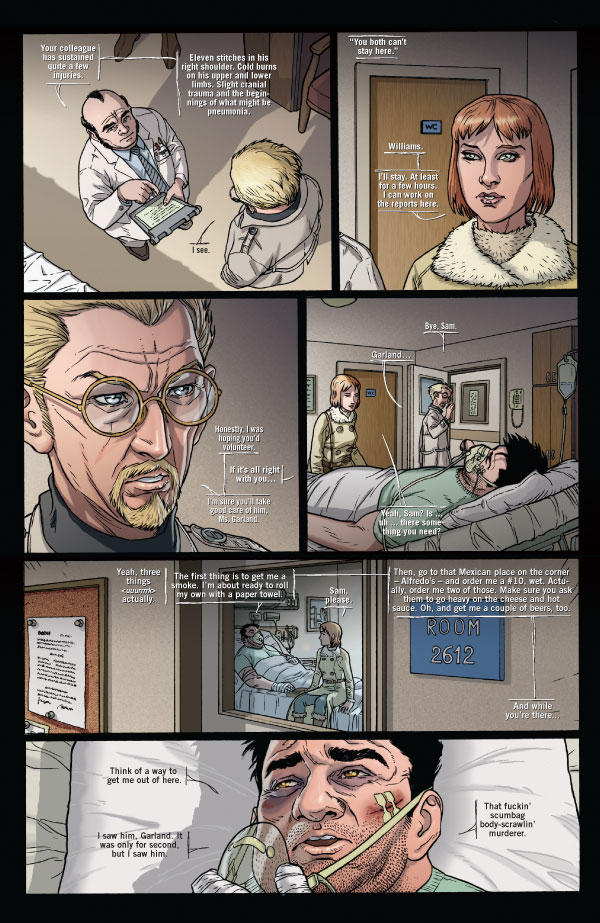
It's tense, witty and gritty detective stuff. There's an unflagging loyalty between Sam, the muscle, and Twitch, the mind. It's brutal and ugly, but like Warren Ellis' FELL, it's ultimately about holding onto your humanity in the face of that brutality.


The 2010 series, by writer Luca Blengino and artists  Luca Erbetta (pencils), Fabio Bono (inks) and Filippo Rizzu (colors), deals with a killer who is carving a novel into his/her victims, word by word. 
 

The book is a tough read at times, not so much because of the content, but because of the visual style. The art is gritty, sketchy and full of detail, bringing to mind Alex Maleev's Daredevil run. Since Maleev's Daredevil writer, Brian Micheal Bendis, also wrote an earlier Sam & Twitch run, that's not surprising.  But the real issue is the text.
No word balloons here. Free floating text, reversed out of the art and connected to the speaker bu a simple line. It scans, but it takes some getting used to.

This is far from the first comic book to use typesetting. Even before the digital revolution (whatever that is), EC Comics were lettered using a Kroy lettering machine that created incredibly uniform text.

And Walt Kelly typeset the speech of his sideshow barker P.T. Bridgeport, though he may have just used presstype- it's been a while since I've seen a Pogo original to confirm, but I recall seeing some text pasteups.
In aid of their detection, Sam and Twitch enlist the aid of a graphologist to help them decipher the text, and locate its murderous author, if the killer is indeed the writer,


As our detectives search for the killer, they are put at risk. Following an uncompromising fight, Sam is hospitalized as Twitch has the final encounter with the killer.
Much as with Holmes and Watson,  Mulder and Scully, or in an unlikely way, House and Wilson, Sam and Twitch are a team with a specific personal chemistry and a bond of camaraderie.
These sample pages only allude to another aspect of this series. It's quite bloody. Most of the time, I don't care for that. Here, it works and it serves the story.
I'm a bit embarrassed that these characters slipped by me for so long. Rest assured, I'll not bypass them again.
Tomorrow: Best of No. 5, a very tasteful book.

Saturday, September 11, 2010

If it please the court, will the witness stop flying about the courtroom?

There's a new exhibit at Yale devoted to comics and the law.
 Of course, comics and the law have a long history.
In addition to the legal battles fought over comics themselves, ranging from the early Superman lawsuits to Marvel's attempts to hold up production of the Rocketeer film over characters with similar names, there have been many characters who practiced law.
The earliest of these in superhero narrative may be Two-Face, the Batman villain who is a scarred district attorney, discussed in this snippet from Frank Miller's Dark Knight Returns.

Two-Face first appears in Detective Comics #66, about 4 years into Batman's run.
Matt Murdock is possibly the most significant attorney in comics in the last 50 years, better known as Daredevil.
Here's a scene from the classic Frank MIller run that shows integration of Murdock's profession and his, ahem, avocation.

Of course, the deal here is that by detecting pulse rate using his heightened senses, this blind lawyer can tell when someone's lying- except in this case, where the culprit has a pacemaker that regulates his pulse! So this in turn effects the way Murdock practices law and the way his deferred identity functions.
Here's the denouement in a later plotline. The adversary realizes the truth.

And my personal favorite, Daredevil #7, with that great Wally Wood art.
Prince Namor journeys to the surface to file a lawsuit against the surface dwellers (that would be us).
Frustrated with the slow pace of the court system, Namor breaks out of jail and runs rampant in the city. Of course, Daredevil must stop him.

The above DD images are all from the delightful Matt Murdock Chronicles blog!
Here's a recent case from Marvel Ultimates. Once most heroes' identities are known, Banner is put on trial for the crimes of The Hulk. Guess who defends?

Of course, comic narratives have been playing fast and loose with the workings of the law throughout their existence, just as have television shows and films.
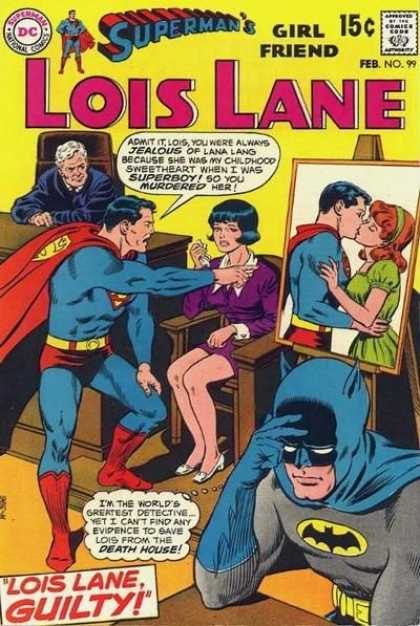
However, this has evolved. Superheroes often used the courts as personal vehicles, as in this Lois Lane story. Who knew both Superman and Batman were licensed to practice law?

In an early 60s story, Superman was on the witness stand and questioned regarding his secret identity. His response was to write the name of his alter-ego on a chalkboard. However, it was written so fast that it melted the slate board. The court accepted this evasion as a valid answer, seemingly without question.
Flash forward to the same question being asked during a murder trial a few years ago.
There's a fascinating analysis of this and related issues over at the Strange Horizons blog. I don't completely agree with it, but it's very insightful.
For decades, Attorney Robert Ingersoll had a column in Comic Buyer's Guide titled The Law Is A Ass, which dealt with legal issues as related to comics content.  An archive of these fascinating columns can be found here.
I doubt this intriguing topic will ever be exhausted.  But we have advanced the portrayal of the superhero in court a great deal since this was all we had.