Friday, February 10, 2012

Best Comics of 2011 no. 3: Habibi

Yes, yes, I know it's on everybody's lists, and Craig Thompson is the darling of comics circles this year.
While I didn't much care for his previous magnum opus, Blankets, I did attend a lecture he gave at the school where I teach, Minneapolis College of Art & Design. I was sufficiently impressed to buy the book and get a spiffy signature and sketch.
And yes, it's a richly layered text, with multiple meanings interspersing tales of love and loyalty with lush and intelligent page design inspired by the Koran. The mathematics of the design are consistent with Islamic beliefs and serve as a framework for structuring the emotionally rich narrative.


And I am quite impressed with the layout and the dense, involving story.
The beauty of Thompson's page design is not lost on me.


But true though that all is, it's not the biggest reason it's on my Best list.
I love books.
I'm not talking about content, I'm talking about form. There's something satisfying about a well-crafted book. The beauty of a good tight binding, elegant end papers, a design and strategy to the physical properties of the volume itself that reinforces the content without calling undue attention to itself. these things inspire me and leave me awestruck.
So when Thompson talked about delaying getting Habibi printed for several months while he located a printer who could fulfill his specs on the volume, and then toured the printer and the bindery(!), I was hooked.
This is an elegant book with exquisite contents.
Few volumes of comic narrative are this well bound. This holds a proud place on my shelf next to the single volume limited edition of Bone, the lovely collection of Brian Wood and Ryan Kelly's LOCAL, and my limited edition first printing of Eisner's A Contract With God.
Great books should be a joy, either open or closed. Habibi is such a book.
Friday, Feb. 10: the final two of 2011.

Monday, February 6, 2012

Best Comics of 2011 no. 4: Kevin Keller/ The Simpsons

Intending to quickly finish these, since circumstances have made me postpone them for more than two weeks.
Next up is a doubleheader.
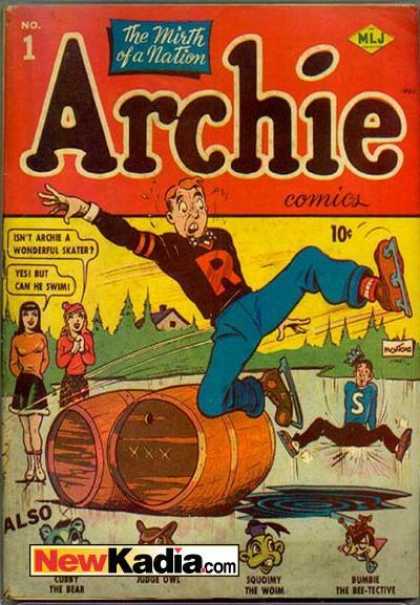
First, an Archie treat: Veronica Presents Kevin Keller.
I've been doing a lot of research and academic writing on Archie Comics lately. Coupled with current events in the company, this has renewed my interest in the formerly tame comics.
What current events?
There's been a fair amount of talk about Archie comics of late, largely due to the dueling lawsuits of the company and its former CEO, Nancy Seiberkleit.
Whether any of these suits have merit or not, it does need to be said that within the rather rigid confines of the Archie brand, Nancy took some big chances that paid off very well. The stories got more interesting, despite the lack of tension required in the plucky Horation Alger meets Henry Aldrich world of Riverdale.
To that end, we had the two Archie Marries storylines, the Day in the Comics Shop mini that paid homage to the company's history in a rather fun way, and the current Archie Meets KISS mini.
Oh, and Kevin Keller.
As gay characters go, Kevin is rather innocuous, but makes up for it in two ways.

First, he's supposedly named after a gay porn star, according to a friend who is, ahem, an occasional consumer of same.
Second, he's got guts.


And style.
 The storylines have addressed significant issues, including politics and marriage, in a slightly watered down Archie fashion. And I find it both laudable and amusing that there's a gay character getting his own book from Archie Comics, the company that championed the Comics Code Authority to the end.
Dovetailing on this is The Simpsons No. 183.
This is a swipe at numerous Archie conventions accumulated over seven decades of stories, beginning with Archie no. 1.
This fun Simpsons issue includes swipes at The Archies, Sabrina, Captain Pureheart, and so many more staples from Archie's history. While Simpsons parodies sometimes feel forced, this one works. Random pages on point posted below.


While Archie is usually rather mundane, the line has evolved a substantial history and has taken a lot of chances (relative to their wholesome mission statement) in recent years. These issues are worth your time.
Next: Best of 2011 No. 3, a blessing and a curse from Allah


Sunday, January 29, 2012

Placeholder

Just a quick note to let my faithful readers, if such there be, know I've not forgotten to blog. I'm just swamped with encyclopedia entries and teaching. As I am submitting the last of the current batch of entries and revision in the next couple days, and I'm done teaching for the week after Tuesday, Wednesday looks promising for catching up.
Meanwhile, here's the cover of a book due out very soon that includes my essay on homoerotic subtext in EC Comics.
For more about this volume, here's its solicitation at its source, McFarland Press. I'm very excited to see this in print!
I'm sorry! I'll work faster, really!

Saturday, January 21, 2012

Best Comics of 2011 No. 5: The Shade mini-series

James Robinson's work on Starman remains a benchmark not just in superhero stories, but in family and extended family narratives.
Is it any wonder, then, that I really like the new Shade mini-series?
The Shade is a 1960s Flash villain, re-imagined as a bit more of a moral cipher in the previous Starman series. In the revisioned narrative, Shade had befriended Oscar Wilde and had film director Tod Browning as a mystic nemesis. This is not the simple saw of villains being more interesting. It's more about the line between good and evil being blurred in one character, which makes for fascinating writing.
In this mini, the side focus is on Shade and his evolving relationship with Molly O'Dare, sister of and officer in the all-cop O'Dare clan, a relationship first suggested in Starman no. 41 (1998). An elaborate story involving Shade's continually cryptic past is the larger framework.
As is the case in much of Robinson's writing, the story offers new questions for every answer.

I was originally put off by the harshness of Cully Hamner's art on this book. I found Tony Harris' elegant, Deco-tinged interpretation of Opal City and its inhabitants a much better fit for Robinson's writing, but the work is growing on me.
I hope sales for this pick up. Robinson has indicated on twitter that the series might not be completed if the floppies don't sell well enough, which I would regard as a real loss. Much of Robinson's superhero work has been strong (though I didn't much care for The Golden Age), and as eager as I am for his upcoming Earth 2 series from DC, this is just as important.
Next: No. 4: a nice Springfield mish-mosh.

Best Comics of 2011 No. 6: Sugar and Spike Archives Vol. 1

Winding down the 2011 countdown.
When Nickelodeon was first starting up, it aired a series called Video Comics. Cheaply made, these were simple old-school animatics. The camera would pan and zoom around comic book frames while actors did voice-overs of the dialogue.
One of the comics used by producers Klasy-Csupo was Sheldon Mayer's Sugar & Spike. K-C went on to "create" Rugrats, a series about talking babies who formed their own society.
Hmm... sure they created it. Uh-huh.
Sheldon Mayer's 1956 creation remains his strongest work, no mean feat for the man who created Black Orchid, the Red Tornado, Scribbly, and wrote and drew what many (including me) consider the definitive Rudolph the Red-Nosed Reindeer stories, apart from the original Gene Autry song. Oh, yes,  Mayer was also the editor who talked DC Comics into first publishing Superman.
Now, there is finally a decent reprint edition of Sugar & Spike.

These deceptively simple tales of babies speaking their own language while trying to understand the world around them have fascinated comic readers for more than five decades. And few had read them.
There was a one- off of the final unpublished issue, number 99, printed in 1992, but created in 1968.
There were a few digests, but none had appeared for more than a decade.
The duo made cameo appearances in books like Brave and the Bold and Kingdom Come, but unless you knew the characters, they were only anomalous ciphers.
In 2002, DC issued a reprint of No. 1, along with a pair of plush dolls.
In fairness, some of the marketing issues are due to creator Mayer's insistence that nobody else do the characters. He had that right, and I applaud him for it, but it may have been one factor in making DC more resistant to reprinting the work.
Now, here it is, in too deluxe a format.
Why too deluxe?
Well, the colors are a little off, the paper a tad bright, and the format is at odds with the content.
As much as I love this work, if there is any comic that's for kids, this is it.
I've written in the past about the delightful paper dolls that Mayer included in the comic. There are also coloring pages and comic pages in which the reader writes in the script.
Now, I don't care how much you love your kids, you're not likely to get them a $60 hardcover book to cut up.
This should be a series of $20 TPBs. Kids should read this, draw in it, write in it, and cut it up.

Sorry, some comics should be kid stuff. This is one, and as wonderful as it is, it deserves to be treated as such.
And being kid stuff doesn't mean it's not worthy of adult attention. This work contains more genuine sophistication and subtlety than any of Frank Miller's recent xenophobic tirades. There's a clear understanding of the human condition in these deceptively simple tales of baby talk!
Sugar & Spike is an important book, but DC seems bent on sabotaging its reissues for some arcane reason.
Until we get a proper reissue, please enjoy this one. If you don't have $60 for it, the library is our friend!
Next: Number 5, something dark yet light.

Wednesday, January 18, 2012

Best Comics of 2011 No. 7: Ruse: The Victorian Guide to Murder

For those who don't recall, Crossgen was a comic publisher with lofty ambitions. They put out a quality product, paid their creators well and gave them benefits (!), and were quite professional in everything except their ambitions.
Recently, Marvel began publishing new material with some of the Crossgen characters. I was delighted to see that Ruse was among those properties.
The original story was a Sherlock Holmes pastiche with a couple novel twists. First, the aide de camp, the Watson character, was a woman, Emma Bishop. Second, she had magic powers that were kept hidden from the Holmes stand-in, Simon Archard.
However, at the end of the Crossgen series, Emma used her powers, losing them in the process. This subtly altered the dynamic, which previously focused on Emma's capacity to aid Simon without his knowledge (the stories are told in Emma's POV). This was deftly done by writer Mark Waid, who managed to avoid having Archard appear the fool in the process.
In the new incarnation, Emma is still invaluable, but must spend a considerable portion of the story trying to get Archard to acknowledge her as an equal.
The art in the original run was by Butch Guice, whose work doesn't always trip my trigger but was quite elegant on this title.  Guice and Waid managed to meld seamlessly in this book, with his Victorian touches coming across as accurate but not forced.
I'm not as wild about the new artist on the series, one Mirco Pierfederici. His work seems much cruder by comparison. It still works, just not as well. However, in fairness, it did grow on me by the end of this brief mini-series.
I picked up two of the single issues, then in frustration, decided to wait for the trade. Marvel's slavish loyalty to their blighted policy of running an ad every other page is not going to do wonders for their floppy sales, whatever's left of those sales. As this was a mini, I also didn't take exception to the equally grating Marvel policy of putting out wafer-thin collections.
The storyline itself involves deathtraps, a layered blackmail plot, and an old nemesis. I'm reluctant to say too much in case one has yet to read it.
There's a dashing element to these stories, and I do really like them if they're well-handled. In a recent post at The Beat, Kate Fitzsimons called Ruse "the most truly Holmesian of all the Holmes comics listed."
 Every issue, or chapter if you will, leads with a page of The Penny Arcadian. I love these little touches. Great device for verisimilitude, and advances and recaps the story nicely. And these are not so labyrinthine as those in the 2003 - 2010 series Rex Mundi, which used pages and pages of faux newspapers to fill in all manner of information about the story's world. Fascinating, but draining. Much more effective here!
This Ruse story is much more action driven than its predecessor, which was also pretty action-heavy.

In summary, this is not as strong as the original run of the title,which is on my short list for becoming a custom bound volume this year. But it's still highly engaging and very challenging, and well worth your time.
Next: Number 6: oh, baby!

Monday, January 16, 2012

Best comics of 2011 no. 8: Scalped, book 8

Today's entry in the countdown reminds me of John Wayne, but not in the way you might think.
Wayne had made iconic Westerns for decades, but his health was failing. In half-hearted recognition of his body of work, The Academy of Motion Picture Arts and Sciences awarded him an Oscar for his role in the original True Grit- a serviceable performance, but hardly on a par with his contributions to The Searchers, Red River or The Man Who Shot Liberty Valance.
So it is with today's entry. This year's collection of Scalped, You Gotta Sin to Get Saved, is not the best of the series to date. That would be 2009's The Gravel in Your Guts.
But since I just discovered this series in 2011, and this is the volume that came out this year, and since the series is winding down, so be it. The series deserves recognition, and now's the time.

This is contemporary Western noir. The complex, gritty story revolves around an FBI double agent, Dashiell Red Horse, assigned to  break the corrupt tribal chief Red Crow, as the chief tries to open and run a casino, going perpetually deeper into a moral morass in the process. The series delves into family histories of the characters and plays fast and loose with real history, with Leonard Peltier and the Wounded Knee battle as recurring characters and back-story events.
I find the violence and language revolting, but at the same time compelling in this context. The possibility of redemption looms larger when the soul falls farther, as the title implies.


The definition of noir is complex, but I see it as having parallels with Agnes Nixon's classic definition of a soap opera: characters doing all the wrong things for what they see as all the right reasons.
The motivations here are complex, with plot turns worthy of Cornell Woolrich in places.
The story is tempered with every character's fervent attempt to comprehend the motivations and morality (or lack thereof) of their actions, often committed without much forethought.
And the problematic issue of Native spirituality is handled rather deftly.
It needs to be said that opinion is highly divided on Scalped, as indicated in this thoughtful but impassioned exchange with writer Jason Aaron.
I've not paid much attention to Aaron's other work, Punisher Max, The Incredible Hulk and Wolverine and the X-Men, but I'll give them a chance based on this work, though they're not my usual cuppa.
Like 100 Bullets before it, this is noir with a challenging twist, and noir that does not use that twist as a crutch to hold up the story, but as a supplement to help move the story forward.
Next: No. 7: something not so elementary.

Sunday, January 15, 2012

Best Comics of 2011 No. 9: Star Trek

As promised, back to back posts to catch up!
Either you like Star Trek or you don't. I do. If you don't, lose the snarky attitude and let me have my fun.
The comics have been uneven over the years. The early Gold Key books were exciting, but had little to do with the series. The DC run with Friedman and Gordon Purcell was quite well handled, as was the Malibu run of Deep Space 9.
The current run takes over from the most recent film, which was an interesting way to reboot the whole ST universe and maintain respect for its roots.
For those not familiar, time travel was used as a device to alter the history of Starfleet and the Federation, and to skew the dynamics of the characters, changing their relationship to one another.
I've seen the most recent Star Trek film three times, and liked it every time. It's engaging science fiction that holds onto the heart of its characters.
And despite the futuristic trappings, which are great fun, the characters are what it's all about.
Well, now they're the characters we know and love, but they're not. They respond to one another differently, and the events are-
but I'm jumping the phaser a bit.
What the current IDW comic is doing is beyond pretty cool. It's retelling the classic episodes of the original series, in the timeline of the aforementioned last film.
I'm very eager to see what happens if they make it to the Mirror, Mirror episode. Parallel universes in alternate timelines: that's the stuff of geekdom joy!
So far, they're taking two issues to adapt each episode. Good, good. Enough space to tell the story well, but not so much as to belabor it.
The art in these is sparse and clean, with solid pacing and characterizations that are on point.
This spread, from the classic Gary Mitchell episode, hits all the right notes: glory shots of the ship, key shots of major characters, relationship building side elements (reinforcing the Uhura/Spock love interest from the film) and some exciting special effects.
The fact that these are different versions of familiar characters is made clear in the resolution of the crisis, handled very differently here.
Rather than the original Kirk move of moralizing speeches followed by a deus ex machina of a convenient rock slide, Kirk recognizes the crisis and destroys the threat, then grieves his lost friend.
Nice.
Tomorrow: Noir with a very different bullet.

Best Comics of 2011 No. 10: Batwoman

Net access remains problematic at home, so came in to work to get some stuff done. I'll post yesterday's entry and today's.
Up first, part of The New 52.
I've ignored most of the line for a while. I read the first Justice League, which struck me as a superhero hissy fit, and some of the early Superman stuff, which was well-done but didn't grab me.
Wonder Woman is well-written with decent art, but I loathe the latest revision of her origin.  I mean really? Instead of being the product of women's love of life, she's the result of an illicit union with Zeus? Really? How sad.
Batwoman, however, is something else.

J.H. Williams III has taken over the writing from Greg Rucka, and the character has retained her integrity.
And the book remains visually lush, with layouts that remind me of Colan's work on Dr. Strange.
In terms of plotting, for the most part Williams & co. are playing up Kate Kane's military background over her lesbian identity. This has created some challenges, as she takes her protege, the former Flamebird, into training, using boot camp techniques.
This is effective to a point.
The over-eager "cadet" breaks training and assumes her old costume to take on the villain of the day unassisted.
The results are, as we say, less than satisfactory.
This is my one sore spot with this run. As Flamebird is hors de combat, Kate is engaged in an amorous tryst. As Williams does parallel cuts between the two scenes, the effect is quite jarring and, for my money, more than a bit distasteful. I didn't like it when Cher and Bob Hoskins used a similar device in the film Mermaids, and I don't much care for it here. It does make some tense strorytelling, but as Trina Robbins once said about Spawn: ick.


The denouement of the scene uses an FBI agent whose appearance, at least, will be familiar to readers of Alan Moore's Promethea, also lovingly rendered by Williams.
Kane remains a worthwhile character in a perceptive book, the problematic "refrigerator" scene notwithstanding. I haven't picked up the latest issue yet, so I'm a tad behind on plot developments.
Sidebar for readers of The New 52: DC has announced TPBs of all the titles' initial storylines, with the odd exception of Wonder Woman.
One last thing I like about Batwoman: the skull-faced FBI director is a very compelling character!

Next: something familiar, yet vaguely not so.

Friday, January 13, 2012

Best Comics of 2011: No. 11: Terry Moore's work

A day late, due to illness, both my own and that of the home Net connection. Now at work and trudging ahead.
The next entry is in two parts. First up is Terry Moore's new book, Rachel Rising.
Like his past works, ECHO and Strangers in Paradise, this work has a female lead.
Unlike those works, this is a horror story.
For a while it seemed like Moore's work, good as it's been, might all be variations on a theme. After all, Both Strangers and ECHO are about two women who pair with varying degrees of reluctance, albeit in very different circumstances and with very different goals.
However, in both books, there's always been an unrelenting tension that drives the plot, as much as the strong characters. Moore's understanding of motivation may be the strongest aspect of his work. And anyone who's read all of either of his previous works knows that Moore is not adverse to blood letting in the furtherance of his plot at times.
So when he announced his next book would be a horror story, I envisioned a smart Mario Bava outing with lesbian overtones.
I was so wrong.
 Rachel Rising is tense and involving, with an uneasy creepiness, owing more to Nicholas Roeg than Bava.
This is not to say the story of Rachel trying to find out if she's dead or not, and who buried her, is bloodless, as this spread from issue 2 demonstrates.
And Moore hasn't lost his trademark wit, although the term "gallows humor" was never more spot on.
I'm a couple issues behind, but despite Moore's annoying tendency to put out truly spiffy collections of his stories on their completion, I'll keep picking up Rachel Rising.
This year, Moore also began his sporadic How to Draw... series.
These are more pragmatic than many drawing books. Moore covers the basics, but in the same tone as McCloud's books on comics. They're more about WHY to draw something or someone in a certain way than HOW to do it.
In my mind, this approach is much more useful than "the leg bone's connected to the thigh bone". You can always expand your understanding of the mechanics. Understanding the psychology and philosophy of your art is vital!


Now that I'm well enough to leave the house, the iffy Net connection will not stop me from continuing my 2011 review.
Next: more lesbians. What, again? Wait for it....

Wednesday, January 11, 2012

Best Comics of 2011: No. 12: FF/Fantastic Four no. 600

First, kudos to Marvel for respecting the original numbering on this series, which has been restarted twice in the last 12 years. Nice to see some respect for history!
Ahem. Now, the story at hand.
Good superhero writing is hard to come by, but it's worth it when you find it, and this year's list has a couple shining examples.
This is the first of those.
Jonathan Hickman has been writing complex, challenging stories for several years now. His work on the 2010 SHIELD miniseries established a plausible framework for what has become a fairly tired story convention, the secret society bent on reshaping the world.
So when he was announced as Mark Millar's successor on Fantastic Four, I had high hopes, especially since I'm hardly Millar's biggest fan and I really the FF when it's good.
However, Hickman almost lost me early on. Hickman's work takes two directions. The first is the more tech and analytical, like his seminal work Red Mass for Mars. The second is taut plotting coupled with deeply moving characterization, as in his other remarkable earlier work, The Nightly News. Early in the run, it looked like his Fantastic Four work might fall into the first camp. Elaborate narratives and seemingly distanced characters.
But 'twas all foreshadowing two large events. The first was the formation of the Future Foundation, a school cum think tank for the progeny of Reed and Sue, along with other gifted paranormal children in their charge. They got their own book right after the second event.
 The second event was the death of Johnny Storm.
Nobody expected it to be permanent, and of course, it wasn't. But it was a real weeper.
After Johnny died preventing the invasion of Earth by forces in the Negative Zone, a recording was played of Johnny recommending that Peter Parker be allowed to succeed him in the Fantastic Four. These pages are from the first FF (Future Foundation) collection.
Here's Peter in action with the Fantastic Four, from the same TPB.

As the subtexts grew, and the potential destruction of our Earth by the Reed Richards of another dimension, the need became apparent. Johnny came back from the dead.
The stories in Fantastic Four No. 600 provided reader satisfaction, but did not resolve the tangle of subplots. Susan may still be Emperor of Atlantis. Peter may still be an FF member. Franklin may tap into his powers in a dangerous way, despite the intercession of his future self.
But even with the reader left hanging for another issue (or two, or eight- I'm waiting for the trades on this one), there's a sense of completion.
We get to see Johnny resuscitated and killed again repeatedly for the amusement of the lord of the Negative Zone, Annihilus, who can only die in our dimension and doesn't particularly care who dies with him.
We see Johnny form a team with his fellow Negative Zone gladiators.
We see Johnny decide to take action when that other Reed Richards makes a deal with Annihilus.
In short, we see a braver, more adult Johnny Storm take a chance on trying to save the day. Again.
His passions are now tempered with resolve. And it plays well.
Fantastic Four has been an up-and-down book over the decades. At its worst, it's twaddle. But when it shines, as it does in Waid's Unthinkable run (one of the strongest IMO) or the 2000 Chris Claremont run, it shows how smart, and how much fun, a superhero comic can and should be.
Thanks to Jonathan Hickman, this is one of the shining times.
Tomorrow: No. 11, another double header!

Tuesday, January 10, 2012

Best Comics of 2011: no. 13: The Lions of Valletta

It's risky to criticize the work of friends. Years ago, Katherine Collins reviewed my first comic. While she praised the writing, she called the art "alarmingly bad." After losing my ego, I took her criticisms to heart and improved my art.
Luckily, I have no such criticism for the thoughtful, playful, strong yet sensitive work of Ursula Murray Husted.
I've been following her work for several years, and had the pleasure of working with her for a couple summer sessions. Even if I'd never made her acquaintance, the joy and bravery in her work would shine through.
Making its debut at MIX 2011, The Lions of Valletta is a preview edition of Part I of Ursula's longer work, the adventures of a Maltese cat (that is, a cat whose home is on Malta).

As with Sailor Twain, the simple line is based in confidence and the  art is in service to the story.
The dialogue of the cats rings true and dominates. For the last 40 pages of the book, all the dialogue is between cats.
As it should be. We love cats.
Without spoilers, the plot concerns a young cat who is determined to find the Good Lady, the human with whom life will be full of food, comfort and love. As the cat's acquaintance notes, aren't we all?
Ursula uses the simple story as a framework to explore visual devices including pages based on tapestries and paintings, to wind through the streets. There's a sense of the real to this that shines.
This work is smart, involving and succeeds in being optimistic without being cloying. Ursula is toying with the idea of doing the work in color. While I like her bright yet controlled palette, I think the B & W is quite effective in this work. Here's an example from this volume, recently colored, from Ursula's blog.
Whatever her decision, I'm sure it will be the correct one. This is the fourth book I've read of Ursula's (fifth if you count her Kickstarter project, well worth checking out as well), and her work has yet to disappoint in any respect.
If you do follow up and pick up The Lions of Valletta,  do yourself a favor and read the smart, witty Notes section in the last four pages of the book. They include such gems as "the academic in me wants to write a bit about cats and nihilism here, but what's the use?"