Thursday, September 16, 2010

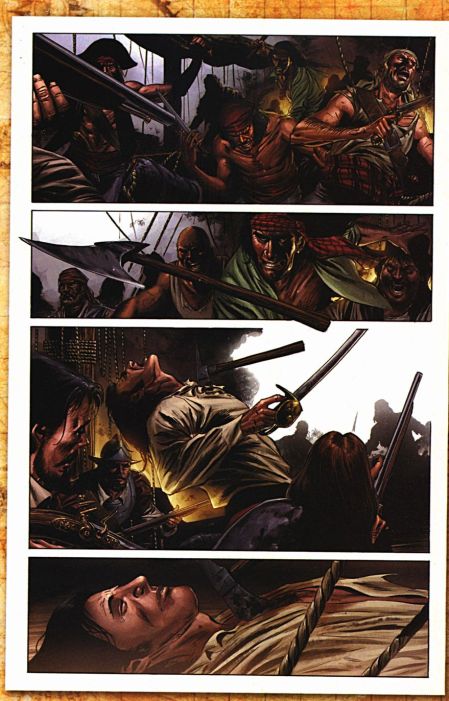
We'll be using yer guts fer garters, mate! (caption, panel 3)

This coming Sunday is National Talk Like A Pirate Day!
It draws many things to me beleaguered and rum-addled mind.
We'll let my old captain, Micheal Nesmith, interrupt now and again.


Arr. Now, then.
Since Pirates of the Carribean, there's been a revived interest in our bilge-soaked seafarers. Mr. Depp's over-the-top portrayal was a delight in that it made several things about pirates clear.
They're unclean.
They're dishonest with others, and not always so honest with themselves.
They're violent and greedy.
Despite that, they're really fun!


Yes. Quite right, then.
Pirates have been fixtures in comics forever. The origins of The Phantom and Tarzan are both steeped in pirate lore. Tarzan's parents were cast away from their burned ship by pirates, while pirates killed Kit Walker's parents in the 1600s, resulting in the Phantom legacy.

It's also worth mentioning that


Ahem. As we were saying.
It's also worth mentioning that many more contemporary superheroes have walked the planks under the skull and crossbones!
Benjamin J. Grimm, the Thing of Fantastic Four fame, was, in reality, Blackbeard.


One of the smartest superhero stories, James Robinson's Starman, uses pirates as a recurring theme, first as an adventure with Starman's late brother, then as a rescued damned pirate who saves Starman's bacon.

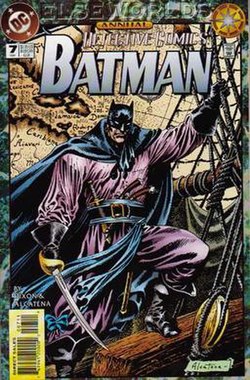
Detective Comics Annual No. 7 featured an Elseworlds story of a pirate Batman. The story, titled Leatherwing, is part of a series of unrelated stories, set outside standard DC continuity. While they often end with the central characters assuming the same roles they do in the "canon" continuities, these outings do give the creators a chance to stretch a bit.

There are also comics that are specifically about pirates, ranging from


(stop that!) er, ranging from this early Classics Illustrated, that adapts the Yul Brynner/Charlton Heston odd little quasi-historical epic The Buccaneer (one of my favorite childhood movies)
to Will Eisner's pre-Spirit strip Hawks of the Sea, represented here in its Canadian version,

to the more recent El Cadazor, from the late publisher CrossGen, whose smart, beautiful comics were hindered by an overly ambitious business plan and the vagaries of the economy.

This book, by the usually snarky/macho and slightly misogynist (but not nearly as bad as Beau Smith in that respect) Chuck Dixon, picks up on the Disney Pirates notion of a woman as captain. Not unheard of in the world of real pirates, but rather uncommon.


Another fixture of the pirate narrative: the abandonment of identity. In all these stories, there's an aspect of the character being reborn as another, a burial at sea of the land persona, if you will. This is often accompanied by a moral shift.
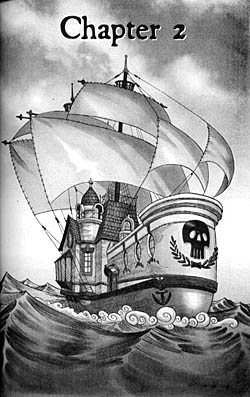
Following the astounding popularity of Disney's Pirates of the Carribean films, the theme began to recur in comics, including this delightful romp from Ted Naifeh, illustrator of the transgender tone poem How Loathsome, written by Tristan Crane.
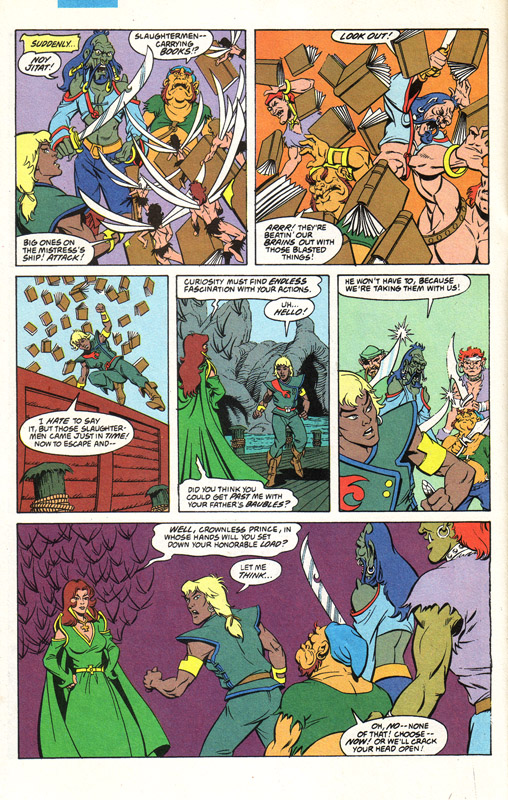
Along the same lines, there's the bright (if derivative of Elfquest) comic based on the short-lived series Pirates of Dark Water. In addition to a page of the narrative, here's the cover of the last issue, with art by the delightful and elegant Charles Vess!


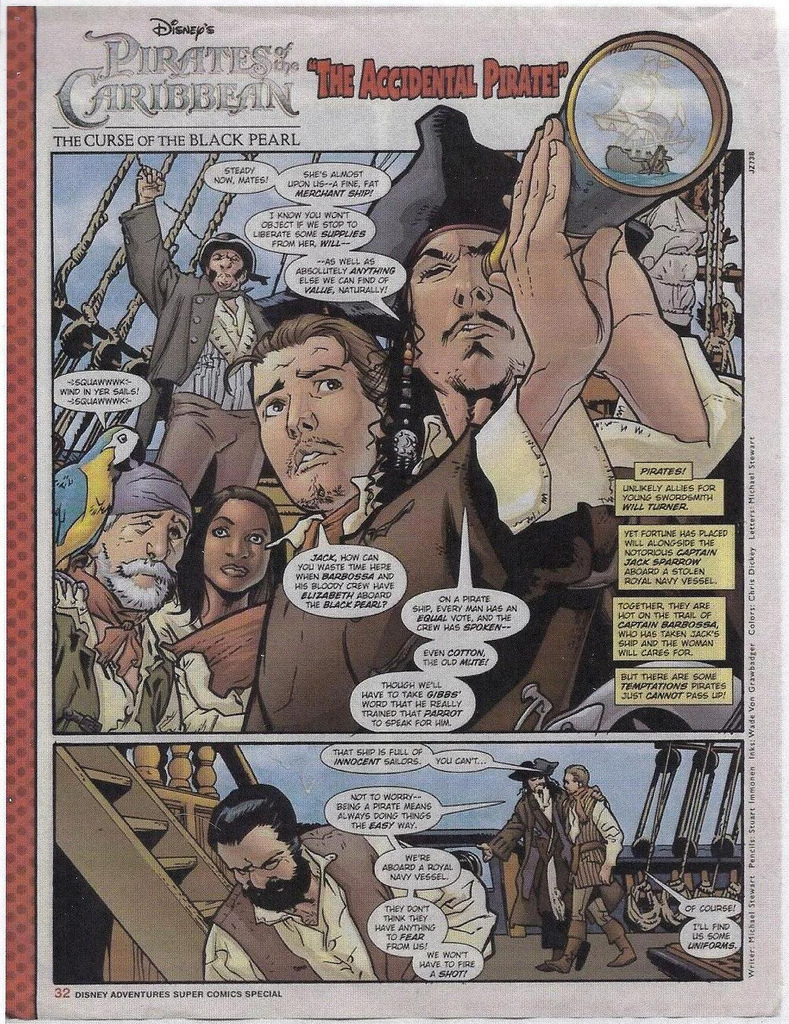
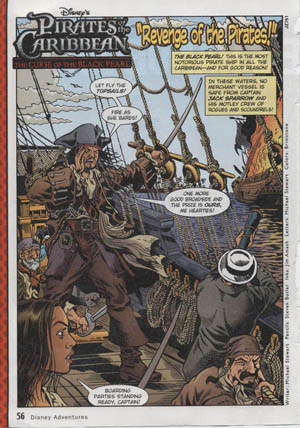
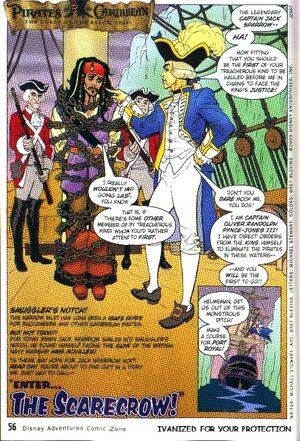
And thanks to the sadly demised Disney Adventures Digest, we have comics featuring Jack Sparrow and Company, illustrated by Brett Blevins, who also did the new Scarecrow of Romney Marsh comics for the same publication!
The first story was Revenge of the Pirates, from the August 2003 issue.
The final tale was The Accidental Pirate, from the Disney Super Special, Sept. 2009.

Approximately midway through the run, this tale appeared, introducing the usually land-bound pirate The Scarecrow of Romney Marsh,  who was featured in a dozen or so stories of his own throughout the run of the magazine.
And the classics.
This post-trend EC title featured some remarkable art and some innocuous stories- of necessity, as demanded by the then-powerful Comics Code.
And let us not forget the use of pirates as metaphor in the meta-comic Tales of the Black Freighter, contained in The Watchmen.

I'll be having some grisly metaphor, if you will, Captain! The true nature of pirates is much closer to the surface here, and is taken to extremes by the labyrinthine S. Clay Wilson in his classic, Captain Pissgums and His Pervert Pirates!
Despite Disney's attempts to turn them into charming rogues, pirates remain lethal, often amoral figures bound by their own code. Their stories are a sort of seafaring noir, wrapped in desperation and urgency as they sail to treasure they can never spend.
This Gentle Giant song sums up the inevitable end of most pirates.


The world of pirates is colorful, adventurous and seductive. It's also nihilist, defeating and doomed. The core conflict is Man Against Sea, and Sea always wins.


Well, maybe it's not THAT grim...
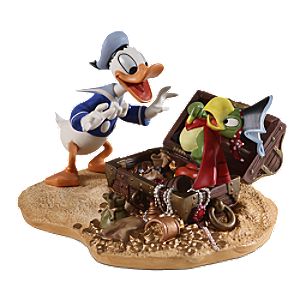
Ah, Pirates do love their treasures!

Sunday, September 12, 2010

Original Art Sundays #58) : Tranny Towers, pp. 6 & 7

In order to get back on schedule, I am posting two more Tranny Towers pages.

For me, this is when the strip started to hit its stride.
The narrative began to go in some new directions, and I was having some fun with the design of the page. The visual shorthand of the funny animal stuff was a bit on the nose at times- a fox as an attorney, a bull as a security guard, and the one that eluded most people at the time: a beaver as a pre-op transsexual.
Due to the minuscule size of the original printing, the Lenny Bruce quote framing the center panel of the second strip in the spread- "the halls of justice, the only place you see the justice is in the halls"- all but disappeared in the work's first appearance.
As frustrating as it gets at times posting old work rather than new, I am enjoying revisiting this material. The writing is much better than I recall, and while I may never do anything new with these characters, watching them evolve into who they were all along was an exciting process.
I recall being told as the strip was near its end that the people in the Lavender offices hated it. Quite frankly, this hurt me a great deal.
So imagine my joy at meeting performance artist Cindy Baker at the national PCA Conference in St. Louis this April and having her recall the work! She told me that she and her partner loved it and couldn't wait for the next episode to come out!
Maybe more people "got it" than I knew.
In any event, revisiting these is a revelation in itself, and more of a pleasure than I expected.
Next: the ladies in A Private Myth start a small adventure.

Saturday, September 11, 2010

If it please the court, will the witness stop flying about the courtroom?

There's a new exhibit at Yale devoted to comics and the law.
 Of course, comics and the law have a long history.
In addition to the legal battles fought over comics themselves, ranging from the early Superman lawsuits to Marvel's attempts to hold up production of the Rocketeer film over characters with similar names, there have been many characters who practiced law.
The earliest of these in superhero narrative may be Two-Face, the Batman villain who is a scarred district attorney, discussed in this snippet from Frank Miller's Dark Knight Returns.

Two-Face first appears in Detective Comics #66, about 4 years into Batman's run.
Matt Murdock is possibly the most significant attorney in comics in the last 50 years, better known as Daredevil.
Here's a scene from the classic Frank MIller run that shows integration of Murdock's profession and his, ahem, avocation.

Of course, the deal here is that by detecting pulse rate using his heightened senses, this blind lawyer can tell when someone's lying- except in this case, where the culprit has a pacemaker that regulates his pulse! So this in turn effects the way Murdock practices law and the way his deferred identity functions.
Here's the denouement in a later plotline. The adversary realizes the truth.

And my personal favorite, Daredevil #7, with that great Wally Wood art.
Prince Namor journeys to the surface to file a lawsuit against the surface dwellers (that would be us).
Frustrated with the slow pace of the court system, Namor breaks out of jail and runs rampant in the city. Of course, Daredevil must stop him.

The above DD images are all from the delightful Matt Murdock Chronicles blog!
Here's a recent case from Marvel Ultimates. Once most heroes' identities are known, Banner is put on trial for the crimes of The Hulk. Guess who defends?

Of course, comic narratives have been playing fast and loose with the workings of the law throughout their existence, just as have television shows and films.
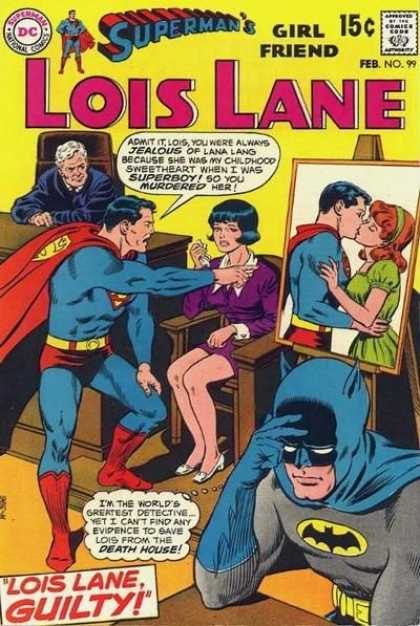
However, this has evolved. Superheroes often used the courts as personal vehicles, as in this Lois Lane story. Who knew both Superman and Batman were licensed to practice law?

In an early 60s story, Superman was on the witness stand and questioned regarding his secret identity. His response was to write the name of his alter-ego on a chalkboard. However, it was written so fast that it melted the slate board. The court accepted this evasion as a valid answer, seemingly without question.
Flash forward to the same question being asked during a murder trial a few years ago.
There's a fascinating analysis of this and related issues over at the Strange Horizons blog. I don't completely agree with it, but it's very insightful.
For decades, Attorney Robert Ingersoll had a column in Comic Buyer's Guide titled The Law Is A Ass, which dealt with legal issues as related to comics content.  An archive of these fascinating columns can be found here.
I doubt this intriguing topic will ever be exhausted.  But we have advanced the portrayal of the superhero in court a great deal since this was all we had.

Original Art Sundays #57 (late) : A Private Myth, the show

Just a quick note that nine pages of A Private Myth, along with the cover, are being shown at the Minneapolis College of Art & Design's Faculty Art Show.
I had a couple friends from outside my MCAD world show up briefly at tonight's opening, and saw some people I used to work with at my previous college, along with many of the usual crowd from MCAD.
Also had a wonderful and unexpected talk with gallery curator Kerry Morgan about the prospects of an upcoming show we hope to have MCAD host. But I don't want to speak out of turn so I'll stop there.
Had a great chat with former student Charles Priceabout fencing and his father the attorney, and talked a bit about Rodrigo y Gabriela with my pal, fellow prog music hound and former Photoshop teacher Rik Sferra, who introduced me to R & G's great music. I was delighted to talk shop with fellow comics teacher Jim Keefe, whose work on Flash Gordon was also on display.
Jim was nice enough to indulge me and take a quick shot of me with the work.
When I first saw this shot, I thought, oh my Lord, I'm a wall. After doing some levels corrections in Photoshop, I was pleasantly surprised- I didn't think I looked that good!
I know, this isn't really new work. It's kind of cheating to use this as Original Art Sundays, especially on a Friday.
But hey, I don't show that often so it's sort of a big deal to me, even being one of many in the show.
Also, seeing the work in different contexts than originals in my grubby mitts or scans posted here allows a fresh perspective. I see different things in the work in this context, both good and bad. This gives me a fresh eye for upcoming pages.
The really weird thing was that my work ended up in the exact same spot where I had my BFA exhibition back in 1999. You've come a long way, baby....

Monday, September 6, 2010

Read on, comics fans! Followup

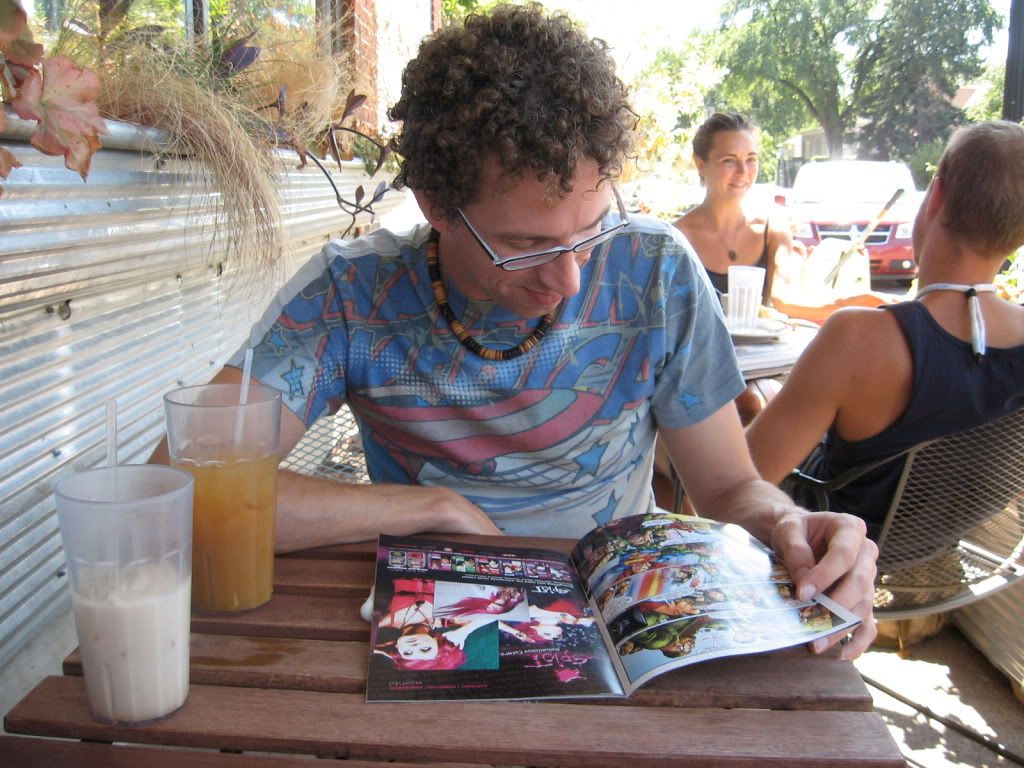
After a few minor delays, I'm able to post photos of me and my pal Clint on Read a Comic Book in Public Day.

Not my most flattering look, but a damn fine comic!
I'm hardly a big Spawn fan, so Sam and Twitch, the detectives from that series, eluded me until this smart, tight miniseries.
Suffice to say I'll be seeking out the back issues as soon as I can afford to do so!

The locale for the little Saturday outing was a fine local coffeehouse/eatery called Anodyne. I'm not a huge coffeehouse maven, but I rather like this one. And their oatmeal is quite refreshing!


Again, not my most flattering look, but I really like the direction J. Micheal Straczynski is taking Superman. This issue may make my Top 10 for 2010!
I admire the fact that he can maintain the quality and humanity of his writing, given his self-imposed mandate to write at least ten pages every day!

The whole populist direction JMS is taking with the character is a refreshing return to Supes' Depression roots, without the Super Dickery that plagued the character from the late 30s into the 70s!

I showed my pal, painter and Webmaster extrordinaire Clint Rost, a key page from this issue.


Mad for the Captain America shirt!
So what did this little exercise accomplish? After all, like many of my peers, I read comics in public on a regular basis.
Well, for one thing, it's fun. For another, it can serve to increase awareness. Finally, in order to read comics in public, you (or someone you know) needs to OWN comics. So like Free Comic Book Day and the upcoming 24 Hour Challenge, it serves both to increase public recognition of the medium and to reinvigorate the base, as they say in political circles.
Now if you'll excuse me,  I have to get back to the new issue of Echo....

Sunday, September 5, 2010

Original Art Sundays #56 (late) : A Private Myth, p. 16

Wow,  a while week late! Unacceptable! I'll do an extra post this week to compensate.
Here's the next page of A Private Myth.
I'm really enjoying the pencil and straight to scan thing.

the shot-reverse shot in the center tier is working pretty well by my lights.
Borders have gone the way of all flesh on this page. That's OK for these dreamy, introspective pages. But to advance the story with real action scenes, you need borders and gutters to control pacing.
I elected to use a mask to allow some of the local color of the paper to show through. I have mixed feelings about the effect, but it's in keeping with the loose sketchy quality I like most about my work.
Next: the plot thickens.

Tuesday, August 31, 2010

Funny Books sold in funny ways

Running late with getting this week's Original Art Sundays up- the page is done, but not scanned- have faith! It's a good one!
Meanwhile, I've been thinking about comics formatting. Not the old Web vs. Print saw, though that comes to mind too. No, I've been wondering about the different sizes that comics appear in. Not the mural "comics" seen in public art, which I also enjoy, but actual print comics.
The smallest comic I've ever seen is the gumball machine comics that Marvel put out in the 60s. Single images with text on the facing page, formatted similar to a Big Little Book, these fit inside a plastic capsule and were vended out of gumball machines.
Product shown actual size, give or take.

The next size up is the tract. This saddle stapled, or sometimes front stapled, long booklets served as the template for the morally opposite Jack Chick tracts as well as many of the Tijuana Bibles.


The zine, usually a collection of gatefolded single sheets, very popular in the 90s, is the next size up.
One of the evolutions of the zine is the local annual event, Lutefisk Sushi, which compiles zines and small press comics by Minneapolis area creators into a spiffy box.
This is another one of those things that I don't quite get around to doing every year.


Golden Age comics were slightly larger than Silver Age and modern comics.

The Treasury Editions of the 70s were the next size up.


Then come the broadsides, comics intended to emulate newspaper sections in size.
Two examples of these are Wednesday Comics and its slightly smaller predecessor, The Clock Maker.


There was also that Giant Book of Comics from the early 70s, sandwiched in between the Treasury Edition and the tabloid, size- wise.
Image to follow when I find the exact title!
The point is that a wide variation in narrative and aesthetic possibilities is offered within the comics format. But before these possibilities can be realized, we must look at the scope of the format itself. If we're talking about comics as printed commodities, we must consider the range of the formats in which they are printed.
This brief overview does not include things like manga phonebooks, European albums, or Russian or African variations.
Looks like there are as many sizes as there are stories!

Wednesday, August 25, 2010

Read on, comics fans!

This Saturday is Read Comics in Public Day! It's also Jack Kirby's birthday, which is no coincidence.


This event is one of those groundswell things. Since comic readers have historically been perceived as  less than literate, despite the posturings of the Simpsons' Comic Book Guy, who now has his own comic book, this event could be an opportunity to dispel preconceived notions about comic readers. We're not semi-literate slobs or social misfits. We're just people who love to read- an increasing rarity. According to the American Booksellers' Association, book sales are paradoxical. While people are ostensibly buying more books, independent stores are closing, and there's no evidence that people are reading the books they buy. Nor do the figures note what types of books are being sold. The largest sellers remain cookbooks and the Bible.
Bottom line is that, according to the US Census Bureau statistics, April 2010 book sales of $917 million are at their lowest level in 8 years.
And comic book stores are not immune from this disturbing trend, as evidenced by the recent closing of one owned by filmmaker and comic lover Kevin Smith, and by the closing of the great Forbidden Planet in England.
Eau Claire Comics and Collectibles, in Eau Claire, WI, the first store to sell my work, is also gone.
We are blessed here in the Twin Cities to have a comics community that supports no less than a dozen comic stores, but I fear for their future as well.
Possibly that's a sad but realistic outcome.
The economy is either improving slowly or doomed, depending on what the economic seers had for breakfast. Unemployment appears to have leveled off around 10% and may or may not rebound. That leaves many people with little, if any, disposable income.
So if we are in an inverted Maslow model, where the hierarchy of needs is worked down to the basics rather than up to self-actualization, I fear that books and comics will not be very high up most people's lists of necessary purchases, at least for a while.
And as is the case with any art form, continued involvement is crucial to comics' thriving.
We've overcome much of the 30s - 60s stigma about comics, partially due to the snobbery associated with the "graphic novel", but we need to be visible. We need to be seen loving our comics, proudly.
Hey, if it's good enough for Bogey, it's good enough for us!

Sunday, August 22, 2010

Original Art Sundays #55: Tranny Towers strips 4 & 5

This week was full of prep for my Comic Book History class (I start teaching again tomorrow, which always feels like coming back to life!), and writing my article on GLBT portrayals in underground comics for the Midwest PCA.
As such, no new work again this week.
I've allocated a whole day for studio this week. This should allow me to finish the partial page posted a few weeks ago, and to complete the new page I've been laying out in my sketchbook du jour.
Meanwhile, please enjoy two more pages of Tranny Towers. The Valentine's ceremony depicted took place at Metropolitan Community Church, one of two local GLBT Christian churches. The text comes from the original ceremony. The male/female couple in the front are a quick loose riff on Reed Waller and Kate Worley of Omaha fame.
Please view full size for a better reading experience!