Showing posts with label Disney. Show all posts

Friday, May 11, 2018

Original Art Sundays (Friday) No. 256: THAIS: MN Opera!

I come and go on Disney stuff. I love the animation and the storytelling is always well-crafted, but sometimes the unsubtle subtext is too creepy for words.
Now and then, however, they get it just right.
There's a number in the animated Hunchback of Notre Dame that sends chills through me. The self-righteously pious Judge Frollo is confessing his obsession with Esmeralda.

His torment and the imagery around sensuality and obsession just captivate me. I found that number to be the best part of that morally haphazard outing.
Spoilers abound from this point on. Read at your own risk.
Pre-show warm-up sketch
This was on my mind as I arrived at Media Night for THAIS. Jules Massenet's 1894 interpretation of Louis Gallet's novel, Thais tells of a sensuous performer, the title heroine, and the Cenobite monk, Athanael, whose obsession with her leads him to attempt the salvation of her soul. Set in Egypt during Roman occupation, the work poses numerous challenges. Staging is complex, costuming is challenging, and most significantly, the title role has a reputation of being one of the most difficult to sing. The roles, especially said title role, are also physically demanding, to the point at which one is exhausted watching the work!
I'm pleased to report that Minnesota's own Kelly Kaduce more than rose to the occasion, in every sense. Her rendition of every theme was achingly beautiful and her physical approach to the role was spot on. I regret that the circumstances of sketching during a dress rehearsal (AKA Media Night) are not conducive to portraiture, so my hasty scrawl does not do her beauty justice.
Lucas Meachem's turn as the obsessed Athaneal was equally moving and profound.  He bought a torment and love to every aspect of the story, from the initial obsession and violation of Cenobite isolation to reform Thais through his own ambivalence as he adopted secular splendor to encounter Thais in that world.
Athaneal's insistence on wearing his hair shirt beneath his camouflage of golden robes, courtesy of the impresario Nacias (also obsessed with the titular heroine), speaks volumes as to who he is and who he must be. The key to drama is the absolute and irrevocable change in values of a character. In that sense, both the principals are classic examples of good drama. Consistent with late 19th Century morality plays, one change arrives too late, as Athaneal learns the converted Thais is dying and resolves that he was wrong to change her soul at the cost of his life.
Thais reflects, in every sense, on the nature of true beauty.
The morality of this work is clearly a challenge for a contemporary audience, as it seems to put piety and the will of a Deity ahead of a woman's self-determination. Perhaps this is a flawed or incomplete reading of the work's complex text. Athaneal truly believes he is putting Thais' best interests at heart as he fights aggressively for her conversion. But isn't conviction true of all zealots? 
Thais dreams as the classic Meditation is exquisitely played.
Once again, MN Opera is remarkable in its staging. Use of transparent/translucent curtains, an angled bed with an impassioned painting on it (!), and delicate use of rains of rose petals and silver shards serve to make the production visually lush. I'm struck by the innovative staging at every new work. Lorenzo Cutuli has earned accolades for this design and its execution. He won the International Opera Award for set design in 2014. If there's justice, he will win again for THAIS. MN Opera is blessed to have him on this production.
As Athaneal and Thais cross the desert to reach the nunnery that is to be her new home, the set is alarmingly sparse. There is only a shiny mound. It took me a minute to realize that the mound was a pile of broken mirrors.
I must write of the impassioned and beautiful dancing that dominates this production. As one of my colleagues from the Black Hat Collective remarked, it felt more like a ballet in spots. This is a compliment. The play within a play model provided wonderful opportunities to explore movement and music. This production took full advantage of them, to my delight.
Usually, just to try to keep balance, I try to find some aspect of a production that was wanting. In MN Opera's current production of THAIS, there is none.  Every facet of the work is impassioned and professional.
Go. I cannot offer any stronger encouragement. This production is beyond language. It will fill and devastate you. THAIS runs 3 hours and 11 minutes, but I was so sorry when it ended.
It is at the MN Opera May 12- 20.
Next: back to the Graphic Memoir.


Sunday, January 8, 2017

Best Comics of 2016, No. 12: The Children of Captain Grant

I used to love those live action Disney movies when I was a wee tad. Now they seem a bit of a cornball, but they still stand up well for the most part. Many of them, like The Incredible Journey, The Miracle of the White Stallions and The Three Lives of Thomasina are about survival and search against impossible odds.
And thanks to Dell/Gold Key, a lot of them got their own comics too! Many were illustrated by Dan Speigle. I didn't realize it at the time, but his art influenced me almost as much as that of Curt Swan.
This book is an adaptation of a film of a Jules Verne novel, one of a very LONG series of adventure books he wrote. Though Disney played fast and loose with the novel, the resulting film (and comic, and I think there was a paperback novelization as well) was very engaging and exciting.
I had forgotten all about it, until I was reading the recent reprint of the French adaptation of the original novel, The Children of Captain Grant. As I was reading it, I found the pacing a bit off-putting, as it has that Victorian air about it that can slow the telling of a story in its deliberation. But I found the story itself oddly familiar. It wasn't until I did some background research for this piece that I made the connection back to this earlier adaptation from my childhood- a "well, duh!" moment.
I may have been misled by the subgenre in which the graphic novel is recast.
The story is retold using the furry motif.
All the characters are humanized animals- or if you prefer, anthropomorphized  humans. There's no real reason given for this. It's just assumed that that's the world in which these characters endure. The same as ours, except that everyone has fur, or feathers, or scales, or fins or some such.
Longtime readers will know of my affinity for such stories, both in consuming and in creating. From my early exposure to Barks' Duck books to my apprenticeship on Reed Waller's Omaha the Cat Dancer (a short chapter in my life that I never tire of bringing up), funny animals have been an integral part of my worlds. And I've seen all stripe (so to speak) of art in these books, ranging from the crude to the energetic and elegant (Katherine Collins' Neil the Horse comes to mind). There are some funny animal stories (to use Reed's preferred term) that take the art more seriously than others- the mechanical precision of Martin Wagner's Hepcats comes to mind here.
But I don't think I've ever seen as lushly painted a furry book as this, with the possible exceptions of Blacksad and the Grandville stories.
Every page explodes with meticulously controlled color. Landscapes, ships, architecture, different cultures, all exquisitely rendered.
Once again, I'll rely on the publisher (in this case, Super Genius) to provide a plot overview: "In this adaptation of the classic novel, the entire cast of characters has been transformed into anthropomorphic animal! It begins with a message-actually three water-damaged messages-found in a bottle removed from the belly of a shark. Written in three different languages the messages reveal that the long-missing Captain Grant was shipwrecked and is being held hostage. The only clue from the messages that might be of any help, will lead Lord Glenarvan and Captain Grant’s children on an adventure literally around the world!"
The story has the requisite elements: quirky characters, burgeoning romance, yearning for a lost parent, and so much adventure and derring-do you could plotz.
Though published in the US in 2016, this book was originally published in three volumes in France between 2009 and 2013. Its creator, Alexis Nesme, is well established as a children's comic illustrator in France. Here's an interview with him (in French- I can make out about half of it, not enough to provide an accurate translation, so I'll leave you to your own devices).

This book was a bit of a slog at times. My tolerance for quaint period writing is not high, so it took me a while to get through it. But that's a failing in me, not in the work. It was worth the effort. This book is exciting, lush and ultimately very satisfying.
Next: Best Comics No. 11, behind the scenes...

Wednesday, November 13, 2013

A few quick thoughts on Disney's Maleficent

Through facebook, I saw this trailer today.


Now, I'm not as locked-in anti-revisionist as this is going to sound. But I have a big problem with this film.
I've seen some remakes I've enjoyed, and quite a few I have not. In general, it strikes me as lazy filmmaking- rework an old idea just for the sake of marketing, rather than come up with something fresh. That's why I give kudos to Marvel for the upcoming Guardians of the Galaxy film. While Marvel is also milking successful franchises like Thor and The Avengers, they're also breaking some new ground, taking some chances.
Maleficent, however, has two problems.
First, it seems to aping the success of recent revisionist fairy tale TV series, which in turn are aping the success of Vertigo's FABLES, which in turn is building on similar notions going back to Gaiman's Sandman and much farther back than that. That's not inherently evil. I'm rather enjoying NBC's current Dracula series, and that's hardly fresh territory.
The other problem is Maleficent's relation to its source material. You can't say Disney and Sleeping Beauty without thinking about that incredible 1950s design work. The film was visually stunning in a new way, reflective of its times, and its look remains iconic.

Yet Maleficent appears to be another live-action effects-heavy take on an old Disney story, like Sorcerer's Apprentice a few years ago. And I suspect that, in the long run, it will be every bit as forgettable. I only hope that people who are first exposed to the characters through this film won't judge the original work relative to it. Lest you think this unlikely, I have students who have used Zak Snyder's film version of Watchmen as the standard by which to judge Alan Moore's original work.
The point: once a watered-down version is out there, it's hard to take it back.
You'd think Disney would have learned that from The Lone Ranger. I still ache for a good and respectful film version of that character! I only hope I'm wrong about this, and that the characters in the 1950s Sleeping Beauty remain memorable.

Saturday, March 31, 2012

The Lone Ranger: A Brief Media History and A Caution

The new page of A Private Myth is giving me fits, and I have a massive deadline tomorrow. So art on the back burner again for the (brief) moment, but never completely off the stove, to torture the metaphor.
I'd like to chat briefly about something else.
The first images of the forthcoming Lone Ranger film are out.
I don't think a logo redesign was necessary....
This on-again, off-again project has the potential to do everything for the Lone Ranger that the other recent film did for his grand-nephew, The Green Hornet. Caught a couple minutes of that this morning by accident, and it is every bit as painful as I feared.
You all knew the Green Hornet and The Lone Ranger were related, right? The Hornet is Britt Reid and the Ranger is his grand-uncle, John Reid.
Ahem. Be that as it may.
This is what the Lone Ranger and Tonto looked like in the original comics. This page is from a bit later, but the style is largely the same, if a bit more refined.


This is what they looked like in the classic 50s and 60s TV series.


Note that Tonto is played by a Native American, one Jay Silverheels. While there are jingoistic aspects to the characterization, Tonto is written and played as smart and honorable.

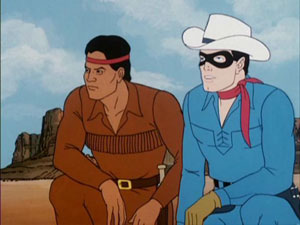
This is their appearance in the 1966 cartoon.
Note that there's a consistency in costume and overall appearance of the characters. Again, Tonto is presented as secondary but equal in skill to the Lone Ranger. This is as it should be, since the Lone Ranger would not have lived or become the hero he is without the intercession of Tonto.
John Reid was left for dead by a band of raiders. He was the sole survivor, the lone ranger to live, hence the name. Reid was orphaned in the attack. Among those killed were his father and brother, also Texas Rangers.
Tonto restored Reid's physical health, trained him in fighting and survival techniques, mended his spirit and gave his new life direction beyond vengeance.
The model of orphaned masked vigilante has numerous precedents. Batman and Zorro come readily to mind.
The character of the Lone Ranger predates Batman, who is also preceded by Zorro. The chronology is as follows.
Zorro debuted in Johnston McCulley's 1919 pulp novel The Curse of Capistrano.
The Lone Ranger began in a 1933 radio show written by Fran Striker.
Batman  was created by Bob Kane and Bill Finger. He first appeared in Detective Comics no. 27, cover dated May 1939.

The Lone Ranger has appeared in other series and films, most notably the 1981 Legend of the Lone Ranger, starring Kilton Spilsbury and Micheal Horse. Despite some minor modifications, the film was largely successful in its treatment of the characters. Again, Tonto is played by a Native American.
This film's flaws were twofold. Spilsbury's voice was too squeaky to do the character full justice, though he did the job admirably despite that limitation. The big obstacle to this film came off screen, when TV actor Clayton Moore was enjoined from playing his old character publicly in promotional events. He had been playing the Ranger for supermarket openings and events at malls, both as a source of revenue and to keep the Ranger's ideals alive. The studio's action against him left the film with a black eye- kind of a shame, as it's a fairly good film.
The character was largely dormant for a time. Topps Comics (an offshoot of the bubblegum card company) did a fairly good Lone Ranger title in the 1990s, and the Cary Bates/ Russ Heath comic strip from 1981 -1984 remains a largely unsung watermark for the character.
The current Lone Ranger comic from Dyamite Entertainment is superb. While the original 25 issue run is slightly better than the current storyline, both boast a nice balance of character driven story and action. The original artist, Sergio Cariello, was a perfect fit for the book.
And now the forthcoming Disney film, currently scheduled for 2013.
Really?
I know it's unfair to judge an unseen film from one still and a bit of publicity, but come on.
Really?
A black suit and Johnny Depp in whiteface? I know they wanted some name recognition and Depp has long been eager for this project, but are there no Native American actors who could play the role?
This look, coupled with the news that the film is being given a supernatural bent (abandoning the studio's original "vision" of The Lone Ranger as a camp comedy) does indeed give me pause.
Just do the character justice.
He's a noble, plausible character. There's no need to make his story a joke or a magic show. Let the Lone Ranger's nobility shine through.
For a change, I'd like to see a major studio take a chance on doing a superhero right. There are plenty of good bits in some recent Marvel films, and in some of the DC stuff, but as this and The Green Hornet demonstrate, there's still a tendency to misunderstand or ridicule the concept of someone taking off on his own to right wrongs.
Consider the Lone Ranger's Code. These are not platitudes to ridicule, they are words to live by:
"I believe that to have a friend, a man must be one.
That all men are created equal and that everyone has within himself the power to make this a better world.
That God put the firewood there but that every man must gather and light it himself.
In being prepared physically, mentally, and morally to fight when necessary for that which is right.
That a man should make the most of what equipment he has.
That 'This government, of the people, by the people and for the people' shall live always.
That men should live by the rule of what is best for the greatest number.
That sooner or later ... somewhere ... somehow ... we must settle with the world and make payment for what we have taken.
That all things change but truth, and that truth alone, lives on forever.
In my Creator, my country, my fellow man."


Thursday, September 16, 2010

We'll be using yer guts fer garters, mate! (caption, panel 3)

This coming Sunday is National Talk Like A Pirate Day!
It draws many things to me beleaguered and rum-addled mind.
We'll let my old captain, Micheal Nesmith, interrupt now and again.


Arr. Now, then.
Since Pirates of the Carribean, there's been a revived interest in our bilge-soaked seafarers. Mr. Depp's over-the-top portrayal was a delight in that it made several things about pirates clear.
They're unclean.
They're dishonest with others, and not always so honest with themselves.
They're violent and greedy.
Despite that, they're really fun!


Yes. Quite right, then.
Pirates have been fixtures in comics forever. The origins of The Phantom and Tarzan are both steeped in pirate lore. Tarzan's parents were cast away from their burned ship by pirates, while pirates killed Kit Walker's parents in the 1600s, resulting in the Phantom legacy.

It's also worth mentioning that


Ahem. As we were saying.
It's also worth mentioning that many more contemporary superheroes have walked the planks under the skull and crossbones!
Benjamin J. Grimm, the Thing of Fantastic Four fame, was, in reality, Blackbeard.


One of the smartest superhero stories, James Robinson's Starman, uses pirates as a recurring theme, first as an adventure with Starman's late brother, then as a rescued damned pirate who saves Starman's bacon.

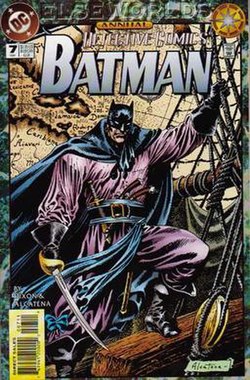
Detective Comics Annual No. 7 featured an Elseworlds story of a pirate Batman. The story, titled Leatherwing, is part of a series of unrelated stories, set outside standard DC continuity. While they often end with the central characters assuming the same roles they do in the "canon" continuities, these outings do give the creators a chance to stretch a bit.

There are also comics that are specifically about pirates, ranging from


(stop that!) er, ranging from this early Classics Illustrated, that adapts the Yul Brynner/Charlton Heston odd little quasi-historical epic The Buccaneer (one of my favorite childhood movies)
to Will Eisner's pre-Spirit strip Hawks of the Sea, represented here in its Canadian version,

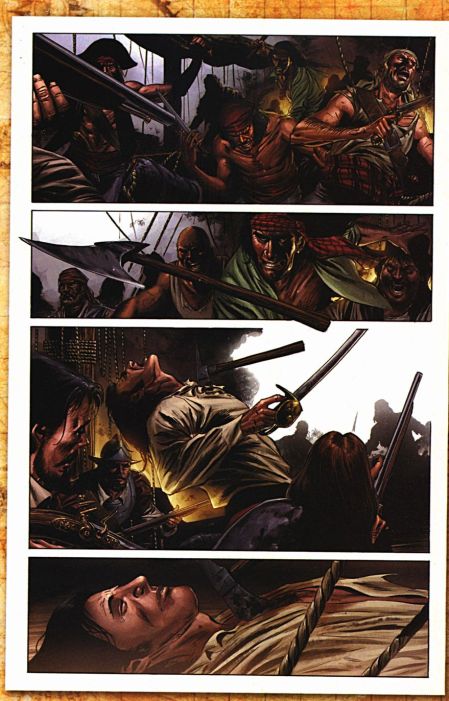
to the more recent El Cadazor, from the late publisher CrossGen, whose smart, beautiful comics were hindered by an overly ambitious business plan and the vagaries of the economy.

This book, by the usually snarky/macho and slightly misogynist (but not nearly as bad as Beau Smith in that respect) Chuck Dixon, picks up on the Disney Pirates notion of a woman as captain. Not unheard of in the world of real pirates, but rather uncommon.


Another fixture of the pirate narrative: the abandonment of identity. In all these stories, there's an aspect of the character being reborn as another, a burial at sea of the land persona, if you will. This is often accompanied by a moral shift.
Following the astounding popularity of Disney's Pirates of the Carribean films, the theme began to recur in comics, including this delightful romp from Ted Naifeh, illustrator of the transgender tone poem How Loathsome, written by Tristan Crane.
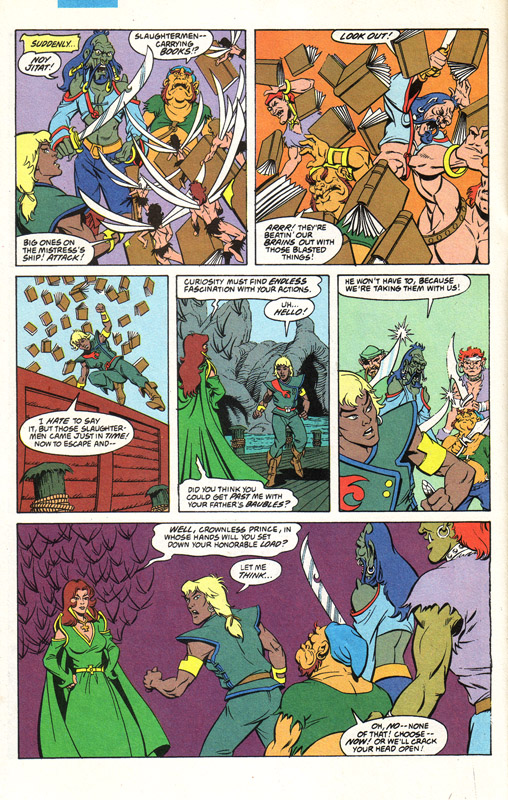
Along the same lines, there's the bright (if derivative of Elfquest) comic based on the short-lived series Pirates of Dark Water. In addition to a page of the narrative, here's the cover of the last issue, with art by the delightful and elegant Charles Vess!


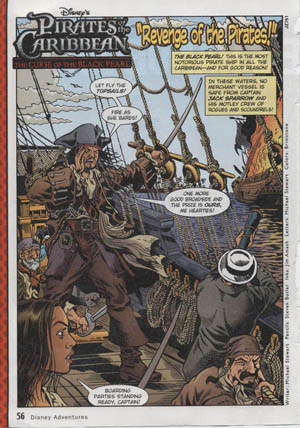
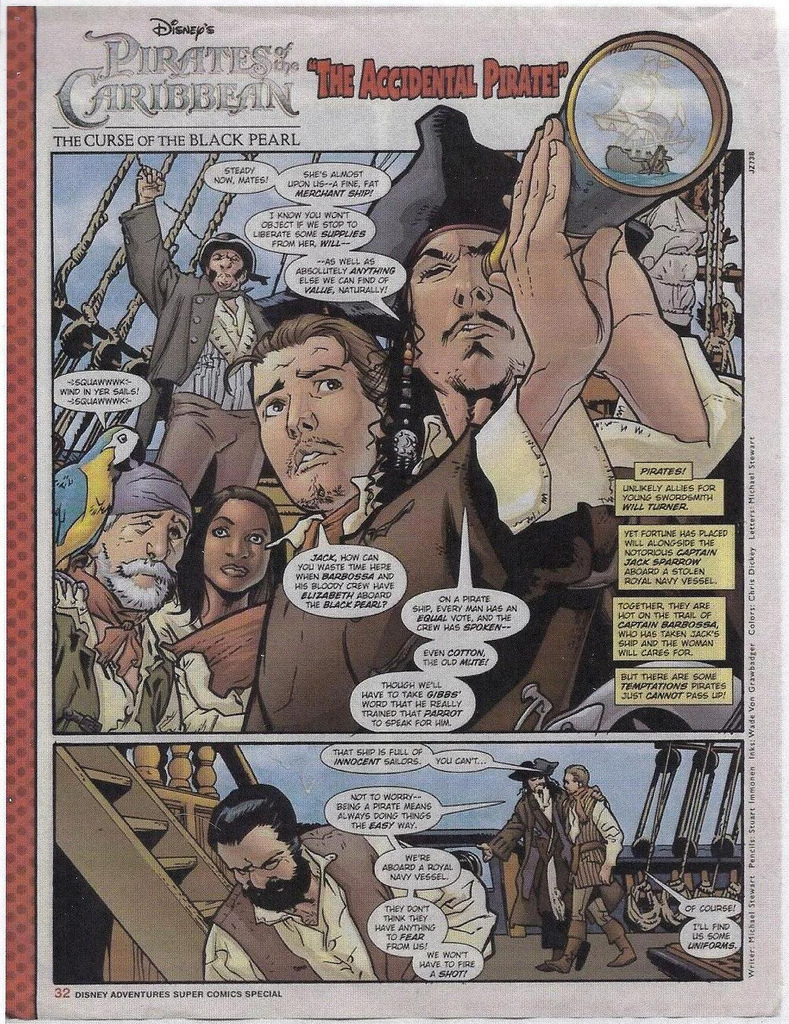
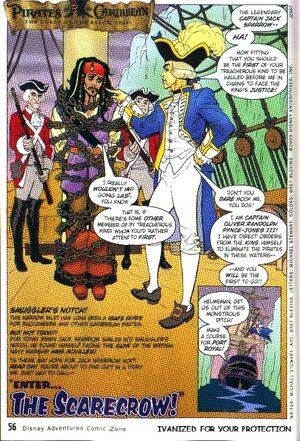
And thanks to the sadly demised Disney Adventures Digest, we have comics featuring Jack Sparrow and Company, illustrated by Brett Blevins, who also did the new Scarecrow of Romney Marsh comics for the same publication!
The first story was Revenge of the Pirates, from the August 2003 issue.
The final tale was The Accidental Pirate, from the Disney Super Special, Sept. 2009.

Approximately midway through the run, this tale appeared, introducing the usually land-bound pirate The Scarecrow of Romney Marsh,  who was featured in a dozen or so stories of his own throughout the run of the magazine.
And the classics.
This post-trend EC title featured some remarkable art and some innocuous stories- of necessity, as demanded by the then-powerful Comics Code.
And let us not forget the use of pirates as metaphor in the meta-comic Tales of the Black Freighter, contained in The Watchmen.

I'll be having some grisly metaphor, if you will, Captain! The true nature of pirates is much closer to the surface here, and is taken to extremes by the labyrinthine S. Clay Wilson in his classic, Captain Pissgums and His Pervert Pirates!
Despite Disney's attempts to turn them into charming rogues, pirates remain lethal, often amoral figures bound by their own code. Their stories are a sort of seafaring noir, wrapped in desperation and urgency as they sail to treasure they can never spend.
This Gentle Giant song sums up the inevitable end of most pirates.


The world of pirates is colorful, adventurous and seductive. It's also nihilist, defeating and doomed. The core conflict is Man Against Sea, and Sea always wins.


Well, maybe it's not THAT grim...
Ah, Pirates do love their treasures!

Thursday, September 3, 2009

Marvel-ous Disney?

I would be a bad toad if I neglected to comment on the purchase of Marvel by Disney.
Well, I'm not too sure what to say.
Truth is, the jury's still out on the impact (if any) this will have on creative output from Marvel. I do hope it improves the visual quality of Marvel animation!
But I can't help but reminisce about past similar deals.
DC acquired Captain Marvel decades after suing to prevent publication of the character. And DC became a subsidiary of Time-Warner, allowing for the flawed but interesting Bugs Bunny/Superman teamup of a while back.
Now Disney controls over 5000 Marvel characters, including Howard the Duck, a character over whom Disney once threatened suit. This resulted in numerous alterations to Howard's appearance, some of which were ludicrous. I mean really. Disney cornering the market on round-eyed, ill-tempered ducks is every bit as silly as Harley-Davidson attempting to patent the sound of its choppers, or Donald Trump attempting to trademark the phrase "you're fired", or the greatest irony of all, Fox News attempting to trademark the phrase "fair and balanced."
Well, now Howard is a Disney Duck. It remains to be seen whether he will be welcomed to the fold, or tolerated with embarrassed silence.
However, one can take hope in the crossover of so many copyrighted characters in Who Framed Roger Rabbit? This remains the only time a Warner Brothers toon (Daffy) appears on screen with a Disney toon (Donald).
Of course, that's now also a DC- Marvel crossover! Well, after a fashion.
The bind moggles.
Special thanks to the immensely talented Amanda Zima for permission to repost her wonderful Aurora/Black Cat image!

Thursday, May 14, 2009

The Princess and the Princess?

Okay, I confess I'm quite excited about Disney's return to traditional feature animation.


However.
Snow White: boy gets girl. Sleeping Beauty: boy gets girl. Little Mermaid: boy gets (fishy) girl. Beauty and the Beast: (fuzzy, scary) boy gets girl. Hunchback of Notre Dame: (handsome) boy gets girl. Lady and the Tramp: boy gets girl.
Okay, that last one is just too wonderful for words.
Great stories all, but isn't there more than one note to played in the symphony of LOVE?
The closest animation has come to gay issues is the Showtime series Queer Duck. There are gay characters in Drawn Together, currently in rerun on Logo, which also has a gay anime' series and Rick and Steve, which is puppet animation a la George Pal.
But it's mostly pretty bad animation. It's what the great Chuck Jones called "illustrated radio", for the most part. Also,most of what is out there is pretty guy-with-guy centered.
There are a great many gay male stories in anime', and much about transgender cahracters, but few lesbian stories. Also, call me a snobbess, but something about the visual style of anime' leaves me cold at times. Not that I don't love Tezuka, but I'd rather read it than watch it.
I like traditional Western animation. And I'd like to see a braver use of the art form.
There are beautiful and sensual stories of men and men, and women and women, and people everywhere on the gender and sexuality spectra, hooking up for physical pleasure, affection and just plain sharing life.
Some studio is missing a bet by not trying to tell a genuine love story about GLBT people in good animation.