Beginning my annual series of posts of the best of the previous year. Most folks do these all at once, but I like to take my time and spend a bit more time on each.
We'll begin with the works that almost made it, and the reasons why.
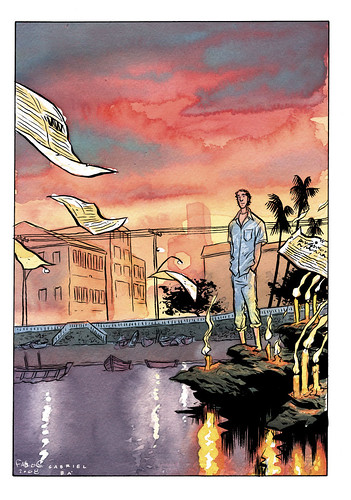
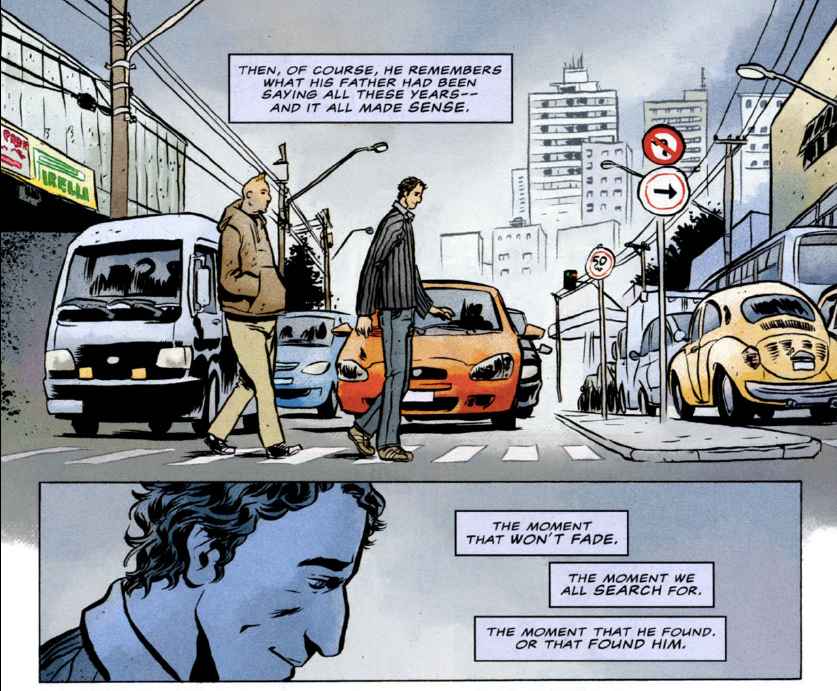
First, Daytripper.
This book remains a fascination, and I wish I'd see something new from the creators. In fairness, I've not checked in with them for a while, but you'd think a work this acclaimed would generate more followup press for the creative team.
This didn't make the cut this year for two reasons.
1. I already put it in last year's Best of... and wanted to leave space for other work equally deserving of recognition.
2. It's not really a 2011 book. The series was completed in December 2010, a fact conveniently omitted by the graphic novel purists who don't pay attention to a work until it's collected. That snobbery really gets under my nose!
Next up: a very different book.
Here's One Soul by Ray Fawkes.
This book is a compelling exploration of the standard 3 x 3 panel grid, used to tell interlocking stories with captions throughout.
The book tells the stories of multiple characters from birth. It slides from one to another, through caption only, occasionally veering away from the 3 x 3 configuration by joining the panel areas into larger panels, but never abandoning the grid.
Here's a sample tier.
This is not included for one simple reason. I'm not done reading it yet!
The same excuse applies to the next runner-up, Return to Perdition.
I've enjoyed the Perdition series a great deal over the years. I own a page from the Garcia-Lopez volume, On the Road to Perdition, and thought the film of the original book was one of the better film adaptations of a comic, despite its altering of the ending. I got to visit my pal Terry Beatty while he was working on this, and was delighted to see it at Minneapolis FallCon this year, just before its commercial release. I'm reading the library copy of this right now, but if he makes it to Spring Con, I'll try to pick one up from Terry then. I'll be done reading this soon, but right now.... no.
See Terry's blog link on the side of this page for more info on him!
The final runner-up is a good book that just had one problem too many for me, Lady Mechanika.
WARNING OF SPOILERS BELOW!
There are a lot of things I like about this book. It's tightly written, elaborately drawn and very well colored. The concept is solid- a powerful woman whose life is a mystery, even to her, both hunter and hunted.
I love the steampunk overtones. The slightly soiled elegance of the whole quasi-Victorian faux antique tech never really wears thin for me.
So with all that going for it, why didn't it make the cut?
Well, it's sort of like the old Dark Horse book GHOST. It dances right on the edge of being sexist.
I'm not talking about the cleavage cut-out in the costume, though that always struck me as highly impractical for battle. Nor am I talking about her ample, ahem, tracts of land. After all, some women are so endowed, though they are (you should excuse the phrase) disproportionately represented in comics in general.
No, I'm talking about her.
There's an axiom that describes the different catalysts in the heroic paths of men and women.
A man becomes a hero by having something taken from him: property, ability (think Daredevil or Dr. Strange), or a loved one (think Batman, Superman, the Phantom, etc.).
A woman becomes a hero after something is done TO her directly. Think about Red Sonja (rape), Batgirl/Oracle (disabling by shooting coupled with implied sexual assault), or Shrinking Violet, who lost a leg in the Giffen Legion run.
To be sure, there are exceptions, but when a female hero's story begins with multiple body part dismemberment, I have a hard time seeing beyond that. Funny how relatively few stories there are that begin with this happening to a man. In fact, aside from Miller's classic RONIN, I can't think of any!
This is still a worthwhile book, in spite of its big thematic flaw, and I'll stick with it for a while to see if it overcomes said flaw. But I'm sorry, it's just not up to Best of the Year material with that in it. Creator Joe Benitez deserves continued attention for the level of work he's doing. I'd like to see his characterizations reach the high level of the other elements of his work.
Tomorrow: the Best of 2011 list begins in earnest.
Insights about comics, prog rock, classic cartoons and films, higher education, sexuality and gender, writing, teaching, whatever else comes to mind, and comics. I know I said comics twice. I like comics!
Showing posts with label daytripper. Show all posts
Sunday, January 8, 2012
Monday, January 17, 2011
Best comics of 2010: No. 2 (tie): daytripper
This was a surprise.
Daytripper is the life of a writer, one Bras de Oliva Domingos. Told in pivotal moments and the events leading up to them, he dies at the end of every issue. Each death is a death of a part of him, though all are presented as literal deaths.
This is eloquent, tender, raw and brutally honest. Daytripper avoids being saccharine or cynical. The book's creative team, Fabio Moon and Gabriel Ba, are doing the con circuit starting this year in Peru! Gabriel is the artist on the new Marvel book Casanova, written by Matt Fraction.
Moon's and Ba's art (they work in tandem on writing and illustration)has that slight distortion that reminds me of both Paul Pope and Ryan Kelly. Its fascinating, having qualities of simplicity and complexity simultaneously.
And the writing - well, the writing just pulses.
It's a book about being there for your own life, even when that means accepting your failures without ennobling them.
It's a book of wonder, not flinching from any part of the human condition.
And it's set in contemporary Brazil.
Sadly, as well received as the book was critically, it didn't translate into sales. Following issue #1, Daytripper's sales were consistently below the 10,000 copy mark, according to monthly reports at The Beat. I am hopeful that sales of the TPB, due out next month, will eclipse that.
We've speculated here in the past that the "floppy", the conventional comic book periodical, may be little more than a loss leader for TPBs in today's comic market. Based on some of the figures Colleen Doran has reported on her blog (and if you're not reading Colleen's blog, go do so right now- it's linked on this one and I'll still be here when you're done), I've come to question that blanket supposition lately.I'm not convinced that TPBs actually sell better, despite having presumably longer shelf life and a more diverse marketing and distribution platform.
But when Vertigo, a branch of DC Comics, can't move 10,000 units of so eloquent a book as Daytripper, we have a problem.
Next: Best of 2010, No. 2, part 2: light the lights!
Daytripper is the life of a writer, one Bras de Oliva Domingos. Told in pivotal moments and the events leading up to them, he dies at the end of every issue. Each death is a death of a part of him, though all are presented as literal deaths.
This is eloquent, tender, raw and brutally honest. Daytripper avoids being saccharine or cynical. The book's creative team, Fabio Moon and Gabriel Ba, are doing the con circuit starting this year in Peru! Gabriel is the artist on the new Marvel book Casanova, written by Matt Fraction.
Moon's and Ba's art (they work in tandem on writing and illustration)has that slight distortion that reminds me of both Paul Pope and Ryan Kelly. Its fascinating, having qualities of simplicity and complexity simultaneously.
And the writing - well, the writing just pulses.
It's a book about being there for your own life, even when that means accepting your failures without ennobling them.
It's a book of wonder, not flinching from any part of the human condition.
And it's set in contemporary Brazil.
Sadly, as well received as the book was critically, it didn't translate into sales. Following issue #1, Daytripper's sales were consistently below the 10,000 copy mark, according to monthly reports at The Beat. I am hopeful that sales of the TPB, due out next month, will eclipse that.
We've speculated here in the past that the "floppy", the conventional comic book periodical, may be little more than a loss leader for TPBs in today's comic market. Based on some of the figures Colleen Doran has reported on her blog (and if you're not reading Colleen's blog, go do so right now- it's linked on this one and I'll still be here when you're done), I've come to question that blanket supposition lately.I'm not convinced that TPBs actually sell better, despite having presumably longer shelf life and a more diverse marketing and distribution platform.
But when Vertigo, a branch of DC Comics, can't move 10,000 units of so eloquent a book as Daytripper, we have a problem.
Next: Best of 2010, No. 2, part 2: light the lights!
Friday, October 22, 2010
Comics? Museums? How perfectly too-too.
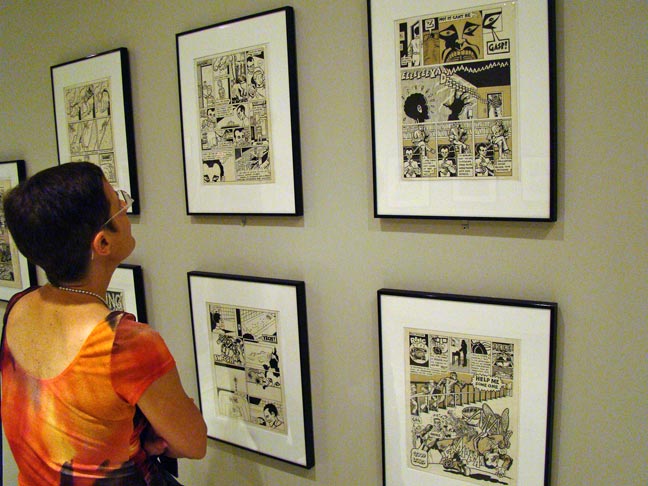
The announcement of a museum exhibit on graphic novels at the James A. Michener Museum of Bucks County is challenging in several ways.
While museum exhibits of comic art in the US and Canada date back to the 1970s (earlier exhibitions happened in Europe, but the only one I can find a a record of is the 1968 exhibition of comic-strip art at Musée des arts decoratifs, Palais du Louvre) with the Steranko: Graphic Narrative show in Winnipeg, the 1980s and the Whitney Comic Art show, involvement of Art Speigleman in the Beyond High & Low show in response to the High & Low Show at MOMA, their presence, while desirable, poses other challenges.
Comics are relatively accepted as an art form now, due in no small part to the Graphic Novel demarcation. Note that the exhibit at the Michener is a "graphic novel" exhibit, not a "comic art" exhibit, despite using panels from a Spirit comic, not a graphic novel per se, in its informational web page. Also, please take note of the sloppy research in attributing the nomenclaute of "commonly accepted as the first graphic novel" to A Contract With God. While the significance of this book cannot and should not be denied, even Eisner acknowledged Masreel's woodcut books as predecessors. Others worked in "wordless books", and the term "picture novel" was used on the cover of the 1950 paperback It Rhymes With Lust and its successor from the same publisher, Case of the Winking Buddha.
The original It Rhymes With Lust has been reprinted twice, first in The Comics Journal and second as a facsimile edition with a new foreword from Dark Horse Comics, the third largest comic company in the US.
Are we to infer sloppy research on the part of the Michener Gallery in its statement that A Contract With God is " is commonly accepted as the first to be called a graphic novel", or is that simply a limitation of copy space, since Milt Gross's name is also cited as being part of the exhibit? Gross's He Done Her Wrong, a 1930 book billed as "The Great American Novel in Pictures", back in print from Fantagraphics, is another work that predates Eisner.
This is journeyman stuff. Any undergrad researcher could discover most of this in a matter of a few minutes.
However, it's rather easy to get one's back up about such things. It may very well be a case of sloppy copy writing and nothing more, especially given the inclusion of Gross in the exhibit. And as comics scholars, many of us have a slight persecution complex. No, really, we do!
All that given, there's the larger question of acceptance and its related costs and advantages.
True, comics are now in museums, although often trough the aforementioned back door of the "graphic novel". The notable exceptions are museums devoted to comics, like San Francisco's stunning Cartoon Art Museum, whose current show, Graphic Details: Confessional Comics by Jewish Women includes the work of old friend Trina Robbins. We've linked to Trina's site numerous times, so one more won't hurt!
What do we gain and what do we lose by comics gaining social acceptance?
For one thing, comics may wither. This is a possible byproduct of the acceptance of manga and graphic novels. After all, why pay $3 -4 per issue for "floppies", old school flimsy paper comics of 24 -32 pages including ads, when you could wait for the collection (not properly a "graphic novel", unless that was the creators' initial intent) and get the whole thing in a more durable form for a lower cumulative price, in many cases?
That's a bit a doom and gloom thing. I firmly believe that the floppy, or conventional comic book, will endure in some capacity, much as live theater still exists but is no longer the entertainment/cultural mainstay it was once was. However, when great books like daytripper sell a meager 9,800 copies, it's hard to avoid a small sense of foreboding.
The other thing we lose with social acceptance of comics is the imprimatur of the outlaw cachet.
So many things regarded as social taboos- pinball, motorcycles, tattoos, comics- have been accepted, with that acceptance ranging from a near-mandate (tattoos) to becoming passe' (pinball). The cadre of misfits has been assimilated to varying degrees.
That has its up side. Comics are a more than valid art form, and deserve to be taken seriously, contingent on content, of course. I have little patience for the latest bombastic, senses-shattering, "this will change everything" multi-book epic from Marvel or DC. Civil War was socially relevant and genuinely important as a metaphor for a divided nation at odds over the false distinction between freedom and security. Crisis on Infinite Earths was a necessary bit housecleaning, with some strong storytelling. They're worthwhile and fun. But enough grandeur already. Just tell me a decent story and I'm there.
My point is that comics deserve to be taken seriously, AS COMICS. Museums are great and comics deserve a place in them. But please don't damn them with faint praise by insisting on the "graphic novel" badge to "legitimize" the work. A great show of Comic Book Art needs no excuses for itself.
It's a bloody comic book. That's all it needs to be. If it's a good one, let it stand on its own merits.
While museum exhibits of comic art in the US and Canada date back to the 1970s (earlier exhibitions happened in Europe, but the only one I can find a a record of is the 1968 exhibition of comic-strip art at Musée des arts decoratifs, Palais du Louvre) with the Steranko: Graphic Narrative show in Winnipeg, the 1980s and the Whitney Comic Art show, involvement of Art Speigleman in the Beyond High & Low show in response to the High & Low Show at MOMA, their presence, while desirable, poses other challenges.
Comics are relatively accepted as an art form now, due in no small part to the Graphic Novel demarcation. Note that the exhibit at the Michener is a "graphic novel" exhibit, not a "comic art" exhibit, despite using panels from a Spirit comic, not a graphic novel per se, in its informational web page. Also, please take note of the sloppy research in attributing the nomenclaute of "commonly accepted as the first graphic novel" to A Contract With God. While the significance of this book cannot and should not be denied, even Eisner acknowledged Masreel's woodcut books as predecessors. Others worked in "wordless books", and the term "picture novel" was used on the cover of the 1950 paperback It Rhymes With Lust and its successor from the same publisher, Case of the Winking Buddha.
The original It Rhymes With Lust has been reprinted twice, first in The Comics Journal and second as a facsimile edition with a new foreword from Dark Horse Comics, the third largest comic company in the US.
Are we to infer sloppy research on the part of the Michener Gallery in its statement that A Contract With God is " is commonly accepted as the first to be called a graphic novel", or is that simply a limitation of copy space, since Milt Gross's name is also cited as being part of the exhibit? Gross's He Done Her Wrong, a 1930 book billed as "The Great American Novel in Pictures", back in print from Fantagraphics, is another work that predates Eisner.
This is journeyman stuff. Any undergrad researcher could discover most of this in a matter of a few minutes.
However, it's rather easy to get one's back up about such things. It may very well be a case of sloppy copy writing and nothing more, especially given the inclusion of Gross in the exhibit. And as comics scholars, many of us have a slight persecution complex. No, really, we do!
All that given, there's the larger question of acceptance and its related costs and advantages.
True, comics are now in museums, although often trough the aforementioned back door of the "graphic novel". The notable exceptions are museums devoted to comics, like San Francisco's stunning Cartoon Art Museum, whose current show, Graphic Details: Confessional Comics by Jewish Women includes the work of old friend Trina Robbins. We've linked to Trina's site numerous times, so one more won't hurt!
What do we gain and what do we lose by comics gaining social acceptance?
For one thing, comics may wither. This is a possible byproduct of the acceptance of manga and graphic novels. After all, why pay $3 -4 per issue for "floppies", old school flimsy paper comics of 24 -32 pages including ads, when you could wait for the collection (not properly a "graphic novel", unless that was the creators' initial intent) and get the whole thing in a more durable form for a lower cumulative price, in many cases?
That's a bit a doom and gloom thing. I firmly believe that the floppy, or conventional comic book, will endure in some capacity, much as live theater still exists but is no longer the entertainment/cultural mainstay it was once was. However, when great books like daytripper sell a meager 9,800 copies, it's hard to avoid a small sense of foreboding.
The other thing we lose with social acceptance of comics is the imprimatur of the outlaw cachet.
So many things regarded as social taboos- pinball, motorcycles, tattoos, comics- have been accepted, with that acceptance ranging from a near-mandate (tattoos) to becoming passe' (pinball). The cadre of misfits has been assimilated to varying degrees.
That has its up side. Comics are a more than valid art form, and deserve to be taken seriously, contingent on content, of course. I have little patience for the latest bombastic, senses-shattering, "this will change everything" multi-book epic from Marvel or DC. Civil War was socially relevant and genuinely important as a metaphor for a divided nation at odds over the false distinction between freedom and security. Crisis on Infinite Earths was a necessary bit housecleaning, with some strong storytelling. They're worthwhile and fun. But enough grandeur already. Just tell me a decent story and I'm there.
My point is that comics deserve to be taken seriously, AS COMICS. Museums are great and comics deserve a place in them. But please don't damn them with faint praise by insisting on the "graphic novel" badge to "legitimize" the work. A great show of Comic Book Art needs no excuses for itself.
It's a bloody comic book. That's all it needs to be. If it's a good one, let it stand on its own merits.
Subscribe to:
Comments (Atom)