Showing posts with label Gay comics. Show all posts

Wednesday, September 27, 2017

Original Art Sundays (Friday): Sharp Invitations: Curt, p.12

We're back to Sharp Invitations.
Got this page done at last! After wrestling with the layout and narrative flow for weeks, dabbling in other projects along the way to keep fresh, I finally got something with which I'm happy.
When we left our heroine (me), she had met Sara just outside the Library. Sara outed herself to Diana, and they agreed to go have a chat.
I kept this clean and did decent, slightly less sparse, backgrounds. It still reads a bit light, as regards heavy blacks for balance, but between Sara's hair and my shirt, I think- hope- there's enough. If I take time for revisions later, I might map some darks on tracing paper, just to see where I can push farther without killing the work.
Layout considerations: the three tier banner layout works fine.  The bottom tier, the open top panel with the abrupt shot reverse shot and jump to a tighter view, connected by my word balloon pointing to both of me- that works if you don't think too much about it. It takes the emphasis away from the album being discussed and puts it on the two of us. the lettering in that last panel is completely free hand- not even ruled guides. I just flew at it.
I wish I still had that particular Procul Harum album. It was a very cool cover indeed.
I'm reconsidering larger flow issues. I'm not sure why Delia's story came first in this large chapter, since I met her second. I may remedy that in the final.
This is exactly the way I remember this talk. I was much more of a jerk about Sara being lesbian, asking some rather asinine questions, mostly because I'd never met a trans lesbian before and didn't know how not to be stupid yet. Also because my attraction to her made me nervous.
My attractions still make me nervous. But I'd like to think I'm more graceful about it by now.
I was surprised to feel that attraction, but even with my being in another relationship at the time, I had no problem giving it voice. As will be shown more fully in the chapter on dating guys, I think that, despite occasional and sometimes powerful attractions, I always knew that wasn't who I really was/am. Sara's line here, "men are scratchy and smell funny" is pretty much my mantra on this topic now, and it's a line I gleefully stole from a Gay Comics Roberta Gregory story.
Again, the real Sara looks very little like this. She always had such incredible musical tastes and experiences. I loved it when our music overlapped. Her taste ran in somewhat different directions than mine. I shan't elaborate on that here.
Material used in this page:
Canson Recycled Bristol Board
Faber Castell brush tip markers
Straightedge, triangle, ellipse templates, Ames lettering guide, Magic Rub eraser
I'm on vacation for a bit, but as it's Inktober in a few days, I hope to be able to post anyway. I'm traveling, and as such, may not have time to do another page before going.
Live in hope, babies.

Sunday, April 23, 2017

Original Art Sundays, No. 242: Queers and Comics Drink and Draw

After months of working two, sometimes three, jobs and dealing with writing assignments, I'm back in the art saddle, so to speak!
These illustrations happened as a result of my attending and participating in the Queers and Comics conference in San Francisco last weekend, which was possibly the best conference I've ever attended. In addition to my contributions to the Queers and Underground Comics and Trans Cartoonists Navigating the Industry panels being well received, I got to spend some time with old and dear friends, including Trina Robbins and Roberta Gregory, and make some unexpected new ones. The Queers and Undergrounds panel was satisfying in that I thought I had little to contribute compared to some of the luminaries on the panel, like Howard Cruse and Vaughn Fricke (with whom I later had a wonderful chat), but I held my own. And after the Trans panel, some folks asked where they could buy my books, so courtesy of the Dealer's Room, I sold come copies of Surrealist Cowgirls and the draft edition of Sharp Invitations.
The first night, Thursday, had an opening ceremony I passed on to share a couple drinks with my gracious host Noel in a Castro bar. However, I did attend an opening at Strut, a community health and wellness space for Gay, Bi, and Trans men that doubles as a gallery space.The opening of the work of Salvador Hernandez culminated in a Drink & Draw. The models were bears and leather boys. 
All the poses were short.

This was done before the poses had officially begun.
I was a bit apprehensive, as it's been a while since I've done live model drawing, but the key remains constant.
Remember the basics. Build the figure from the inside out, rather than trying to do an outline drawing. Looking around between sketches, I was surprised and dismayed to find so may artists trying to do an outline. The teacher in me wanted to take over, but I held myself back.
This was one of the most relaxed and easiest sketches. The subject sat relatively still for most of five minutes, enough to get a sense of mass and proportion and a sense of place.


The first official pose involved two models. This posed some foreshortening challenges, as one subject was prone while the other kneeled. I struggled with proportion issues on the feet for a while, then made the deliberate decision to concentrate on overall mass.
It was a special challenge to map lights and darks, since the light was gallery light- very bright and even, and offering few cast shadows! Still, something as simple as a hint of a cast shadow beneath a chair can do wonders in this arena.
As the note indicates, this was a 10 minute pose.
I wasn't particularly interested in facial expressions on these, but I did want to get a reasonably accurate sense of facial features and proportions.
This was part of the penultimate pose, another duo. I found the pose intriguing and the relative size variations of the two men a fun challenge.
I found myself losing my place in mapping the relative features and seemingly simple, yet not really so, proportions of the front and back gents. To try to remedy this, I went in with a brush tip marker and did some outlining in spot color. I think the decision to stick to one additional color was wise. Had I more time, I could have done some fun things with pushing background tones in both graphite and rust tones.
It should be mentioned that, aside from this one, these pieces are all done on marginal tooth sketchbook paper with #3 and #4 graphite pencils.
I was also the only person I saw using an eraser!
Please. It's not cheating to correct as you go. It's smart.
I took out quite a few construction lines, but elected to leave some in, as they add to the overall feel and energy of a piece sometimes.
The final pose of the evening was a complex interlocking of all the models- eight, I believe. The alternated facing front and back and linked arms behind the backs of the gent next to them.
I found this pose impossible. It was a fairly long pose, 15 minutes if memory serves, but I started three times and grew increasingly displeased with my results each time.
I made a deliberate decision to edit, and concentrated on a head shot of one of the leather men.
In retrospect, while this would have benefited from some background tone, I'm pretty happy with it as it is. There's a sense of confidence and repose in the face that I find very satisfying and reassuring. It's nice to end a session on a good note. While some might find it cheating to do a head shot in a figure drawing session, the reminder that this isn't a class applies to me too. The only people I'm answerable to in making my art are me and any clients/readers I may have.
Additionally, this is a good sketch, especially for the three minutes I took for it. Since photography was verboten during the session, you'll have to take my word that this is a reasonably accurate representation of the model's face.
At one point, I got frustrated by the barrage of testosterone I was drawing. This is not to disparage the models or the venue. I just wanted variety. At that point, I started drawing another artist, a young lesbian who was sitting directly across from me.
This is the first of two drawings I did of her. The second, which I liked much better, I gave to her. She left almost immediately after I did so!
When I saw her at the conference the next day, I apologized for my presumption and said I hoped I hadn't freaked her out. She replied no, she had to leave at that time as her girlfriend was picking her up. She added that both of them loved the drawing!
I'm very sad that this conference doesn't happen again for two years. I talked with one of the organizers, Jennifer Camper, about having one in the Midwest, ideally in Minneapolis. She opined that a smaller one might be a possibility. After watching her run about madly for three days, I could see her point. I still think it's a good idea. Not that I need another project, but I plan to bring this up to some friends and see if it goes anywhere.
Next new art: the anniversary sketch.

Tuesday, January 5, 2016

Best Comics of 2015, Numbers 10 - 6

I like this approach of doing slightly larger batches. Doing one a day gets tedious after a while, no matter how rich the material. While these take me a couple days to get out, it's still faster than taking 2 weeks to finish them off one at a time.
Here are the next five on our hit parade!
10. Story of My Tits
I'm not always a fan of the graphic memoir/confessional, which is rather odd since I'm working on one now. I read Story of My Tits grudgingly, expecting some stereotyped housewife heart wringing done by someone who didn't know about comics and didn't care about comics, someone who didn't know how to say something in the form, someone whose perspective was coming from privilege, the way I felt about Lucy Knisley's Relish. I hate it when people dabble in something that matters to me, and I assumed this was one of those cases.
I was wrong. Oh, I was so wrong.
This is brilliant.
This is Jennifer Hayden's first full-length work. She's a member of the NY webcomics collective ACT-IVATE (currently dormant) and  has a collection of her shorter pieces, Underwire, also from Top Shelf. Her art has that neotenic quality that I often find annoying, but here it works. I think that's because, as in the work of Lynda Barry, there's an underlying awareness of basic artistic principles that influences the work. Hayden comes to comics from the trenches of freelancing in writing and in art, as she details inside this book. Hayden traces her life through her breasts and through breasts in general, talking about her mother's health concerns and then her own.
Hayden doesn't pull her punches, but then she doesn't lionize her suffering either. She has a way of bringing you right there, creating genuine empathy when dealing with cancer and all its implications. She's able to draw on her cerebral and spiritual sides without seeming didactic. In short, she cares about all aspects of her art and craft, and it shows in the final product.
Ms. Hayden in repose!
This review is a bit dry in contrast to the emotional impact of Hayden's work. The Story of My Tits is moving and compelling at all times. Its 352 pages move along at a perfect pace. I once told a department chair that one of two proposed textbooks was thinner and had more in it than the other. That's the way I feel reading Hayden's pages. There's a clear economy, nothing unnecessary, but everything necessary is there.
If the work has a drawback, it's that the reader can see the craft evolving as the work progresses. This is not the end of the creative world, it's just that earlier pages appear to be slightly less resolved than later ones. I suspect that some later pages were done before some earlier ones,  based on the relative skill levels of these pages. As Hayden points out in the text, there's much more to doing comics than there is to either writing or art as solitary disciplines.
But please don't infer from that that the earlier pages don't work. They're successful, just less successful than later pages. I'd like to see Hayden break out of her 4-panel page grid and give less "luxury border" margins. There's a lot of air on those pages, Ms. Hayden!
Those minor quibbles aside, this is a strong work, grounded in tough material. I eagerly await future volumes.

9.  Wuvable Oaf


Ed Luce at Autoptic
I met Ed Luce at Autoptic this year, and we had a brief but intriguing talk about challenges of diversity in queer communities. I picked up the Fantagraphics hardcover of Wuvable Oaf, thinking to support a fellow queer comics creator and not expecting much in the work to engage me. After all, I'm not into bears (a term Ed does NOT care for) or punk rock, which are two of the three focal points of the series (the third being cats!).
As was the case with some other works on this year's list, I was delightfully surprised. This story of a huge man who's deeply into boyfriends, punk rock and kitties is one of the tenderest, most human stories I've read in a long time.
There are some pages that squeal with strangeness, but the overall vulnerability of every major character comes through. This is surprisingly most true of Eiffel, Oaf's on-again, off-again boyfriend (the relationship is much more complex than that simplistic description suggests).
Wuvable Oaf is about frailty and strange humor. The cat with the strange dreams and the ailment that cannot be diagnosed, Pavel, is off-putting and empathetic at the same time.
Luce's art is engaging. I can't really describe it properly, but for want of more accurate descriptors, it reminds me in spots of some of Mark Beyer's surrealism coupled with the clean cartooning of Jerry Mills' great strip POPPERS. I doubt if that's how Luce would describe it, but that's how I see it. Others, notably the Comics Journal, have compared his work to Jaime Hernandez and Bryan Lee O'Malley. I confess to not knowing O'Malley's work, but I don't really see the Hernandez comparison.
Wuvable Oaf has a sort of stream of consciousness aspect. It is, after all, a series of short pieces that (mostly) tell one larger story.
Eiffel in all his diminutive glory
One drawback is that there are very few women in this book. Is Luce required to put women in his book? Certainly not. That doesn't mean I don't want to see more of them. In Kyle's Bed & Breakfast, a perennial favorite online strip in the blog list at screen right, women only show up every now and then, but I'm delighted when they do.
I can't find any indication that Luce has new work out, but I hope he does. There are still dangling plot threads and the work is so engaging that I want more.


8.  Lady Killer

Lady Killer was another great surprise, a clever, compassionate book about a 1060s housewife/assassin for hire.  JoĆ«lle Jones' book draws heavily on cliche´s of the passive housewife. I mean, come on, she takes out the first victim seen in the book by trying to sell her Avon products. If you must have a standard elevator pitch, think My Little Margie meets Kill Bill.
It's good to see Dark Horse branching out. As previously mentioned, DH took a bit hit when they lost the Star Wars franchise, and they've rebounded with some very creative books. I don't know if the sales have echoed the innovation of the work, but I do know a second series has been announced for this year. To
quote Jones from a Mary Sue interview: " The family has relocated to Florida and Josie has decided to go into business for herself. That’s it. That’s all I’m saying."
The art is precise, jagged and engaging. Jones does the art and shares the writing credits with Jamie S. Rich.
It's also good to see women doing noir, even satirical noir. I had a frustrating conversation with James Ellroy during a radio call-in show. Ellory contended that it was impossible for women to write noir, that noir was a male genre by definition and necessity. I didn't yet know Patricia Highsmith's work at that time, so I didn't have a proper rebuttal.  If I could talk to Ellroy again, I'd throw Jones at him as well. Lady Killer, already out in trade and available from your local bookstore and library, approaches the genre with wit and verve. The adrenaline pumps reading this one, folks.

7.  Invisible Ink
A surprise, to be sure. I always detected an undertone of melancholy in Bill Griffith's wit, and this memoir goes a long way to showing why. Invisible Ink starts slowly and quickly builds to a maze of ideas and possibilities.
Griffith and Lariar in session!
The story of Griffith's mother's longtime affair with cartoonist Lawrence Lariar, known for his "peanut" figures and books on cartooning, Invisible Ink is a meditation on the complex relationship between mother and son, a comment on the nature of cartooning as an art form and as a profession, and an unanswered question: what if this man had been my father?
Griffith begins the story with some detective work following a funeral. He quickly jumps to the most frustrating and elusive type of detective work, discovering one's self.
While Griffith never fully abandons his own style, and spends time coming to terms with his own characters, including the neglected Mr. the Toad, he does have some fun playing with Lariar's style and musing about incorporating it into his own work.
Like Griffith's early work in Young Lust Comix, this book is a surprise, and a welcome one. Most of Griffth's work of late has built on the success of the Zippy comic strip- a deserved success, to be sure, but one that has become a bit predictable of late, after almost 30 years! Invisible Ink resonates with such emotional force and introspection that it's difficult to contemplate the fact that this was his "evenings and weekends" project. I am quite eager for his next long-form work, a biography of Schlitzie, the microcephalic from Tod Browning's FREAKS who was a primary inspiration for Zippy.
The last few pages of Invisible Ink are silent, a remarkable and fitting way to end such a thoughtful book.
Griffith at the Billy Ireland Cartoon Museum, October 2015


6.  Archie


There was a bit of a tempest in a teaspoon earlier this year when Archie comics tried running a Kickstarter to fund their new comic line. Now, several well-established creators and businesses have used crowdfunding platforms since their inception, but the Archie one touched a nerve. There was a hue and cry on the Interwebs, O my brethren, and much gnashing of teeth about the effrontery of this corporate giant intruding into the realm of crowdfunding. About two weeks into it, the campaign was pulled, with apologies from the instigators.
However, true to their word, the Archie publishers bought out their latest new take on their main character, begun 75 years ago(!), on schedule.
And it was good.
Mark Waid, whose work I've respected on many titles including a great Dr. Strange miniseries and "Unthinkable", arguably the best Fantastic Four storyline since Stan Lee stopped writing the book, has made Archie Andrews plausible without losing the character's Henry Aldrich universal appeal. Fiona Staples' art is just right, a compelling realism with just a touch of the cartoony quality we've come to expect from the Archie line.
It needs to be said here that I make no apologies for liking Archie comics and I never have. While they are insipid when they're at their worst, they are, more often than not, fun and exciting, and reflect the times in which they are created. Since the character was created as a sort of Everyman response to Superman, it could be argued that Archie Comics are precursors to the underground comix movement.
This Archie is every bit as hapless as earlier interpretations of the character, but with a touch more vulnerability. In previous Archie incarnations, even in the recent Married Life and Death of Archie storylines, there was always a sense that Archie would prevail in some odd way. In the Waid Archie series, there's less certainty about that. And that's somehow very reassuring. Archie's relationship with Betty is much more complex, and Veronica has just been whisked into town by her father, there for business reasons. All the pieces are in place, and the story is unfolding briskly but gradually. As of this writing, the second story arc is due to start any week now.
I'd be remiss to pass up mention of Chip Zdarsky's fine work writing Jughead. As ongoing characters, the best vehicles for imagination in the Archie line have been Little Archie (especially the Bob Bolling issues) and Jughead. The cynic/dissident/iconoclast figure, Jughead has consistently been used for fantasy. There was even a brief title, Jughead's Fantasy, that dealt with nothing but that. In the current title, originally featuring art by Squirrel Girl's Erica Henderson, a delicious pattern has evolved. Jughead is confronted by corrupt authority (also a theme in the current Archie book, as Principal Weatherbee has been replaced by a nefarious authoritarian), has a fantasy that ties back to the crisis at hand, and has a revelation that leads neatly to the next chapter.

Though I was glad to see Cosmo, the Merry Martian revitalized briefly, most of the recent updates of the Archie line were less aesthetically successful than the current one. I hope the creators can sustain the high level they've set for these titles.
I've always thought Archie was kind of cool. It's nice that these books give the rest of the comic world a chance to catch up with me.
Next: Best Comics of 2015, Numbers 5 - 2.

Wednesday, January 2, 2013

Best Comics of 2012: No. 12: Earth 2

Beginning my start of year countdown of the ended year's best.
As stated last year, I have mixed feelings about DC's "New 52" concept. I don't completely see the necessity in narrative terms of scrapping decades of stories just to start over. But I do understand the commercial necessity of attracting new readers, and I know on a practical level that you can't always do that with old stories. I also accept the notion that a mythos needs to be reinvented every generation, and New 52 factors into that.
That said, I've fallen away from most of the New 52 titles. Everything is urgent, fast, and full of so many gritted teeth that I suspect what the new heroes really need is one of the fine laxatives on the market. I also question the frequency of these "cataclysmic" epics. When every story is an Earth shattering new mythology that will change things forever, it rapidly becomes mundane.
There are a couple notable exceptions.
First of these is James Robinson's Earth 2.
This has many of the aforementioned elements I find tedious, but it uses them effectively and consistently rises above them.
This is in no small part due to James Robinson's storytelling. I've made no secret of my admiration for his work on Starman (though I have mixed feelings about his script for the film version of League of Extraordinary Gentlemen). Robinson manages to effectively meld characterization and action with the space opera superheroics that charmed so many us relics in the 1960s.
In some ways this is reminiscent of DC's First Wave of a couple years back- reinventing heroes and their relationships with one another, all while on the move in a nonstop story owning as much to Republic serials as to more recent comic storytelling innovations.
But here we begin by doing away with the Big 3.
In issue 1,  we lose (or possibly just misplace- I'm a couple issues behind) Superman, Batman and Robin and Wonder Woman.


Then things pick up steam.
With no heroes (or as they're called in this narrative, "wonders") left, Earth seems helpless against the onslaught of dual forces. First is an elemental force, building on now decades old concepts in Alan Moore's Swamp Thing. Second comes a "save the world by destroying it" threat in the person of one Terry Sloan.
Robinson's playing with some great concepts here. He crosses some of the origins to create hybridized versions of the heroes with whom we're so familiar. The Atom is a military man with atomic powers, a la Captain Atom. The Flash is granted power by the god Mercury, making him something of a Wonder Woman pastiche. And Green Lantern builds on the Swamp Thing Earth elemental concept.
There was substantial ballyhoo concerning Alan Scott being reinvented as a gay man. It struck me as a tempest in a teaspoon. Robinson has written smart gay characters in the past (again, see Starman) and he handles Green Lantern's personal life with equal aplomb.

More significantly than the character being gay, there is a plot element that plays out involving a choice between Scott's sexuality and his new mission as a wonder.
When tempted by a false image (an echo? a simulacrum?) of his deceased lover, seen at right in his introduction (while still alive in the storyline), Scott chooses to abandon the illusion of contentment for the struggle to do right.
This is Orpheus, this is Christ in the desert, this is the temptation of Doctor Faustus, this is Jabez Stone fighting for his soul.
This is the stuff of myth and faith, dressed up in ecological superhero drag.

And it works.
Unlike Keith Giffen, Robinson knows how to temper the bickering between his protagonists to keep it from becoming tedious, though it does come close at times.
But the interaction of Hawkgirl and the Atom poses a challenging dynamic. Her "I don't have time to teach you this stuff" tutoring of the impulsive Flash is equally engaging.
The most recent issue I read was no. 6, so I'm about 50 pages behind on this story. But rest assured, I will catch up.
I'd be remiss if I failed to note the art of Nicola Scott. Team books tend to be overly busy and loud, but Scott brings subtlety and just the right measure of ornate design to her work.
She manages to maintain a high level of detail and accuracy, even when illustrating crowds and battle scenes.
She also never neglects to show emotion in her faces, and is quite adept at doing so. Others have compared to George Perez, which in turn evokes comparison to Phil Jiminez. I think those are valid analogies, but I'd go a step farther and say that her storytelling chops homage the man I consider the master of superhero art, Curt Swan.
I've enjoyed her past work on both Birds of Prey and Secret Six. Ideally, Earth 2 will increase her recognition and options for work. I'll be keeping up with this Australian artist!
Tomorrow: Number 11 of the Best of 2012,  another entry from the New 52.
Sunday, July 1, 2012

GLBT Pride 2012: Thoughts and a superhero wedding!

So, after several years of missing it, I finally got to PRIDE this year.
It was much more fun than I had last time.
This was a surprise, since many of the people I hoped to run into were nowhere to be found. CLCC (City of Lakes Crossgender Community) didn't appear to even have a booth, much to my dismay.
But I did run into my old friend Debbie Davis, and we had a brief but lovely chat. Pleased to see her doing so well.
As always happens, there was a spate of upcoming events that sounded intriguing. Listened to some truly fun music, but I neglected to get the name of the band, or the stage they were on!
I was surprised at how much the atmosphere had changed. When I first came out, I found the queer communities very divided and almost hostile to one another. Then as I got more involved, that attitude appeared to dissipate.
It came and went in waves. Last time I was at PRIDE, there was so much of it, coupled with rampant corporatism, that I was put off going back for some time.
This year I had the opposite experience.
I don't know if it was the day and time I went, the mood I was in, the people I happened to run into, but this year I experienced none of that. Nothing but universal acceptance and everyone in a good mood!
 I heard some really good music, but I neglected to get the band's name or even the name of the stage so I could look it up later. Ah well, so be it.
I had only planned to stay till about 2 and then meet my summer students for a possible film outing. But then I stopped by the Gaylaxicon booth, and had a number of really pleasant chats. A very pleasant bear asked me if I was interested in stopping back around 3 PM.
"What's happening at 3?"
"We're re-enacting the X-Men gay wedding!"
So what the hey, I thought I'd hang out for it.
Making my way back around to the booth, I discovered that they were handing out copies of the comic to be used as scripts, courtesy of our friends at The Source Comics & Games in St. Paul (thanks, Nick!). These are the fine folks who are so helpful and work so hard on Spring Con and the one day Fall Comic Book Party, and who were so instrumental in the success of the CBLDF booth (more on that later this week).
Anyway, I went to the wedding!
Here's what it looked like in the comics:


And here's what it looked like live.
Some great folks having a great time.
All celebrating three things that mean so much to me: superheroes, comics and love.
The other person shooting video said he'd e-mail me the group photo I was in, and that he'd post it with the video soon, but I've seen none of either.
Still.
If I have the money, and am caught up on my personal obligations, I think I'll try to take in Gaylaxicon. It sounds like fun.
The news at the booth was that Guest of Honor Wendy Pini had bowed out for health reasons. However, they were trying to get P. Craig Russell!
Wow. If they get him, I'm definitely finding a way to go.
However belated it may be, I hope you all had a Happy Pride!

Sunday, March 20, 2011

Whose stories are these anyway?

The Lambda Literary Foundation has announced its 2011 award nominees.
There is one graphic novel on the list Jon Macy's Teleny and Camille (which I've not read), and only one comic anthology.
The anthology in question is Justin Hall's Glamazonia, the Uncanny Super Tranny.
Now I like Justin just fine, and do enjoy the strip in a casual way. But the collection is nominated in the category of Transgender Fiction.
Huh.
Well, yeah, I suppose it is. Technically. But it's not what I first think of when considering this work.
It's about a superheroine drag queen who is gay male identified.
Drag is part of the trans community. Transgender is a blanket term. But it's sort of like your cousins. You enjoy their company, you're glad to see them, but you really don't have that much in common with them.
To further complicate the issue, Justin isn't trans in any sense.
Does that mean his voice on the issue is invalid?
Not necessarily. Just as men can write intelligent, capable women, and white people can write plausible people of other races as characters, so can someone write outside their own sexual experience and identity. But to have that someone nominated for an award as representative of that community is, well, problematic.
See, my problem with Glamazonia is not that it's unfunny or that it doesn't speak to part of the trans community. It is funny, and it does speak to a specific subset of what passes for a trans community.
But it's very gay male identified, and wrapped in a language, philosophy and way of life (I loathe the term lifestyle) that is removed from the experience of a great many trans folk.
It's good work and deserves recognition. I'm not sure if it belongs in this category, though, for the reasons enumerated.
One of the complaints many cisgendered women have about drag is that it feels to them like a form of blackface- a sort of parody of their identities. I see their point. When I read someone else's version of who I am, who we are, who anybody outside their own experience is, it chafes more than a bit. It's kind of like Lenny Bruce said about the cop testifying at Lenny's obscenity trial: someone is doing your act, and you're being judged by their performance.
Now, Justin fully recognizes this issue, and is very responsible in discussing it. This clip from the Queer Press Grant panel at last year's San Diego con is an example of that. Go to about 10:45 in the clip.


So I cannot, and am not of a mind to, really take Justin to task on this issue. he does good work that deserves to be recognized.
But the LLA committee: well....
Why no recognition of graphic narrative as an inherent form? There are categories for fiction, nonfiction, some types of genre fiction, all broken down by sexuality or sexual identity.  It cant' be for lack of good work- why is Rucka's exemplary work on Batwoman (and J H William's engaging follow up) not recognized, or even the Archie issue with new gay character? The latter is not the apex of the form, but is certainly culturally significant.
Have we reached the point at which these narratives are more integrated, and  queer graphic narrative exists in the context of larger works and separate recognition is no longer necessary?
Well, that would be nice, but I don't think we're there yet. Closer than we've ever been, but still no cigar is no cigar, to mix a metaphor.
Lambda has never had an award category for Graphic Narrative, or Graphic Novel, or whatever nomenclature trips your trigger.
They've nominated Stuck Rubber Baby, and Alison Bechdel has won in the past. But given the immeasurable quality of their work, that's almost a no-brainer.
Now, i realize that these folks owe me nothing. If I want to see an award for this work, I can always start one on my own.
But given that these folks are already out there, so to speak, I shouldn't have to.

Sunday, January 16, 2011

Best comics of 2010: No. 3 (tie): The Land of Oz

After a rough couple days of writing deadlines and wrestling with money, I can get back to posting for a brief time.
The tie for the No. 3 spot is Marvel's Land of Oz.
I've been enjoying Marvel's Oz adaptations a great deal, not just because the writing of Oz scholar Eric Shanower is faithful to the source texts, but because Scottie Young's art manages the neat trick of being fresh and feeling at home with this book. Since the original novel was first published 107 years ago, that's no mean feat!

The story has new life in these adaptations. The duo has moved on to the third Oz book now, and I hope sales continue to warrant new adaptations through the 15 OZ books by Baum (including the short story collection Little Wizard Stories of Oz, and not including the Big Little Book The Laughing Dragon of Oz, written by Baum's son).
The writing on the Marvel Oz books is faithful not only in plot and tone, but in spirit. There are many thousands of people who love Oz because of the Judy Garland film (as do I, for reasons previously enumerated), but if those people have never read an Oz book, especially one by Baum, they really don't know Oz.
Sidebar: it needs to be said that the 1939 film is not without its problems. Those problems are skillfully enumerated by Peter David in his 1990 essay, which predates Gregory Maguire's Wicked by more than a decade. Interesting, as Maguire is building his narrative on some of the ideas in the David essay. Not to say he lifted the ideas. Far from it. Great minds often think on similar lines.
So what is the tone that eludes so many creators in adapting Oz?
Baum's stories are driven by a very sophisticated blend of wit, melancholy and pacing.
He refused to write down to children.
There have been hundreds, probably thousands, of Oz adaptations over the 11 decades since the first book. Many of these, building on the homilies in the 1939 film (which I do love, so much, despite my protestations here), have a cuteness bordering on simpering.
Again, a long post on Oz in comics is forthcoming sometime next month. Perhaps I'll do that as my birthday present to me.
Meanwhile, the book at hand.

The character designs are a nice cross between the heavy-line work of Denslow on the first book and the delicate pen work of the great Jon R. Neill on subsequent books (it should be noted in passing that Neill was an official author, or "royal historian", for seven Oz books following the Ruth Plumly Thompson series).
The pages flow cleanly and efficiently, as in this spread from issue 3.
But that's what happens when a good artist is also a good writer.
Not to take anything away from Scottie Young, but Shanower's comic work has been top-notch since his debut on some Nexus material in the early 80s. I've followed his career through the Nexus work, several appearances in Gay Comics, the First comics Oz graphic novels, the wonderful Trojan war book Age of Bronze, and now this. He's never disappointed. He even wrote a couple very good Oz novels!
And the Marvel series does not shy away from the transgender aspect of the original novel, which is quite welcome in itself.
These are fresh, smart versions of stories over 100 years old. Marvel is doing the comics world a favor in publishing them. This was just about the only Marvel book I bought this year.
That's partially Marvel's own fault. Their storytelling has been uneven, but the big sticking point is the ads. For example, in Land of Oz No. 4, there are 8 pages of ads, not counting the inside front cover and both sides of the back cover. That's a quarter of this 32 page book, which sold for $3.99. And that's a skimpy ad count compared to some. Daredevil No. 50, a few years ago, was the worst offender in recent memory, with a 50/50 ad/editorial ratio! Every other page an ad? Come on now!
In fairness, Marvel has been producing lovely (if very thin) hardcovers of these Oz series shortly following the completion of the storyline. Listing at $29.99, and probably a lot less online, that's an OK deal. Single issue price is $24 for the run.
But why gouge the reader of traditional format comics (AKA floppies) like that? Of the 8 pages of ads, half are house ads or ads for Marvel-related projects. If they need to offset their single-issue printing revenue that badly, they're in trouble.
That aside, this series (along with its predecessor, the Wizard of Oz, and the current successor, Ozma of Oz) deserves accolades.
If I've piqued your interest in matters Oz, do yourself a favor and get back issues of the paperback magazine put out by Shanower and his partner David Maxine for six years, OzStory!

Next: best of 2010 No. 2, part 1: As days go by...

Sunday, December 12, 2010

More paper dolls! (catch- up No. 1 of 3)

Now that grading is done and I can concentrate on getting a new fill-in gig and putting this year's design projects to bed, I can catch up on my blogging a tad.
First up, those new paper doll finds I promised last week!
The first is a jam paper doll series, the center spread from Wimmen's Comics No. 11.
Included in this delightful piece, clockwise from top left:
Bugs Herbert
Aline & Sophie Crumb
Trina
Dori Seda
Lee Binswager
Caryb (?) 
Diane Noomin
This may be the first time I mentioned the late, great Dori Seda here. Her work has this compelling combination of raw raunchiness and innocent vulnerability.
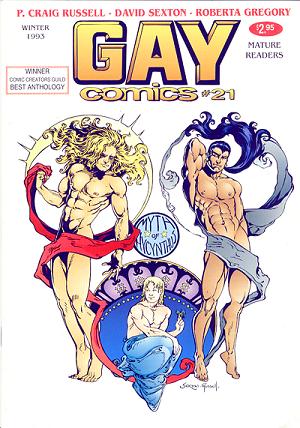
Next up, another Trina Robbins paper doll, this one from Gay Comics No. 25.
This piece is noteworthy in a couple ways.
First, it's a sort of redemption for Trina. Her story "Sandy Comes Out", from Wimmen's No. 1, was one of the first, if not the first, comic story about lesbians, dated 1970. Mary Wings took exception to the story, and followed with her 1974 book Come Out Comix. It should be noted that Trina and Mary remain friends and that Trina's subsequent work in this arena has been very well recieved.
Second, Gay Comics No. 25 was the last issue, and featured most of the creators who had appeared in the title prior. To the best of my knowledge, it's the only time Trina and I had work in the same comic! I posted my Tranny Towers page from that issue some time back.
It's possible Gay Comics will return, but I've heard nothing of that possibility for almost two years now.
Tomorrow: Catch- up Post No. 2.

Wednesday, May 13, 2009

da bode'!


As I prepare some of my extra art for auction, a step towards financing my paper presentation at San Diego in July, I'm drooling over a pencil prelim of a Vaughn Bode' Deadbone page.
My fascination with da Bode' waxes and wanes, but never completely fades. I wrote a bio piece on him for a gay comics website some years back, which has just resurfaced on the redesigned Gay League web page.
I also wrote (and need to rewrite!) a structural analysis of Bode's work for San Diego three years ago, my first formal paper presentation.
Vaughn was a pioneer in panel layout, use of materials, manipulation of language, and communication of raw emotion, often evoking comparisons to Walt Kelly in the the latter two respects.
He was also known for his personal life, being sexually ambiguous, bisexual, prone to S & M experimentation, and a cross-dresser with transsexual tendencies.
However, Trina Robbins described him as "a very eager straight boy who liked to dress up".