Wednesday, January 12, 2011

Best comics of 2010: No. 4: Phoenix Without Ashes

In 1973, an awful TV series came out. It was based on a great idea, and was ruined by unnecessary "creative" input from studio executives.
The series was called The Starlost.
Based on a treatment by Harlan Ellison, the beautiful idea was watered down to nothing.
Watch if you're brave.


The premise: a generational ship is taking representative micorocosms of human cultures to another star. Problem is, they've been in space so long they think their self-contained structures are all there is. To compound the dilemma, the ship is wearing out, and may soon fall into a nearby sun.
Great idea, lousy execution.
Ellison wrote (with co-author Ed Bryant) a novelization of the first teleplay, Phoenix Without Ashes. In the accompanying essay, Ellison details the chaotic world of TV executives, and how their pointless interference caused him to fall back on his screen pseudonym, Cordwainer Bird, in the show's credits. The unfilmed version of the first script won a Writers Guild Award as best teleplay of the year.
This year, IDW released a comic book of it. A four-issue miniseries, to be precise.
It's such great vindication. I hope Ellison (who I've met twice and managed not to offend both times, last time we had a great little chat about the difference between having a good story and telling the story well) feels the same way about it. He sets a high standard for adaptations of his work.
But I think this measures up. It certainly did for me.


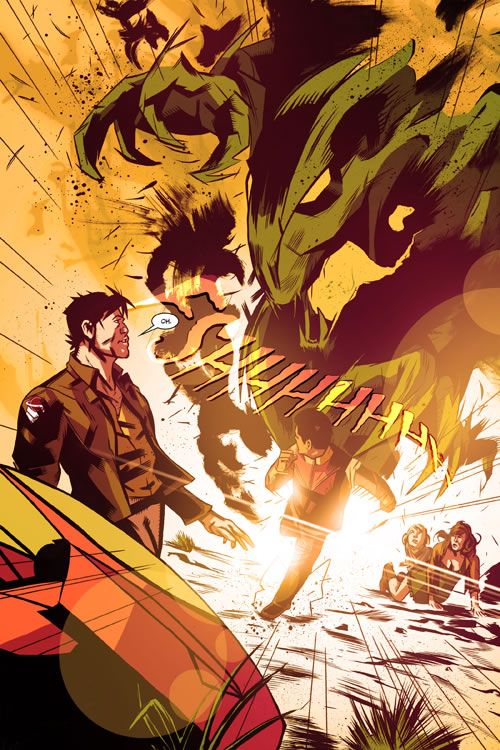
The mini deals with a young man in a harsh Puritanical dome society discovering parts of the truth of his world, and trying to overcome the Philistine pig ignorance of his elders. So much is at stake: the quest for truth, the transformation of this and potentially many other dome societies, and the survival of the human species.
Here our erstwhile hero, who until now has only known harsh Puritan existence and the punishments of elder scolds, learns some of the truth.
It's about time this wonderful idea was given a proper dramatization.
Alan Robinson's art is innovative and has a hard-edged caricature quality to it. His line style reminds me of some of Ron Cobb's stronger work. And that, my friends, is a compliment!
This is not the first time Harlan Ellison has worked in comics. Far from it.
He's written Batman, the Hulk, the Avengers, a comic book version of his classic A Boy and His Dog (illustrated by Rich Corben), and of course, his Dark Horse series Harlan Ellison's Dream Corridor.
His Batman story for Julie Schwartz was a real treat, with Batman unable to find a single crime while on patrol!
There was also the underground comic Harlan Ellison's Chocolate Alphabet. I also rather liked Marshall Rogers' work on Ellison's Demon with a Glass Hand, which was part of a very well done series of DC graphic novel adaptations of SF and fantasy classics. That series was also my first exposure to George R.R. Martin's classic Sandkings.
This is not intended as exhaustive. Far from it. I suspect that Harlan Ellison's written more comics than I've had hot breakfasts.
As reported on Colleen Doran's blog a while back, this year's Wiscon will be Harlan's last public appearance. He has announced that his health is failing and that he's done with the convention and autograph circuit.
It's Harlan's life, and his death, when such a sad day comes. But I'm a fearful, selfish little thing. The prospect of the world without Harlan in it seems a bit more drab.

Tomorrow: best of 2010 No. 3, tie, Part 1: the day it begins and ends.

Tuesday, January 11, 2011

Best comics of 2010: No. 5: Chew


Another one that eluded me at first. Hence its presence on the 2010 list, not the 2009.
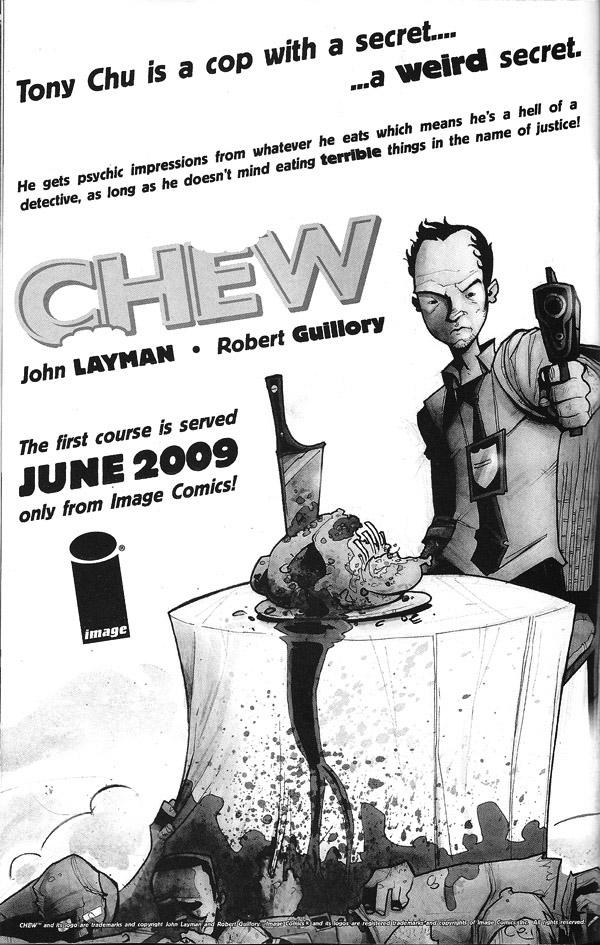
CHEW is about a cibopath. For those not "in the know" that means that Detective Tony Chu gets psychic impressions from every food he eats.
Except beets.
As the series begins, he's working vice in Philly. His brother's an ex TV chef who had a psychotic episode on the air concerning the "chicken conspiracy" (more on that below).
While on stakeout, Tony and his partner John Colby observe Tony's  brother on infra-red. He's packing. Not heat, but meat. Turns out chicken has been made illegal due to a bird flu epidemic, and the FDA now has more power than the FBI. As a result of this, there's a huge bootleg traffic in chicken parts.
Well, that's a summary of the first 6 pages of issue 1.
After a preview in The Walking Dead no. 61, the book took off. It remains one of the few books to demand any sort of coin on the back issue market, despite numerous reprints and a couple very tasteful (sorry) TPBs. 
(House ad from Walking Dead No. 60)
Ahem. Back to issue 1.
Tony and Colby are having lunch, when Tony's gift/curse reveals that one of the sous chefs is a serial killer who eats his victims and cooks with them, serving the results to restaurant customers.  They confront him. Colby gets a hatchet upside his head for his trouble.
At the end of issue, Chu becomes an FDA agent. He works on cracking the conspiracy behind the bird flu scandal. Colby becomes his reluctant partner, following a facial reconstruction that leaves him looking like a poor man's Terminator.
As the story twists the readers into abstract sculptures, Tony finds a girlfriend, a food critic whose reviews are so well written that they make people taste the food.
It's also revealed that Chu is one of three cibopaths.
Who are the others?
What is happening with the mysterious octopus-pineapple-chicken plant thing in issue 6?
It might seem like this facile device would wear out in short order. After all, the bit only works if you keep putting food with criminal ties of some kind on the protagonist's plate.
Surprisingly, writer John Layman and artist Rob guillory manage to keep it fresh (there's really no way to avoid food puns on  this one, so let's just muddle through, shall we?).
The book has been optioned for a TV series. The production company is the one responsible for The Walking Dead show on AMC, which is quite good, so I have hopes that the material will translate successfully.

The comic's writing is action-driven, but not the expense of intelligence. A book based on an idea this wild could be terminally stupid. This is not. There's a delightful balance of humor, empathy and the macabre.
Not so surprising when you think about it. Some of the best horror stories are also comedies.  Perhaps instead of whistling by the graveyard, we ought to chuckle.


As with Meta4, kudos to Image for putting out such an unusual and delightful book. It's also to their credit that these books have such different styles and, one presumes, different core audiences. But then, I'm reading both, so possibly not so different.
Perhaps the difference, if there is one, is in the core readership for each book. People who read Meta4 might be more willing to give CHEW a chance than vice versa, akin to Clockwork Orange fans being more accepting of Singin' in the Rain than the reverse.
I hope the pop culture references in CHEW don't wear thin over the years. I'd like to see this book become one of those comics that is recommended for decades.
Hm. Maybe this cover really is timeless at that.

Tomorrow: Best of 2010, no. 4: it burns!

Monday, January 10, 2011

Best comics of 2010: No. 6: Sam and Twitch: the Writer

Another book that slipped by me for years.
I have little use for most of the Spawn franchise. I enjoyed some of the guest creators' work in early issues, and the rest of the stuff Alan Moore did for Image, while far from his strongest work, was an engaging read. But in general, Spawn leaves me cold.
These two detectives, Sam Burke and Maximillian "Twitch" Williams, were spawned (yeah, I know, I did that on purpose just to get it out of the way) of the early series. They were sufficiently well received to get their own titles, a series of shorter and longer minis.
It's tense, witty and gritty detective stuff. There's an unflagging loyalty between Sam, the muscle, and Twitch, the mind. It's brutal and ugly, but like Warren Ellis' FELL, it's ultimately about holding onto your humanity in the face of that brutality.


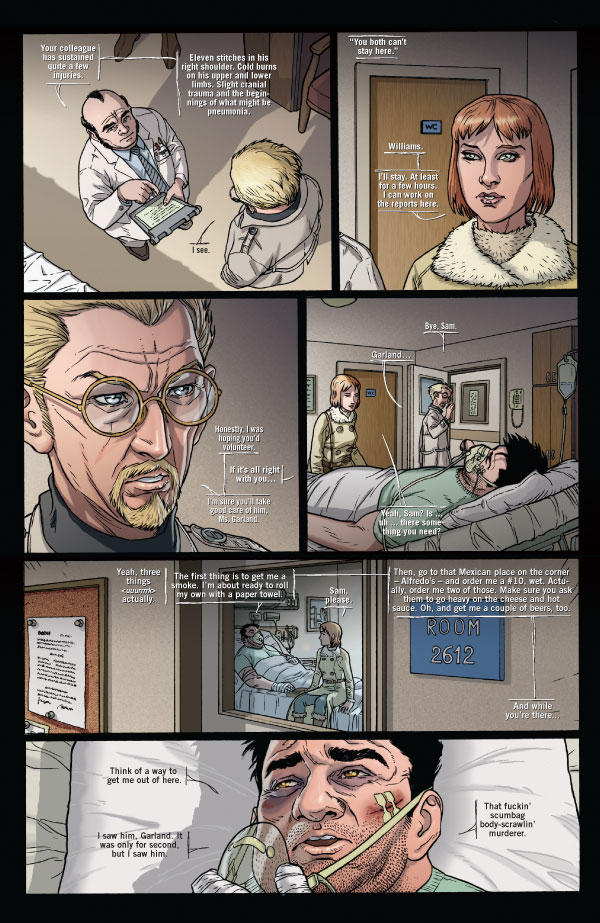
The 2010 series, by writer Luca Blengino and artists  Luca Erbetta (pencils), Fabio Bono (inks) and Filippo Rizzu (colors), deals with a killer who is carving a novel into his/her victims, word by word. 
 

The book is a tough read at times, not so much because of the content, but because of the visual style. The art is gritty, sketchy and full of detail, bringing to mind Alex Maleev's Daredevil run. Since Maleev's Daredevil writer, Brian Micheal Bendis, also wrote an earlier Sam & Twitch run, that's not surprising.  But the real issue is the text.
No word balloons here. Free floating text, reversed out of the art and connected to the speaker bu a simple line. It scans, but it takes some getting used to.

This is far from the first comic book to use typesetting. Even before the digital revolution (whatever that is), EC Comics were lettered using a Kroy lettering machine that created incredibly uniform text.

And Walt Kelly typeset the speech of his sideshow barker P.T. Bridgeport, though he may have just used presstype- it's been a while since I've seen a Pogo original to confirm, but I recall seeing some text pasteups.
In aid of their detection, Sam and Twitch enlist the aid of a graphologist to help them decipher the text, and locate its murderous author, if the killer is indeed the writer,


As our detectives search for the killer, they are put at risk. Following an uncompromising fight, Sam is hospitalized as Twitch has the final encounter with the killer.
Much as with Holmes and Watson,  Mulder and Scully, or in an unlikely way, House and Wilson, Sam and Twitch are a team with a specific personal chemistry and a bond of camaraderie.
These sample pages only allude to another aspect of this series. It's quite bloody. Most of the time, I don't care for that. Here, it works and it serves the story.
I'm a bit embarrassed that these characters slipped by me for so long. Rest assured, I'll not bypass them again.
Tomorrow: Best of No. 5, a very tasteful book.

Best comics of 2010: No. 7: Batwoman: Elegy (spoilers!)

There are spoilers in this post. The story's been kicking around for a while, but a caution seemed apropos.
An elegy is "a poem of serious reflection, typically a lament for the dead." That's the dictionary definition.
In Greg Rucka's stunning work, it's a lament for lost career, lost love and lost family, all lost to a gay woman's integrity.
But like all deaths, each implies the possibility of new life.
Kate Kane's relationship is lost to her nocturnal activities as Batwoman, a role she undertakes out of a sense of moral necessity. The first death. This is in itself a departure, as most who associate with Batman's mission do so in response to some sort of violation.
Kate's sister is lost to terrorists, the price of her father's military career. The second death. However, the sister resurfaces as the insane villain The White Queen, a sort of female Joker (though that description does not do her justice).
Kane's own military career is truncated by her honesty about being lesbian. She chooses to honor the cadet's code: a cadet will not lie, cheat or steal, nor suffer others to do so.  Like Margarithe Camameyer before her, she chose honor over career.
The last death.
Her choices were always moral, never easy.

Following her discharge, Kate meets Renee Montoya, closeted Gotham cop at the time of their meeting, who later assumes the mantle of The Question.
Like Bruce Wayne's parents, Kate is attacked by a mugger. Unlike them, her attempt at self-defense succeeds. Declaring herself a soldier, she looks up after her assailant has departed, sees a silent Batman, then the Bat signal, and knows what her next uniform will be.
This is strong on so many levels. It avoids the standard saw of a woman becoming a hero after being attacked. I agree with the late Kate Worley. Rape-based origins are insulting and unimaginative.
Most male heroes have something taken away from them- parents, family, career, home. Most female heroes have their bodies violated in some way. Seeing this tawdry trend reversed here is refreshing.
Greg Rucka is no stranger to writing realistic, strong women. His work on Whiteout and Queen & Country are exemplary. I even liked Countdown to Infinite Crisis. And I loathe most of those sprawling, galaxy chanign events storyline.
And the sexuality is not played for shock value. It's simply an important part of who the character is.

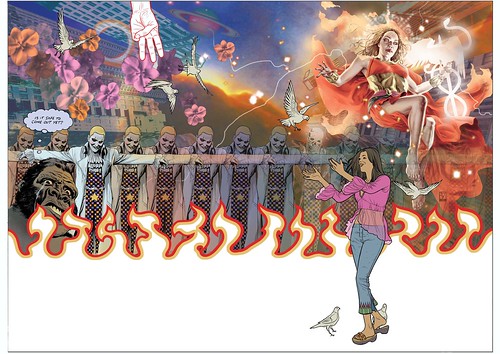
I must comment on the art. I've admired J.H. Williams' work since I first became overtly aware of it in Promethea.  Here's his cover art for Absolute Promethea, book 3.
Williams' work has that photo-realistic aspect, but coupled with a strong and highly informed design sense (his Promethea covers included homages to Parrish, Warhol, Peter Max, and the Superman/Spider-man crossover) and an incredible imagination.  Along with Haden Blackman, he's writing and drawing the new Batwoman: Zero series.
The page designs of this book are remarkable, not just for their clever and effective visual elements, but for the successful integration of those elements into the narrative. Anyone with technical skill can toss around pretty pictures and shapes. It takes storytelling talent to not let those elements get in the way.
Most significant and least discussed visual element of Batwoman: Elegy: her costume.
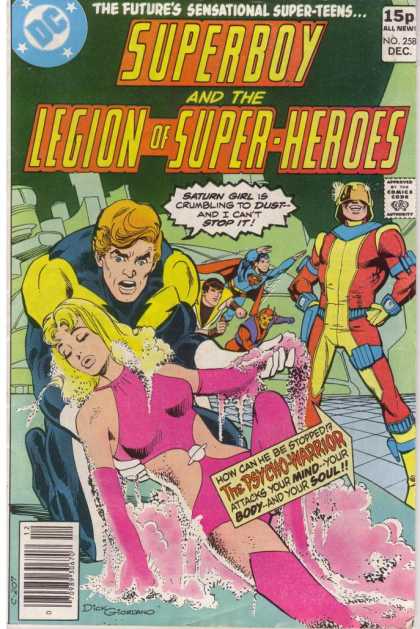
For decades I've been playing with a superheroine costume that's functional as well as aesthetic. I mean really. Look what Saturn Girl "gets" to wear for a fight.

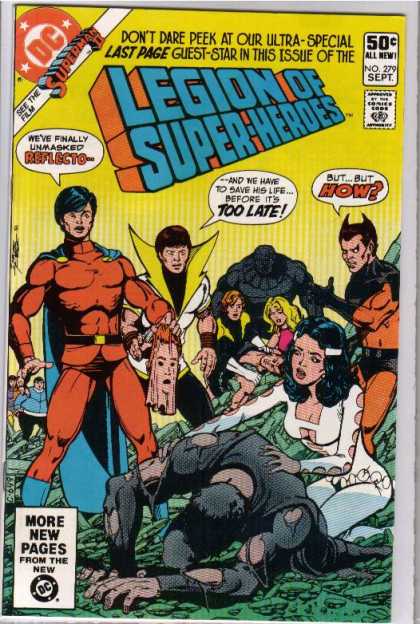
And Phantom Girl...

And Dawnstar!
I'm not talking about politics as much as I am strategy. Imagine flying through the air with huge portions of your body exposed, to say nothing of the difficulty of fighting in such unlikely togs.
Batwoman has designed her costume more as a military uniform. Every part of it is geared towards its combat capacity, from the materiel used to her hair!
And those boots! Finally, a superheroine who doesn't wear CFMs to fight!
  
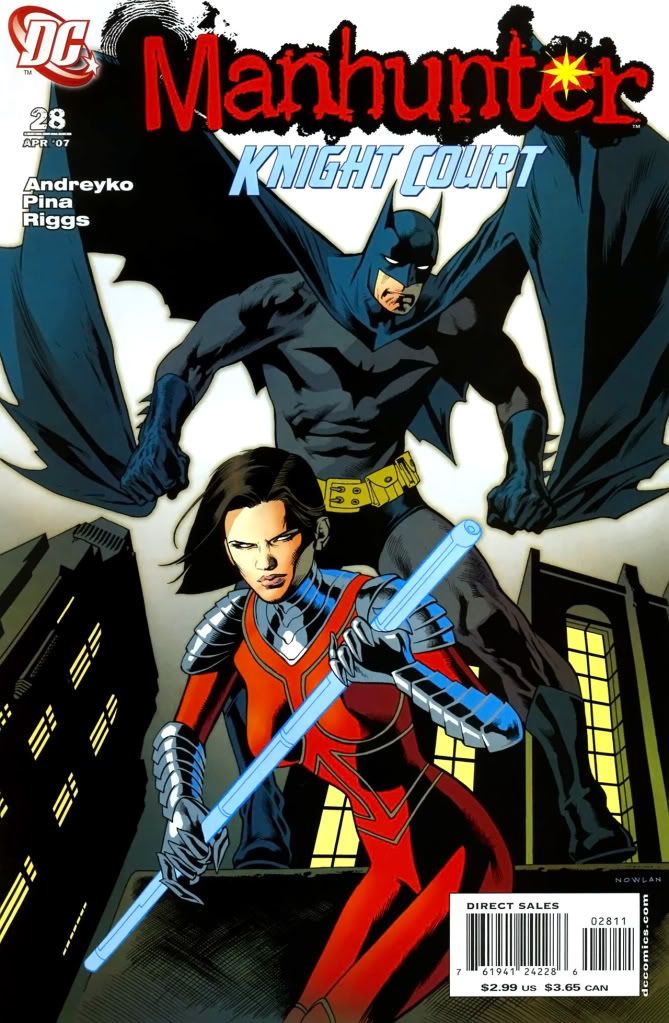
Granted, the costume of Andreyko and Sale's Manhunter from 2005 was also built around function, but not BY the heroine.

Kate Kane is strong, smart, resourceful, impassioned, beautiful and gay. Batwoman: Elegy is a great read.

Tomorrow: Best of 2010 No. 6. It's all about the writing!

Saturday, January 8, 2011

Best comics of 2010: No. 8 (tie): Royal Historian of Oz

I'm from Judy Garland's home town.
When I was very young, my Mother had a 19430s Ozma of Oz with Jon Neill plates. She also had the Wizard of Oz paperback with the Krenkel illustrations.
I ended up with both books when Mother passed, and added them to my modest Oz library. Most of the Krenkel illustrations can be found at this Golden Age Comics blogpost.  Some great Jon Neill works follow it in the link.
Oz has been a big part of my life.
I'll do a separate post on Oz in comics after I'm done with this Best of 2010 run. Suffice to say that there have been some magnificent comics based on Oz, and some dreadful ones.
So when I saw this book, I was skeptical.
Many creators conflate Baum's melancholy and irony with cynicism. For some reason, there are many-far too many- "new, dark and gritty" versions of Oz. It's so tiresome. Remember the SFTV mini-series Tin Man? I believe they even used the phrase "dark and gritty" in their promos. So sad, so wrong. The worst offender in comics may be Caliber's OZ book from 1994.

It's powerful, sleek art. But in terms of Oz, it's just wrong, at least to my lights.
But The Royal Historian of Oz is something rare, a fresh take on a classic. It reinterprets the source material and expands on it without soiling it. As a reviewer on Guttergeek complained, "This is the sort of book that pisses me off because, like any writer, I am sick with jealousy that I did not come up with this great idea."idea.

Note the cover price! Slave Labor is to be commended for jumping on the first issue loss leader bandwagon that has served Vertigo fairly well in the last couple years.
In another growing trend, creator Scott Kovac put up a promo trailer for issue 1. Since this was also Slave Labor's contribution to 2010's Free Comic Book Day, that may have been in part an imperative from the publisher. It is one of the better trailers for I comic I've seen, and it nicely sums up some key plot points.


Here's a spread from issue 1, to give a sense of the impressive, energetic art and design.
Kovac's other comic work hasn't grabbed me. It's not bad work by any stretch, just not to my taste, but this resonates with me. It's partially due to the subject matter, of course. But I also enjoy his handling of fandom- the description of Oz fans as "a bunch of gay old men with dogs named Toto" shows an understanding of the non-fan's perception of fannish activity, as well as implying the risks of obsessive fandom.
There's also an implicit understanding of the maturing of a father-son bond as the son wakes up to what the father has really experienced, and what the father really has to offer him.
And the fantasy aspects of it are pure fun, handled with ample ingenuity.
This is only scheduled to run five issues. I hope Kovac decides he has more stories to tell in this arena, and they they all live up to the realized potential of these early issues.

Tomorrow: Best of 2010 No. 7, and issues of service.

Friday, January 7, 2011

Best comics of 2010: No. 8 (tie) : Mr. Mendoza's Paintbrush

As I was reviewing this list, I realized that there were a few really important books I'd omitted.
Since these things are arbitrary anyway, I decided that a couple of these spots would be a tie.
So today's Best of 2010,  No. 8, Part One is Mr. Mendoza's Paintbrush!
Written by award-winning author and poet Luis Alberto Urrea, this slim graphic novel does not take full advantage of the form, but tells a story that is quiet, energetic and magical.
Mr. Mendoza is the senior citizen of the village. He is also its resident tag artist, and is respected as such by most of the locals. His tags are biting social satire on the locals, and he spares no one his  brush's venom.
The story is related to the readers by two young boys that are rapturously observing Mr. Mendoza's  efforts as they discover the possibilities of life.
Luis Urrea is the author of The Hummingbird's Daughter, Into the Beautiful North (the one I'm currently reading), and The Devil's Highway.
I first became aware of Sr. Urrea's work through my man Shawn Phillips. Here's Shawn's song based on the latter Urrea book.
This performance is from St. Cloud, MN, July 30, 2009.


Wow.
Shawn also played guitar on the audio book version of The Hummingbird's Daughter, which I have yet to add to my Shawn archive.
The deep color scratchboard art of Christopher Cardinale works fluidly with the text.
In the last few days, I've talked a bit about the possibilities of comics working as an adaptation medium.  I have more of a caution about people who are versed in other disciplines trying their hand at comics. Some of these, like the comics work of rock musician Dave Stevens or that of actor Nicholas Cage, are well-intentioned but mediocre in their execution.
In this case, Urrea has embraced the possibilities of the form, albeit a mite tentatively. There's an excessive reliance on large panels, but the text and the image support one another with minimal redundancy.
It's clear that Sr. Urrea has approached the form and the narrative respectfully.
The climactic event of the book involves Mr. Mendoza announcing at the local watering hole that he will be leaving the next day.

The flow of the page through the beam of light, the cascading purple swirls and the vaguely neotenic angels create an effective layout, one that's moving in every sense.
So does Mr. Mendoza die the next day?
I'm not saying, other than to say that it's his final great work of art.
In that sense, this is also a bit reflexive, in that it's art about art.
But at the risk of seeming facetious, isn't it all?
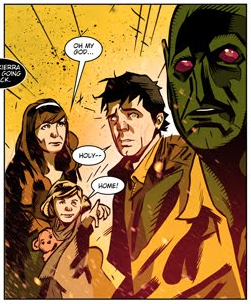
Urrea's observation that "home isn't just a place. It's also a language" is reinforced by the first page of this slim graphic narrative.

Tomorrow: best of 2010, No. 8, Part II.

Thursday, January 6, 2011

Best comics of 2010: No. 9: i, zombie

I don't much get zombies.
Dawn of the Dead was great social satire in its day (the Romero version, that is). Walking Dead has its moments, and I enjoyed the couple episodes of the AMC series I've seen to date. If I Am Legend is a zombie story and not a vampire story (I see it as a bit of both), that one has merit on many levels.
But most of the best zombie stories are about the people surviving them, not about the zombies themselves.
I mean really. How much personality can you have if you can be accurately described as brain dead?
And I like Mike Allred enough. Red Rocket 7 was fun, the Nexus/Madman crossover is a longtime favorite, his run on X-Statix was intoxicating goofiness, and I adored his work with Neil Gaiman on Metamorpho in Wednesday Comics.
But this book is something special.
With Chris Roberson writing, Allred is giving us a wild romp through monsterdom with a touch of of Generation Tech (or whatever the media term is for the current generation) wit.
A cadre of twenty-something monsters holding it together in the so-called "real world". Among them, a ghost, a zombie (an annoyed young woman who works as a gravedigger), and a were-terrier.
The zombie abosrbs the sentience of the deceased after her feast. This makes her privy to the thoughts of a killer.
The killer, in turn, informs her of the way monsters work. In a fascinating issue about how ancient Egyptian religious concepts of the fractured soul result in different types of monsters, creatures and supernatural beings, a larger narrative is begun.
In the larger narrative, this gives our zombie heroine, Gwen, cause to rethink her actions.

But hey, right after that, it's the origin of Scott (Scottie?), the were-terrier!
Also on board are Dixie, the waitress at their all-night coffee hangout, Nemia the vampire, a blond ghost whose name I can't find at the moment, and a couple rather cyncial and capable monster hunters.

Tomorrow: paint, tag and old men, as we hit Part I of Best of 2010, No. 8

Wednesday, January 5, 2011

Best comics of 2010: No. 10: Fevre Dream

Avatar Press has done some impressive, but frustrating, books.
Fevre Dream is no exception.
Based on the George R.R. Martin novel from 1982, this riverboat vampire tale can be seen as a thematic successor of sorts to the Anne Rice stuff from 1976. Beautiful vampires,  a set of vampiric laws revealed to a hapless soul drawn into their sphere (in Martin's case, a steamboat captain; in Rice's, a reporter), and a power play between said vampires. The core elements are certainly comparable.
But that's as far as it goes.
Martin's characters, especially the Captain, are more, dare I say, human, and lack the high-flown trappings of overblown prose that Rice inflicts on her characters, even in their early 90s Innovation comics versions.
Also, Martin writes to be read. Rice seems rather full of herself as a writer, at least to me.
This is a great story, made all the more so because of its twists and turns. It was long overdue for adaptation, with its kinetic and visceral aspects.
Fascinating characters indeed.
Is the Captain concerned for the welfare of his crew, himself, humanity? Yes, but more of his concern lies with his ship.
Are his vampiric co-owners and passengers a threat? Yes, but no so much that they cannot candidly speak of their necessary business, and they may be a greater threat to one another than to humanity.
Rafa Lopez's art alternates between chunky and sleek, with heavy elements of caricature (and lots of rather large hair for 1857!). I wasn't mad for his work on Lady Death, but then I wasn't a big fan of the book in general. The writing integrates smoothly with the images: a classic blend of show, tell, show and tell, and all the permutations thereon. Daniel Abaraham's "sequential adaptation" is consistent with the source material.
As alluded to earlier, the publisher, Avatar Press, is a mixed bag. They produce books of consistent quality (though I was quite disappointed in Alan Moore's Neuronomicon). They publish some fine Warren Ellis works- I really liked last year's Ignition City, for example, and this year's Captain Swing was wild steampunk fun. Some of their stuff, like Miller's Robocop books and the George Romero stuff, does nothing for me, but I recognize their quality even if they're not to my taste.
Every issue of Fevre Dream is offered with multiple covers, as are most Avatar books.
Multiple covers? Really? How 90s pre-bankruptcy Marvel of you.
I think the wraparounds are just fine, and see no need for other covers. Why go to the extra expense of printing multiple covers?
Avatar has a fairly chunky ad section, all house ads, all conveniently put in back of the book. Damned decent of them.
However, the ads are mainly a back issue shop, and offer back issue prices on books not yet available, as well as multiple "special" editions of their books.
This is a mite confusing, and I can't believe this practice helps their orders any. Dynamite used a similar strategy on a slightly smaller scale with its Lone Ranger line, which ends this month, I'm sad to say.
Fevre Dream is not Martin's first foray into comics. His Hedge Knight series has been servicably adapted by Marvel, and his Wild Cards anthology was adapted as part of Marvel's Epic line more than a decade ago- fitting, as it's a "real world" superhero anthology. There was a Dynamite revival of the title recently, but I can't speak to its quality, having passed it by at the time.
Here's a bit of the Marvel/Epic stuff.

Comics have long been accepted by those "in the know" as a viable vehicle for adaptation, in some cases more so than film, or at least on a par with it, as evidenced by Jon Muth's version of Fritz Lang's M.
I hope they do a decent trade of this series. If not, I'd happily have my issues bound.
Tomorrow: No. 9 of 2010, as we go from drinking blood to....

Tuesday, January 4, 2011

Best comics of 2010: No. 11: Johnny Recon No. 2

Wot, a local book making the year's best?
Yes, when it's this much fun.
 Johnny Recon No. 2 appeared in July 2010.

Mitch Gerads' art is both graceful and choppy, alternately invoking Krigstein, Nino and Al Williamson. Scott Dillon's writing is deeply steeped in pulp/space opera traditions, dancing on the edge of being an old chestnut, but avoiding that through innovative plot elements and sheer energy.
I mean really. Vampire grasses. How much fun is that?

Gerads and Dillon's Popgun Pulp Comics puts out a very professional product (but guys, you really need to update your webpage!). They've been tight and professional, and quite aggressive, in their marketing. As they are locals, I've seen their solicitation postcards promising oodles of delicious goodies at comic stores in the Twin Cities metro.
But it wasn't until recently that I became aware of their successful use of Kickstarter.
I really like Kickstarter. It adheres to a core philosophy I've tried hard to embrace in the last couple years: abundance. If your work is good enough, the support for it is out there. If the work is lacking, make it better. Kickstarter is the ultimate put up or shut up model, and is successful more times than not. It's a fascinating hybrid of capitalism, socialism and craftsmanship.
Here's the Popgun Pulp video used in their successful Kickstarter funding for this issue.


With local marketing blitzes, successful Kickstarter funding,and POD through KABLAM, these guys are the epitome of the future of comics publishing.
It's about recognizing that no one approach will do the job any more. In order to achieve whatever measure of success remains possible in comics, one must employ multiple strategies.
Even then, it's a crapshoot.
Your odds are helped if you tell your story well.
Vampire grasses. Marshans. A heroine sidekick who kicks some serious alien bad guy butt.
Way to go, guys.

Tomorrow: more vampires, but not of the flora variety, as we enter the Top 10 of 2010!

Monday, January 3, 2011

Best comics of 2010: No. 12: Meta4

Ted McKeever is an odd duck.
He;s been at it close to 30 years, on and off.
His comics appear sporadically and appear at first blush to be abstract sketches, tone poems that function more as ciphers than narratives.
Then you finish reading an issue and realize the scope of his accomplishment. He's sucked you into an impossible emotional whirlwind of story. How does he do that?
His works Metropol, Transit and Industrial Gothic defined and redefined 90s Dadaist angst. His Superman's Metropolis, putting Kal-el in the word of Fritz Lang's classic SF film, remains one of the best of the Elseworlds books to date.


His anti-technology bent and oddly empathetic nihilistic tone bring to mind the mutant offspring of David Lynch and recent Zemeckis films. 
2010 was a bit of a renaissance for this curious creator. In addition to a continuation of Shadowline's Definitive McKeever Library, we saw his new mini-series Meta4.
I want to applaud Image for taking a chance on this. In a year in which floppy sales were down by an average of 30%, to push such challenging material is brave indeed. Image has taken many more chances this year (more on at least one of them in future posts in this series), and this has led me to re-evaluate them as a publisher.
As for the book itself, the only reason I've ranked it so low in my top books of the year is that my budget didn't allow me to pick up the last 2 books in the 5 book series.
The story of an amnesiac astronaut, a mute giant woman, and a cadre of other damaged characters, this is challenging stuff.
Communication through icon and reflection. Sparse, lonely, and absurd. And yet I couldn't help my fascination with this story.
Here we are, wrapped in suits of skin, able to see distorted images of one another, but unable to really touch. How tragic, how absurd, how human.
We soon discover that what we took for an alien landscape trapping our astronaut is in reality a decayed Coney Island. He has no idea how he got there. A Coney Island of the Mind, if you please, thank you, Mr. Ferlinghetti.
NO less a creative voice than John Mueller, creator of the two profound, brutal and beautiful 90s series, OINK, has also sung the praises of this work.
Tomorrow: No. 12, and a rocket ship!

Sunday, January 2, 2011

Best comics of 2010: No. 13: DV8: Gods and Monsters

Next up on our hit parade is Brian Wood's miniseries of his creation DV8.
A teen superhero team like GEN 13, DV8's distinguishing factor is that they are inherently selfish.
I enjoyed Wood's writing on the Oni Press series LOCAL (with art by former classmate Ryan Kelly) a great deal, and thought to give this a chance based solely on that.

What intrigued me about the DV8 miniseries was not the selfish aspect of the characters (I mean really- selfish teenagers- how cliche' is that?) but the circumstances of the story.


The characters are stranded amid two pre-technological cultures, and are choosing up sides in the wars of those cultures, and debating whether they should have any involvement whatever.
Action, philosophy and snark of the best kind.
While the sniping between characters got a mite tedious around issue three, overall this posed some interesting possibilities- sort of a Rising Stars meets Lord of the Flies scenario. Questions of how powerful people still coming to terms with themselves respond to the potential influence they can have on society, or societies, are challenging.
But this is not some philosophical diatribe, no, my friends. This is war, aided and abetted by very powerful and not-quite mature beings.
Serious superhero slugfest, teen angst, and some very aggressive locals.

Cool.
Tomorrow: Number 12.

Original Art Sundays #74 : Midnight Lightning

As promised, something a bit different this week.
As I may have mentioned here before, ever since my Mother passed, I create a book of her paintings for my siblings as part of a communal Christmas present.
Mother gave us all the same thing every Christmas, and it was always this odd melange of stuff. For example, one year we got a book on Biblical mathematics, a pound of Basmati rice, a kitchen fire extinguisher and a roll of silver dollars, all in a stainless steel stock pot.
When she died, we agreed to keep doing it between ourselves, for each other and in her memory.
My contribution has been the books of her paintings, most of which were left in my care.
This year, it was a book of her portraits. Last year, some of her abstract and surrealist imagery.
Since she did a Hendrix paining for a family friend, inspired by the cover of Midnight Lightning, and she shared a birthday with Jimi on Nov. 27, I decided to do a recording of Hendrix's Little Wing and create a short video of her work.


So in hope for the new year and in memory of Esther Bender, enjoy.