Sunday, March 27, 2011

Original Art Sundays #85: Placeholder: V for Vicodin

My inking sucks today.
Therefore, although the next page of A Private Myth is bordered, penciled, lettered, and about half inked, I'm going to come back to it and post in a day or two.
The next Surrealist Cowgirls page will still post next Sunday.
To tide over the faithful, here's some Photoshop perversity featuring two of my favorite inspirations: Alan Moore and Gregory House.


I love this piece. I was able to fight my natural tendency to throw too much in, and I think it works.
Join us in a few days for the next page of A Private Myth.

Sunday, March 20, 2011

Whose stories are these anyway?

The Lambda Literary Foundation has announced its 2011 award nominees.
There is one graphic novel on the list Jon Macy's Teleny and Camille (which I've not read), and only one comic anthology.
The anthology in question is Justin Hall's Glamazonia, the Uncanny Super Tranny.
Now I like Justin just fine, and do enjoy the strip in a casual way. But the collection is nominated in the category of Transgender Fiction.
Huh.
Well, yeah, I suppose it is. Technically. But it's not what I first think of when considering this work.
It's about a superheroine drag queen who is gay male identified.
Drag is part of the trans community. Transgender is a blanket term. But it's sort of like your cousins. You enjoy their company, you're glad to see them, but you really don't have that much in common with them.
To further complicate the issue, Justin isn't trans in any sense.
Does that mean his voice on the issue is invalid?
Not necessarily. Just as men can write intelligent, capable women, and white people can write plausible people of other races as characters, so can someone write outside their own sexual experience and identity. But to have that someone nominated for an award as representative of that community is, well, problematic.
See, my problem with Glamazonia is not that it's unfunny or that it doesn't speak to part of the trans community. It is funny, and it does speak to a specific subset of what passes for a trans community.
But it's very gay male identified, and wrapped in a language, philosophy and way of life (I loathe the term lifestyle) that is removed from the experience of a great many trans folk.
It's good work and deserves recognition. I'm not sure if it belongs in this category, though, for the reasons enumerated.
One of the complaints many cisgendered women have about drag is that it feels to them like a form of blackface- a sort of parody of their identities. I see their point. When I read someone else's version of who I am, who we are, who anybody outside their own experience is, it chafes more than a bit. It's kind of like Lenny Bruce said about the cop testifying at Lenny's obscenity trial: someone is doing your act, and you're being judged by their performance.
Now, Justin fully recognizes this issue, and is very responsible in discussing it. This clip from the Queer Press Grant panel at last year's San Diego con is an example of that. Go to about 10:45 in the clip.


So I cannot, and am not of a mind to, really take Justin to task on this issue. he does good work that deserves to be recognized.
But the LLA committee: well....
Why no recognition of graphic narrative as an inherent form? There are categories for fiction, nonfiction, some types of genre fiction, all broken down by sexuality or sexual identity.  It cant' be for lack of good work- why is Rucka's exemplary work on Batwoman (and J H William's engaging follow up) not recognized, or even the Archie issue with new gay character? The latter is not the apex of the form, but is certainly culturally significant.
Have we reached the point at which these narratives are more integrated, and  queer graphic narrative exists in the context of larger works and separate recognition is no longer necessary?
Well, that would be nice, but I don't think we're there yet. Closer than we've ever been, but still no cigar is no cigar, to mix a metaphor.
Lambda has never had an award category for Graphic Narrative, or Graphic Novel, or whatever nomenclature trips your trigger.
They've nominated Stuck Rubber Baby, and Alison Bechdel has won in the past. But given the immeasurable quality of their work, that's almost a no-brainer.
Now, i realize that these folks owe me nothing. If I want to see an award for this work, I can always start one on my own.
But given that these folks are already out there, so to speak, I shouldn't have to.

Original Art Sundays #84: Surrealist Cowgirls, it does this, p. 4

Here we go with the next page of this fun, silly story.
Enjoy!
This is as far as I got with this back in 1989, or whatever lost year it was when i did this work. A new page is about half done, and will be ready for posting by the next time it's due in the rotation.
I like the cleanliness and confidence in these pages. In particular, this page advances the story while playing with some fun visual conventions (if the sun needed glasses, they'd be sunglasses, right?).  I also like that Louise (who usually ends up in the sort of Gracie Burns role) has the bright idea here.
The next page... well, I don't want to give it away, but it will be stylistically consistent while a bit more elaborate.
Next week: A Private Myth, page 21!

Sunday, March 13, 2011

Original Art Sundays #83: Tranny Towers, p. 14

For your reading pleasure, the next chapter of Tranny Towers. There are 24 chapters in the first of the two main story arcs.
This page gave me fits.
First, I worked it slightly oversize, so I had to scan it in tiers for printing.
It didn't work.
For the life of me, I could NOT get the press tape borders to align in the scans!
Then there was the attempted visual device in the banner. I was trying for an opening wrought iron gate (I'm fascinated by wrought iron), but without extra frame of reference, like laying a roadway under it, it just reads as some pretty scaled text.  The scaling was done by hand using that old tool, the vanishing point, not in Photoshop.
In panel 5, there was a dumb problem to be fixed. I was ready to go to press, when I realized that Sonia's head was going the wrong way in response to the backhanded slap. This realization came a few hours before deadline time. So hurry, redraw the head and mortise it in, and still make the deadline!
That panel could also use more weight in terms of spotted blacks.
Finally, while I like sparse backgrounds, there's a little too much omitted here. The space of their apartment was established in a previous chapter, the one with the Mother, so referring back to it a bit more would have improved continuity.
There are some very nice things about this page. The classic six panel layout is a proven winner for advancing narrative, and identifies more with action stories than its 8-panel counterpart, which is usually associated with comedy and funny animal stories.
It's also action driven. A lot of my work is dialogue driven, and this gave me the chance to stretch out a bit. Like the "hands" page in an earlier chapter, it's a way to make me face a kind of work I've not excelled at in the past.
This was an emotionally wrenching page in other ways. I was less than two years out of an abusive relationship at this point, and this page was part of my facing that. I believed at the time that it was dishonest to have your personal life show up in your art. I now think that it's inevitable. The trick is to have the art come first, and let the personal stuff show up in whatever form it does.
Next week: Surrealist Cowgirls!

Sunday, March 6, 2011

Original Art Sundays #82: oddments: Elvis Has Eaten the Building

I'm going to try a fresh rotation.
An oddment (something outside the storylines, a fun piece), followed by
A Tranny Towers page, followed by
A Surrealist Cowgirls page, followed by
A Private Myth page.
This will serve to give me time to do the work. This is especially significant as regards A Private Myth. The emotional aspects of those pages really take their toll, and balancing them with lighter fare will do my head good.
Today's oddment is from Ink Tantrums No. 1, my first self-published comic circa 1994. It's a silly little page. Had the idea, banged it out using some shoddy tools, one of the more fun pages I've ever done.

The Elvis jokes had become the rage again in the early 90s for some reason, and my Gamera fascination played against the HHH Metrodome was- oh, what the hell, I was just being silly.
Great fun to draw this one!
This was after Commercial Art school, but before MCAD.
Next week: Tranny Towers.

Happy Birthday, Will Eisner!

Just a very quick post.
If you don't know who Will Eisner was, you're reading the wrong blog.
Suffice to say that comics would not be what they are today without him.
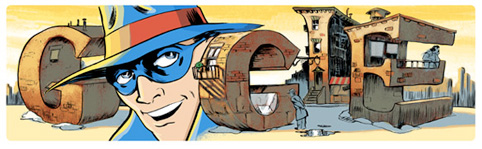
Instead of going into some long elaborate theoretical diatribe, as is my way, I'll let today's Google search logo do my talking for me!

Sunday, February 27, 2011

Original Art Sundays #82: A Private Myth, p. 20

Delighted to get this one out there!
Thoughts:
I need to fight the temptation to jump to my comfortable brush tip markers. A good rich black from pen and ink or crowquill would yield a richer result, without having to pump levels.
This page owes a great debt to Dick Giordano's classic Batman story No Hope in Crime Alley.
The visual device is also used on an inner page to advance the narrative. Like I said, classic bordering on iconic.
I debated actually trying to drop some heavier blacks around our heroine to reinforce the homage, but decided that it was a late afternoon scene and that was that.
I now have a bunch more Tranny Towers pages, one more page of Surrealist Cowgirls and quite a few oddities ready to go, so barring illness or accident, I remain good to go for Original Art Sundays for a while now.
Next week: hmm...

Sunday, February 20, 2011

Original Art Sundays #81: Surrealist Cowgirls, it does this, p. 3

The next page of A Private Myth sits awaiting a scan. I sit waiting for the blizzard to stop so's I can go do the scan.
My friend Seamus told me a of cheap, reliable large-bed scanner. When I have the ready funds, it seems a worthwhile investment. Until then, I'll keep slogging away with remote access. It has its frustrations, but it's short term pragmatic.
Meanwhile, here's another page of the Surrealist Cowgirls adventure. This one has the rather obvious pun I alluded to in the last SC post!
A couple nice Bode' references on this page, in the bottom tier. The lizard, of course, the odd little bird on the branch, and the use of environment as frame in the last panel, a device of Vaughn's I particularly like.
This was great fun to draw, using stipple, a technique I revere but rarely use. Kay's design is inspired by pointillism, of course, which makes drawing her in this technique a solid plot device, as well as an excuse to keep my hand in on this technique, mastered by the great Howard Cruse.

Next: the next scanned page of A Private Myth.
I hope my readers are enjoying my bouncing around between three storylines! If you've been around here a while, you know they DO get completed!

Monday, February 14, 2011

Love and pain and the whole damn thing

Ah, Valentine's Day.
Another day of stresses and celebrations. Whether you're alone or coupled (or more, depending on your chosen life), the day has stresses, strictures, real and perceived obligations, all tied to a biological, societal and personal imperative to share our lives with one another at different levels of intimacy.
As to St. Valentine, stories vary, but most hold him to be a martyr and savior of persecuted Christians. Small wonder that he's embraced over the much more personally sacrificing (at least in contemporary material terms) St. Francis. After all, how could you merchandise the story of one who took a vow of poverty?
While the connection between St. Valentine and romance is tenuous at best, it's also moot. The day is what it is. The cultural connotation is not be be undone.
In comics, several images come to mind.
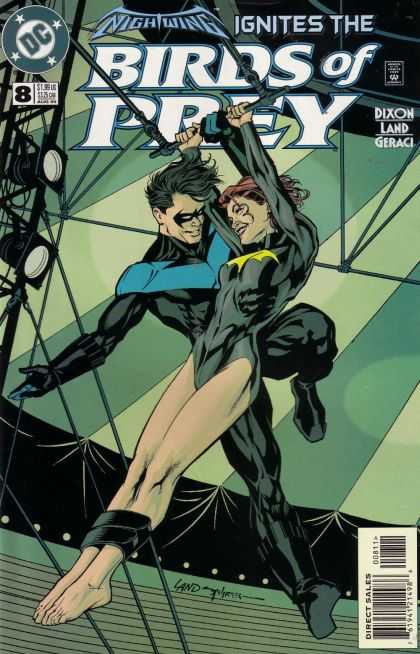
First, this Birds of Prey cover.
I'm not much on Chuck Dixon's writing. All that smug macho nonsense leaves me cold. Battleaxes was the least entertaining comic I'd read in years. I have the same problem with Beau Smith's work, and on occasion that delightfully irriataing Mike Baron.
But I did really like Dixon's work on this series.
I also rather enjoyed the TV series, even with its flaws. You can watch the whole thing on HULA now for free, You have to put up with a few commercials, but he, that's what the mute on your laptop is for, right?
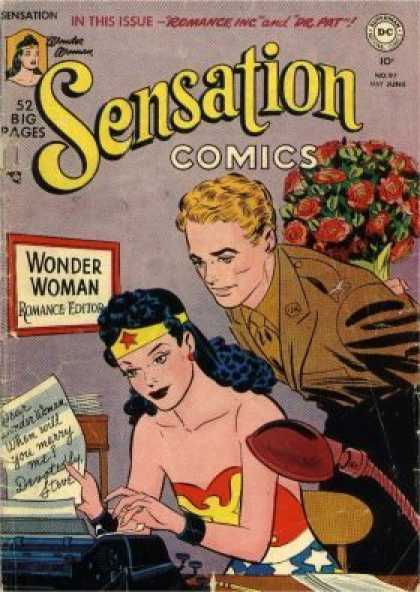
The cover below also comes to mind in terms of romance, even though that's not exactly what's going on here.
Such a smart book!
I find it interesting that books about women and superheroines invariably come around to the romance stuff, while it doesn't seem to surface nearly as frequently in "guy" superhero narratives. There are notable exceptions, but the superhero scared of romance in the 1950s mode remains the default for many comics.  One wonders if that's still the presumption of the marketing folks (that this is what the readership wants) or if that's where the writers are at. In some cases, I suspect the latter- smug little bully boys who are ascairt of girls.
There are many emotionally mature writers working in comics. And it's possible to write strong men without resorting to this macho garbage. Bill Loebs, Warren Ellis, Alan Moore (whose characters all seem injured in some way anyway), even some aspects of Mike Baron's writing succeed in this arena.
Surprisingly, many of Neil Gaiman's love stories  involve his characters behaving very poorly towards one another, in different ways. Consider Morpheus imprisoning his lover in Hell for ten thousand years, for the "crime" of rejecting life with him. Or the poorly defined manipulative behavior of Miraclewoman in Gaiman's Miracleman run- an act of jealousy, as the last panel imples, or a mistake pure and simple?
The narrative of Foxglove and Hazel is just as messed up. A naive lesbian gets preggers, and her abuse-surviving girlfriend sticks with her, grumbling the whole way. But that has a happier ending, or if you prefer, a resolution, since they get to go on.
That's the thing about love stories. If they're going to be realistic, they're messy.
There's only a small percentage in hearts and flowers. Most of us have to deal with the messy aspects of trying to understand one another. If doesn't matter if you're gay, straight, bi or polyamorous, though the latter relationships have far greater complications (but when they succeed, they're great!). People are complicated, screwy and self-contradictory. We want someone to love us forever, and when we get them, we want time to ourselves, or we're let down that they're who they are and not who we expected/hoped them to be.
It's a balancing act that never stops.
In comics, the love story as primary plot is becoming more prevalent. I can think of two splendidly successful narratives of the last 20 years.
First, the remarkable Strangers in Paradise.
Never mind that there are some incredibly implausible aspects to the story, and some wild inconsistencies. Is Katchoo an alcoholic, as mentioned in a couple issues, or not, as indicated by her apparently controlled drinking in subsequent issues? How could Casey be in the employ of her true boss and be such a ditz? Sometimes it felt like a Tezuka narrative- the character playing a variety of roles, some of which contradict the roles played by the same "paper actor" in another story. You also see this phenomenon in Barks' Duck stories, and it's worth noting that Barks was irritated,  bordering on insulted,  by Don Rosa's attempts at imposing a unified narrative on the loose aggregate of Barks tales.
That aside, Strangers works despite its occasional implausibilities. This is because:
a) Moore is a strong enough storyteller that he was able to pull it together in a way that worked, and
b) No matter what else it is, it's a love story first and foremost. The issue is not that the people love one another despite all this stuff happening. It's that their love sees them through this stuff, even when they're at one another's throats over real or perceived wrongs.
The last comic to consider on this day dedicated to the ideal of romantic love (and to the sale of cards, flowers and chocolate) is True Story, Swear to God.
There's this guy, Tom. Nice guy, comic book nut.
Takes himself a vacation to Disney World. Meets a Puerto Rican woman at a bus stop. They fall in love instantly. He moves to Puerto Rico to be with her.
It's true. Every last bit of it. Tom has photos and everything to prove it.
The story is about all of the above: miscommunication, frustration, dealing with life, trying to understand each other. It's told simply and cleanly, with honesty that avoids being maudlin.
Tom published about a dozen issues himself, then took the book to Image, where it has currently run 12 more issues. The book deals with everything from a Californian living in Puerto Rico during 9/11 to his spouse wanting to shave her head in support of her cancer afflicted sister. This is what comics can do best- say something about our lives.
I've deliberately not discussed the other great comic book romance that affected my life, Omaha, tonight. Too many memories, not all of them good for this particular day. But I do hold the book and its creators in a treasured place, and will write about them again when appropriate.
For right now, let's just leave it at the default optimistic thought:
Ain't love grand?


Sunday, February 13, 2011

Original Art Sundays #80: Tranny Towers, p. 13

Well, the next page of A Private Myth is done, but my scanner access is limited till tomorrow or Tuesday, so please enjoy another Tranny Towers page until then.

A few notes on this page:
First, I really liked the title banner device.
Second, the whole drag show thing that Dan and Dena are dishing about... that's a world I was never much part of. I danced on the periphery of it for a while, but never really got into it. Now, thanks to Ru Paul's Drag Race, the runway show become a default association with trans folks for a great many people, gay and straight. Well and good, but it doesn't really speak to the whole range of our experience. Truth is, living day to day life is not a constant catfight, and I don't put on a ton of makeup, mile-high hair and CFMs to play with the kitty.
I do really like the line "she learned the art of makeup form a paving contractor", however.To me, that dry wit is the best of that world!
I'm not sure if the bottle device works as well as I hoped it might. I wanted to leave the reader with an image of Ricky standing on the roof holding out the bottle with a funnel in it, which struck me as an odd and giving thing to do.  Problem with the page is that the reading path is interrupted so strongly by the bottle. It works, but then again, there may have been a more effective approach, in retrospect.
 There are approximately 24 more pages of Tranny Towers to post. Nine remain from the anthology, and there were 10 or 12 pages that were not collected. The characters also appeared in two strips in GAY Comics, a couple truncated attempts at The Great Transgender Graphic Novel (first as Athena, which predated all other attempts, and then as TranScending, some pages of which have been posted here previously), and some scattered appearances in editorial strips in the late lamented TransSisters magazine. All told, there's somewhere around 50 or 60 pages of these characters. After I've posted them all here, I'll anthologize them. It would be nice to have a comprehensive edition with a spiffy new cover!
I'll post the next page of A Private Myth later this week, right after I scan.

Monday, February 7, 2011

"The Congressman from Georgia has the word ballon..."

It's been announced at The Beat and at Bleeding Cool (see links on left) that GA Representative John Lewis will be writing a graphic novel for Top Shelf.
Top Shelf has done some innovative work, including a handsome edition of Moore and Campbell's FROM HELL, Jeff Lemire's pre-Sweet Tooth work Essex County, the continually fascinating and frustrating League of Extraordinary Gentlemen series from Masters Moore and O'Neill, and the popular (with everybody but me) Blankets by Craig Thompson.
Representative Lewis and co.

A couple things need to be noted.
First, no artist has been named at this point.
Second, this book is based on Lewis' experiences during the 1960s Civil Rights Movement.
To quote an article in the Tuscon Citizen, reprinted in USA Today:
"As a young man, Lewis was beaten in Selma, Ala., on the day in 1965 that has become known as Bloody Sunday. Marchers were on their way from Selma to Montgomery when Lewis and others were beaten by Alabama state troopers on the Edmund Pettus bridge."

That's Lewis on the left, next to Dr. King.
Sounds like a promising project, and I'm eager to read it, but all accounts imply that Lewis and his co-writer, Congressional staffer Andrew Aydin, are doing a factual account of events. Shouldn't this then be categorized as "graphic memoir" a la Fun Home or released without categorization, like Harvey Pekar's underrated and revolutionary Macedonia?
Perhaps it should just be called a "graphic history" like Harvey's history of The Beats.
Does it matter?
For the umpteenth time, yes. If the diverse potential of the form is to be recognized, it cannot be seen as just one thing. That would be akin to referring to all long-form narratives as novels, rather than recognizing their variations as epic poetry, screenplays, or religious texts like the Gita or the Bible.
Beyond that, there's the issue of veracity. Howard Cruse was taken to task, rather unfairly, I thought, by comic creator Ho Che Anderson for Cruse's memories of the times around the Civil Rights Movement in Stuck Rubber Baby. So questions of fiction/nonfiction/metafiction are concerns here as well.
Finally, the news accounts are sort of true.
This is the first time a Congressman has authored a graphic novel. But he's not the first Congressman who worked in the comics form!
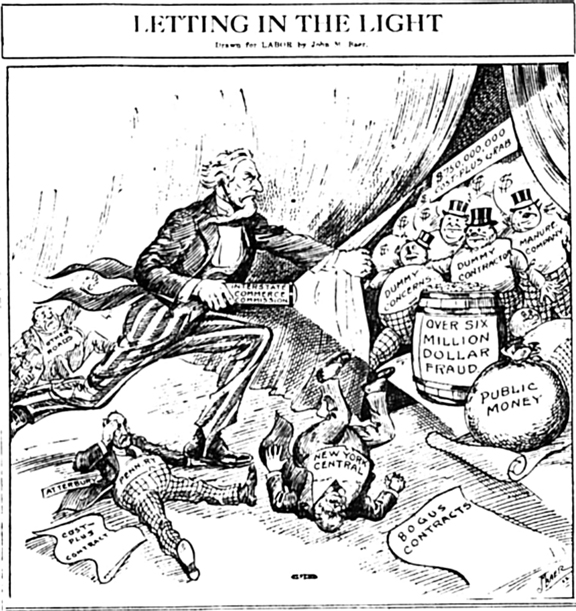
That distinction goes to John Miller Baer, whose comics first ran in the Non-partisan Leader in 1916.
A rare color piece by Baer

He served one term as a US Representative from North Dakota. He was not re-elected, and returned to his first loves, journalism and political cartooning. His cartoons were primarily concerned with farmers' rights and the evolution of granges.
His work was stylistically typical of the period, heavy on detail and tentative in its handling of text.
Thematically, his message was a departure from the more well-known political cartoonists that preceded him. Winsor McCay, for example, though a humanist, was very much in keeping with some of the more stringent political views of his employer, William Randolph Hearst. McCay's views on social problems manifest in many of his own works, notably the film Sinking of the Lusitania.
So carry on, Representative Lewis! You are following a proud tradition, whether you know it or not!
I love telling my Comics History students about Baer. Thanks to the innovative efforts of Rep. Lewis, who is scheduled to receive the Congressional Medal of Freedom, the nation's highest civilian honor, later this month, I have a window to share Baer's achievement here as well.
Left: one of Baer's cartoons, for your, ahem, scholarly review.
Below:
Cartoonist (and Congressman) Baer.


Sunday, February 6, 2011

Original Art Sundays #79: Surrealist Cowgirls, it does this, p. 2

I was hoping to spend a big chunk of yesterday finishing the next page of A Private Myth (which is a tricky page, and invokes one of the best Batman pages of all time). Much to my surprise, I was called in at the last minute for a weekend temp job (about which I will post more at my other blog in the next few days).
So it's back to inventory. Luckily, I have something good at the ready, the next page of the Surrealist Cowgirls story I began a couple weeks ago.

Even though the ensuing name pun (page 3, coming up next) is a bit on the nose, I still really like it. I love the way Maggie's mule looks on these pages!
I also rather like the device of a wand in a holster. Very much in keeping with the magic/Western theme.
Finally, there's the Zappa joke!


Next week: either a Tranny Towers page or the next morsel of A Private Myth.

Friday, February 4, 2011

Recent reading lists

As you may be aware from my other blog, money is a bit tight at the moment. As such, I'm not really buying comics now, much as I might like to.
But that doesn't mean I'm not reading any!
Here are my recent new reads and a few thoughts:
Secret Invasion
Finally got around to this. I figured I owed it to my students to read it so I could honestly discuss it.
This thing is a mess.
Mind, I love a good superhero slugfest. One of my favorite books of the last decade was the JLA/Avengers crossover.  I mean really. Superman with Cap's shield and Thor's hammer. How many kinds of cool is that?

But that worked. The plot was every bit as convoluted as Secret Invasion, but it retained its charm, and most importantly, its characterizations. Secret Invasion was largely about profaning the heroes, for no discernible reason other than to see if they could. Bendis' work on Daredevil, Powers and Alias was engaging on every level, but this is just loud and unpleasant. I'm not sorry I put off reading it for more than a year.
I reiterate: this is a mess.
Pax Romana
There. That feels so much better...


Joanthan Hickman is the cause celebre in comic writing circles these days because of his Fantastic Four death issue, ostensibly also the final issue of the title (yeah, right). I enjoyed his early take on Reed Richards on the run, and his work on the Illuminati cum Alfred Bester "secret history" of SHIELD was quite engaging.
This book, a compilation of the four-issue mini, revolves around the Catholic Church developing time travel and using it to re-imagine and relive history. It's smart, complex, bloody where it needs to be to tell the story, and beautifully rendered by Hickman himself.
My one issue, the thing that led me to shy away from it in the first place, is that the typeset sans serif text is quite dense and a challenge to read in places, just because it's hard on the eyes. But with these innovative and effective layouts and these tightly controlled palettes, it's well worth the effort.
To round out today's trifecta, Charles Burns' X'ed Out.
Created as homage to Herge' and specifically the Tintin adventure The Shooting Star, this slim volume (56 pages!) evokes William Burroughs as much as it does Tintin, with its layered inner journeys that double back on themselves.
Burns never fully settles into the claire ligne' approach of Herge, shifting back to his standards of masterfully controlled darks coupled with unsettling borderline-realistic figures before returning to a simpler line. His disturbed innocent in this one lacks the wide-eyed melodrama of Big Baby, and avoids the noirish crudity of El Borbah. The central character shifting in and out of three identities (or is it three aspects of one identity?) should make empathy with the character elusive. Surprisingly, it doesn't.
The story will be continued in the next volume, The Hive.  The final panel is as much a scene from Naked Lunch, as our hero is guided by a piggish and crude dwarf through a desert city towards a giant hive.
The coloring says Tintin. The imagery says Burroughs. But it's all pure Charles Burns.
I both wish that Burns was more prolific and am relieved that he's not. If we get one book of this caliber a year, it's worth the wait.
Up next in reading adventures: Chicago, operations and a Beagle.